Short-Term vs Long-Term Capital Gains Tax 2026: Rates, Rules & How to Save Thousands
Complete guide to short-term vs long-term capital gains tax in 2026. Compare rates (up to 37% vs 0-20%), understand the holding period rules, and learn strategies to qualify for lower long-term rates. Includes real examples and tax savings calculations.
The One-Day Difference That Can Cost You $34,000
A client of mine named Raj called me last December in a full-blown panic. He had sold $200,000 worth of stock on December 28th and was about to owe roughly $64,000 in taxes. I asked him one simple question: when did you buy the stock? He said January 3rd of the same year. I told him if he had waited just six more days to sell — until January 3rd of the following year — his tax bill would have dropped to about $30,000. Six days. Thirty-four thousand dollars.
That is the power of understanding the difference between short-term and long-term capital gains. The IRS draws a bright line at one year. Hold an asset for one year or less, and your gain is taxed at your ordinary income rate — up to 37%. Hold it for more than one year, and you get preferential rates of 0%, 15%, or 20%. On a large gain, that difference can be life-changing.
This guide explains everything you need to know about short-term vs long-term capital gains in 2026. The rates, the rules, the holding period quirks, and the strategies that can save you serious money.
What Is a Capital Gain, Exactly
Before we get into the weeds, let me make sure the basics are clear. A capital gain happens when you sell an asset for more than you paid for it. Buy stock at $50, sell at $120, you have a $70 capital gain. It is that simple.
But the IRS cares deeply about how long you held the asset before selling. That holding period determines whether your gain is classified as short-term or long-term — and that classification determines your tax rate. Use our short-term capital gains calculator or long-term capital gains calculator to run the numbers for your specific situation.
Short-Term Capital Gains: The Expensive Side
A short-term capital gain is any profit from selling an asset you held for one year or less. The tax treatment is straightforward and painful: short-term gains are taxed at your ordinary income tax rate, the same rate as your salary or wages.
The 2026 Ordinary Income Tax Brackets
For 2026, the federal ordinary income tax brackets for single filers look like this:
| Taxable Income | Rate |
|---|---|
| $0 - $11,600 | 10% |
| $11,601 - $47,150 | 12% |
| $47,151 - $100,525 | 22% |
| $100,526 - $191,950 | 24% |
| $191,951 - $243,725 | 32% |
| $243,726 - $609,350 | 35% |
| Over $609,350 | 37% |
For married filing jointly, the brackets are roughly double. The point is, short-term capital gains stack on top of your other income. If you already earn $200,000 in salary and have a $100,000 short-term gain, that entire gain is taxed at 32% or 35%. You owe $32,000 to $35,000 in federal tax alone.
Add the Net Investment Income Tax of 3.8% if your income exceeds the threshold, plus your state capital gains tax rate, and your combined rate on a short-term gain can easily exceed 40% in high-tax states. That is nearly half your profit gone to taxes.
What Qualifies as Short-Term
Pretty much any asset held for one year or less produces a short-term gain when sold at a profit:
- Stocks, bonds, and ETFs bought and sold within 12 months
- Cryptocurrency held for less than a year before selling
- Real estate flipped within a year (though this can get complicated with dealer rules)
- Collectibles held short-term (note: long-term collectibles have a special 28% rate — see our collectibles tax guide for that)
The holding period starts the day after you acquire the asset and ends on the day you sell it. So if you buy stock on January 1, your holding period starts January 2. If you sell on January 1 of the following year, that is exactly 365 days — still short-term. You need to hold until January 2 or later for it to count as long-term.
Long-Term Capital Gains: The Preferential Rate
A long-term capital gain comes from selling an asset you held for more than one year. The tax rates are dramatically lower:
The 2026 Long-Term Capital Gains Brackets
| Filing Status | 0% Rate | 15% Rate | 20% Rate |
|---|---|---|---|
| Single | Up to $47,025 | $47,026 - $518,900 | Over $518,900 |
| Married filing jointly | Up to $94,050 | $94,051 - $583,750 | Over $583,750 |
| Head of household | Up to $63,200 | $63,201 - $551,350 | Over $551,350 |
These brackets are based on your taxable income, which includes the capital gain itself. So if you are single with $40,000 in ordinary income and a $50,000 long-term gain, your total taxable income is $90,000. The first $47,025 of your gain falls in the 0% bracket, and the remaining $2,975 is taxed at 15%.
That is right — many Americans pay zero federal tax on long-term capital gains. If your total taxable income is below the 0% threshold, your long-term gains are completely tax-free at the federal level. Use our long-term capital gains rate calculator to check where you fall.
The Holding Period Rules You Cannot Afford to Mess Up
The IRS is extremely specific about how it counts the holding period. Getting this wrong by even one day can cost you thousands. Here are the rules:
When the Clock Starts
For purchased securities, the holding period begins the day after the trade date. The settlement date does not matter — only the trade date. So if you buy stock on March 15, your holding period starts March 16.
When the Clock Ends
The holding period ends on the day you sell. If you sell on March 15 of the following year, you held the stock for exactly 365 days — still short-term. You need to sell on March 16 or later for the gain to qualify as long-term.
Special Rules for Different Assets
Inherited property: You automatically get long-term treatment regardless of how long you or the deceased person held the asset. Even if your parent owned a stock for three months before passing away, when you inherit it and sell it, the gain is always long-term. Our guide on capital gains tax on inherited property explains the stepped-up basis rules in detail.
Gifted property: You inherit the giver's holding period. If your friend gives you stock they held for eight months, and you sell it two months later, your total holding period is ten months — short-term.
Stock splits and dividends: A stock split does not restart the holding period. If you held the original shares for eleven months and the stock splits 2-for-1, your holding period on the new shares is still eleven months. Stock dividends work the same way.
Mutual fund shares: These use specific identification, FIFO, or average cost methods to determine which shares were sold and their holding periods. See our mutual fund and ETF tax guide for the full breakdown.
RSU and stock options: The holding period for RSUs starts on the vesting date, not the grant date. For stock options, it starts on the exercise date. Our stock options and RSU tax guide covers these timing rules in depth.
How Short-Term and Long-Term Gains Interact
Here is where things get interesting — and where most people get confused. Short-term and long-term gains are not taxed independently. They net against each other before the tax is calculated.
The Netting Process
The IRS uses a three-step netting process:
- 1Net short-term gains against short-term losses. If you have $30,000 in short-term gains and $10,000 in short-term losses, your net short-term gain is $20,000.
- 1Net long-term gains against long-term losses. If you have $50,000 in long-term gains and $15,000 in long-term losses, your net long-term gain is $35,000.
- 1Net the results against each other. If you have both a net short-term gain and a net long-term gain, they are taxed separately — the short-term at ordinary rates, the long-term at preferential rates.
If you have a net short-term gain and a net long-term loss (or vice versa), they offset each other. Any remaining net gain is taxed at its respective rate. Any remaining net loss up to $3,000 can be deducted against ordinary income, with the rest carried forward.
Why This Matters for Tax-Loss Harvesting
The netting process means that short-term losses are actually more valuable than long-term losses in many cases. Short-term losses offset short-term gains first — and short-term gains are taxed at the higher ordinary income rate. By harvesting short-term losses, you are offsetting gains that would have been taxed at 32% or 37%, saving you more money per dollar of loss.
This is one of the reasons tax-loss harvesting strategies are so powerful. But be careful about the wash sale rule — you cannot repurchase the same or substantially identical security within 30 days before or after the sale, or the loss is disallowed.
Strategies to Qualify for Long-Term Treatment
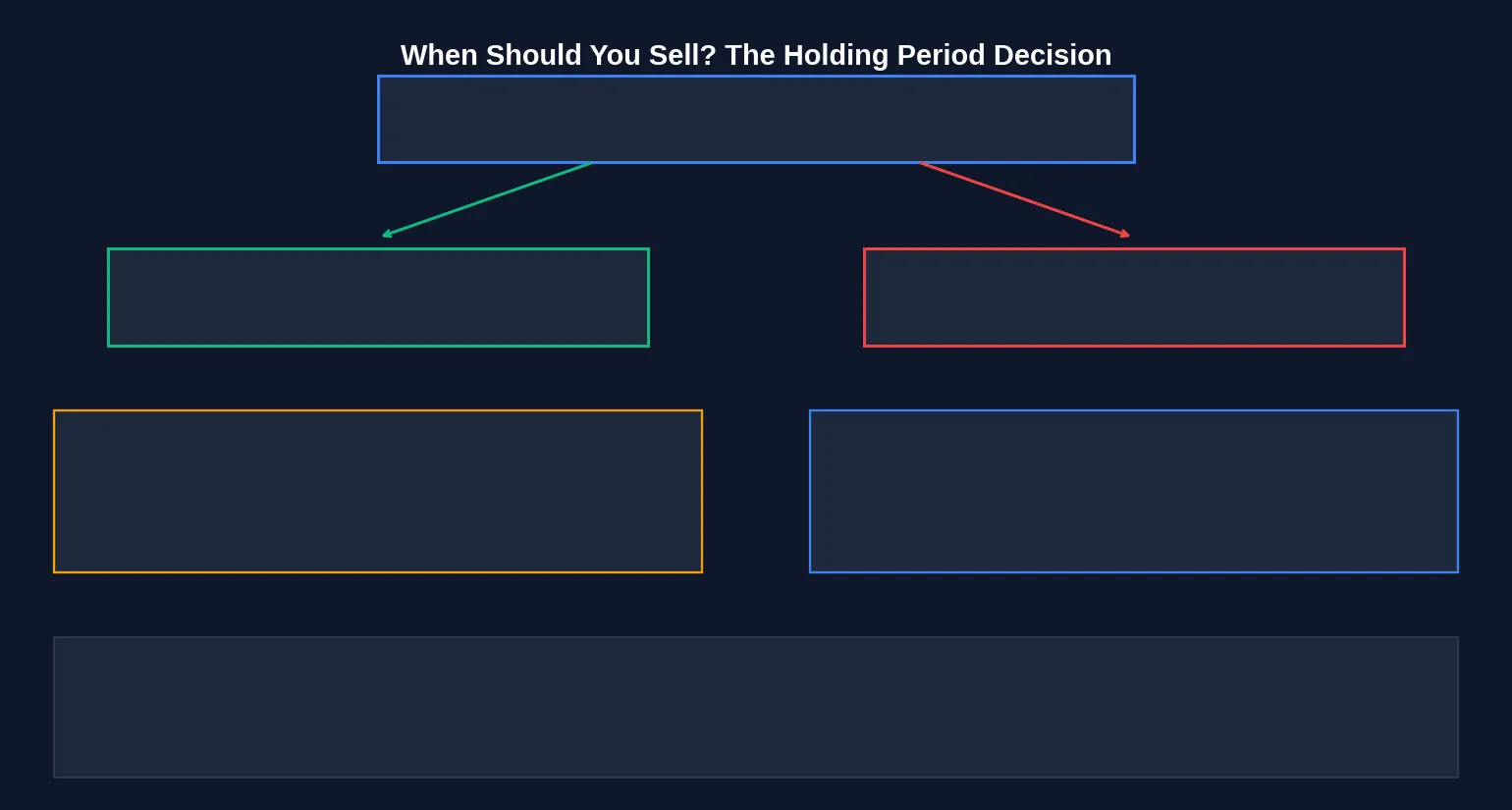
If you are sitting on a gain and want the lower rate, here are the strategies that actually work:
Strategy 1: Simply Wait
This is the most obvious and most powerful strategy. If you are within a few weeks or even months of the one-year mark, and you do not need the cash urgently, just wait. The tax savings from converting a short-term gain to a long-term gain can be enormous.
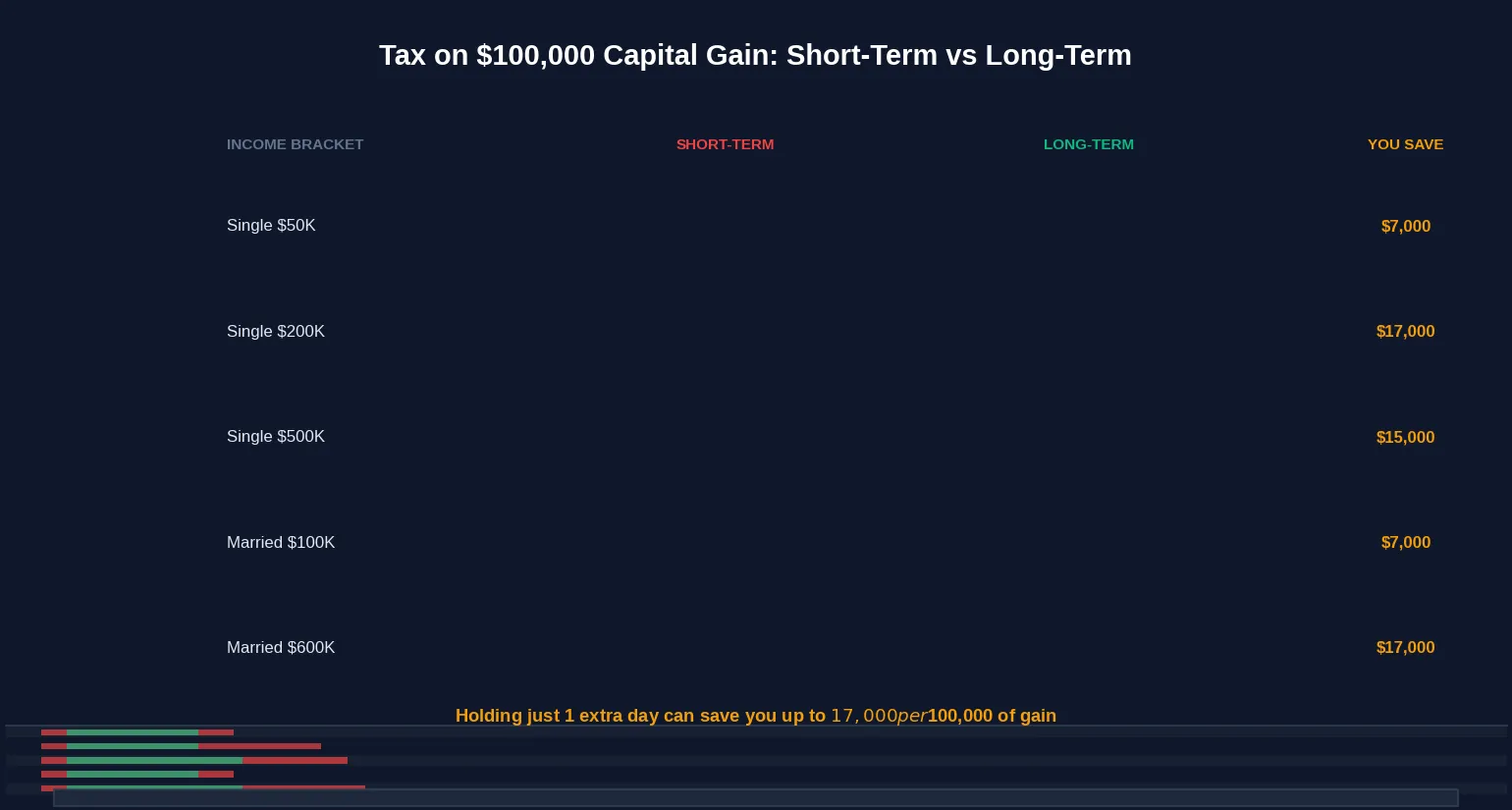
On a $100,000 gain at the 32% ordinary rate, you owe $32,000. Wait a few weeks, qualify for the 15% long-term rate, and you owe $15,000. That is $17,000 saved by doing nothing but being patient.
Strategy 2: Harvest Losses to Offset Short-Term Gains
If you have short-term gains you cannot avoid, look for short-term losses you can harvest. Sell losing positions to offset the gains. This is especially effective at year-end when you can see exactly how much short-term gain you are sitting on.
Just remember the wash sale rule — wait 31 days before repurchasing the same security, or buy something similar but not substantially identical.
Strategy 3: Use Specific Lot Identification
If you bought shares at different times, you can choose which shares to sell. Tell your broker to sell the shares you have held for more than one year first, and you lock in the lower long-term rate on those specific shares.
Most brokerages default to FIFO (first in, first out), which usually works in your favor since older shares are more likely to qualify as long-term. But specific lot identification gives you more control, especially when you have multiple purchase dates.
Strategy 4: Donate Appreciated Assets Instead of Selling
If you were planning to make charitable donations anyway, donate the appreciated stock directly instead of selling it and donating cash. You avoid paying capital gains tax entirely, and you still get a charitable deduction for the full fair market value.
This works only for long-term holdings donated to qualified charities. Short-term holdings donated give you a deduction limited to your cost basis, not the market value.
Strategy 5: Consider Installment Sales for Large Gains
If you are selling a business or investment property with a large short-term gain, consider structuring the sale as an installment sale where you receive payments over multiple years. This can spread the gain across tax years, potentially keeping you in a lower bracket each year. Our capital gains deferral strategies guide covers this and other deferral techniques in detail.
Special Situations That Change the Rules
Not every capital gain falls neatly into short-term or long-term. Here are the exceptions you need to know about:
Collectibles
Capital gains on collectibles — coins, art, antiques, wine — are taxed at a maximum rate of 28% for long-term gains, not the usual 20%. Short-term collectible gains are still taxed as ordinary income. So the preferential rate for collectibles is higher than for stocks, but still lower than the top ordinary rate.
Qualified Small Business Stock (Section 1202)
If you hold qualified small business stock for more than five years, you may be able to exclude 50%, 75%, or even 100% of the gain from federal tax, depending on when the stock was acquired. This is one of the most generous exclusions in the tax code, but the requirements are strict and the stock must meet specific qualifications.
Unrecaptured Section 1250 Gain
When you sell real estate investment property that you depreciated, the depreciation recapture is taxed at a flat 25% rate — not the ordinary rate and not the long-term rate. This is called unrecaptured Section 1250 gain, and it only applies to the portion of your gain attributable to depreciation you previously claimed.
Dividend Income
Qualified dividends are taxed at the same preferential rates as long-term capital gains — 0%, 15%, or 20%. Non-qualified dividends are taxed at ordinary income rates, just like short-term gains. The distinction matters for your overall tax planning.
How to Report Short-Term and Long-Term Gains
Both types of capital gains are reported on Form 8949 and Schedule D. But they go in different sections:
- 1Form 8949, Part I: Short-term transactions (held one year or less)
- 2Form 8949, Part II: Long-term transactions (held more than one year)
The totals from Form 8949 flow to Schedule D, where the netting process happens. Schedule D separates short-term and long-term gains into different sections, applies the netting rules, and calculates your final tax.
For a step-by-step walkthrough, our guide on how to report capital gains on your tax return covers every line of Form 8949 and Schedule D.
The NIIT on Top of Everything
Do not forget the Net Investment Income Tax. This 3.8% surtax applies to both short-term and long-term capital gains if your modified adjusted gross income exceeds $200,000 (single) or $250,000 (married). It stacks on top of whatever rate you are already paying — whether that is 37% for short-term or 20% for long-term.
For high-income earners in high-tax states, the combined rate on a short-term gain can be devastating: 37% federal plus 3.8% NIIT plus 13.3% state (California) equals 54.1%. More than half your gain could go to taxes. That is why understanding the holding period rules is not optional — it is essential.
The Bottom Line
The difference between short-term and long-term capital gains tax is one of the biggest levers you have for reducing your tax bill. Short-term gains are taxed at ordinary income rates up to 37%. Long-term gains get preferential rates of 0%, 15%, or 20%. On a $200,000 gain, that can mean the difference between owing $74,000 and owing $30,000 — a $44,000 swing that comes down to whether you held the asset for 365 days or 366 days. Know your holding periods. Plan your sales around the one-year mark. Harvest short-term losses to offset short-term gains. And always factor in the NIIT and your state tax rate when calculating your real combined rate. For more strategies and detailed guides, explore our full collection of capital gains tax articles and tips.
Fact-Checked & Reviewed
This article was written by James Park (EA, CFP (Certified Financial Planner)) and reviewed for accuracy by Sarah Mitchell (CPA, MST (Master of Science in Taxation)). Published by Wasim Akram, Founder & Lead Researcher at TaxGainsCalc. All tax rates, thresholds, and rules referenced are based on IRS publications and current tax law as of the date published. Tax laws change frequently — always consult a qualified tax professional for advice specific to your situation.
Enrolled Agent & Tax Researcher
James Park is an Enrolled Agent licensed by the IRS and a Certified Financial Planner with over 12 years of experience in tax research and financial planning. He specializes in capital gains strategies for real estate investors and cryptocurrency tra...
Certified Public Accountant (CPA)
Sarah Mitchell is a Certified Public Accountant with over 15 years of experience in individual and business taxation. She holds a Master of Science in Taxation from Golden Gate University and specializes in capital gains tax planning, investment tax ...

Founder & Lead Researcher, TaxGainsCalc
Wasim Akram is an independent web publisher and digital entrepreneur based in India. Since 2018, he has been building custom CMS platforms, WordPress plugins, niche websites, and AI-powered digital products with over 8 years of real-world experience....
Disclaimer: This article is for informational purposes only and does not constitute tax, legal, or financial advice. Tax laws and regulations change frequently, and the information presented here may not reflect the most current updates. You should consult with a qualified CPA, tax attorney, or financial advisor before making any tax-related decisions. TaxGainsCalc is not responsible for any actions taken based on the information provided in this article.