Capital Gains Tax on Mutual Funds & ETFs 2026: Distributions, Cost Basis & What Actually Costs You Money
How capital gains tax works on mutual funds and ETFs in 2026. Understand capital gain distributions, cost basis methods (FIFO, Specific ID, Average Cost), tax-efficient fund selection, and how to avoid the biggest tax traps that catch fund investors off guard.
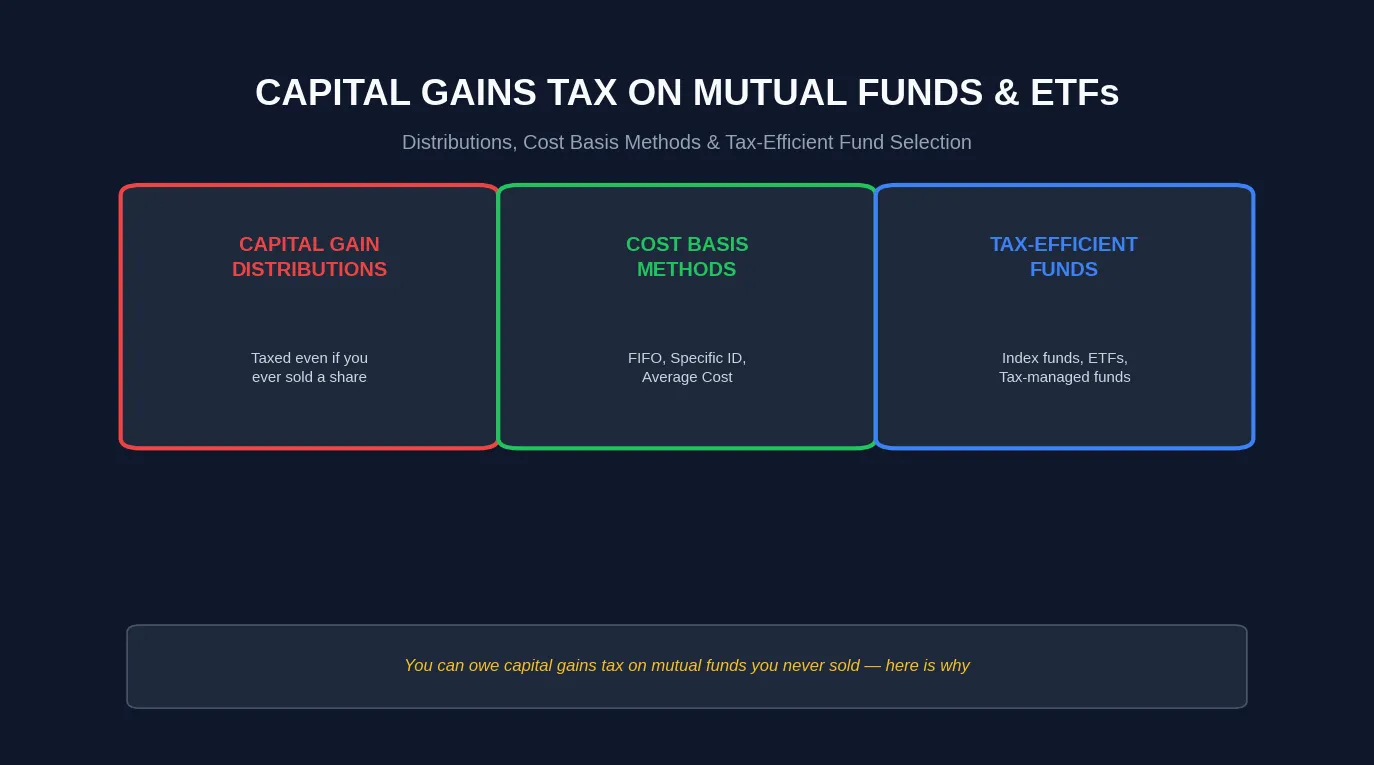
The Mutual Fund Tax Surprise That Nobody Warns You About
Last December I got a call from a guy named Richard. He had been buying shares of a popular growth mutual fund through his brokerage for about three years. Never sold a single share. Then his 1099 shows up in February and there is a capital gain distribution of $4,200 sitting on it. He was furious. "How am I paying tax on gains when I did not sell anything?" And honestly, that is a completely reasonable question. It just happens to have an answer most people do not want to hear.
Here is what happened. The fund manager sold stocks inside the fund at a profit during the year. By law, mutual funds have to pass those net realized gains through to shareholders. If they do not, the fund itself gets taxed at the corporate rate, which would be a disaster for everyone. So the gains flow to you, and you get to pay the tax bill whether you like it or not. You do not even have to have made money on your own shares. If your fund lost value but the manager sold older positions at a profit, you could owe tax on a fund that is down for the year. It is a lousy situation, and it catches new investors off guard every single year.
ETFs work a bit differently, and I will get to that, but first let me lay out exactly how mutual fund capital gains work because there are a couple of layers here that matter.
Capital Gain Distributions: The Tax You Did Not Ask For
Every year, usually in December, mutual funds calculate their net realized capital gains from trades made during the year. After subtracting any losses, the net gain gets distributed to shareholders as a capital gain distribution. You will see this on your year-end Form 1099-DIV, and it gets reported on your tax return just like any other capital gain.
The key thing to understand is that capital gain distributions from mutual funds are automatically treated as long-term capital gains, regardless of how long you personally held the fund shares. Even if you bought the fund three weeks before the distribution, the distribution itself is long-term. The logic is that the fund held the underlying assets for more than a year, so the character of the gain passes through to you. This is actually a small blessing — long-term rates top out at 20%, while short-term capital gains rates can hit 37%. Still, owing any tax on an investment you did not choose to sell feels wrong to a lot of people.
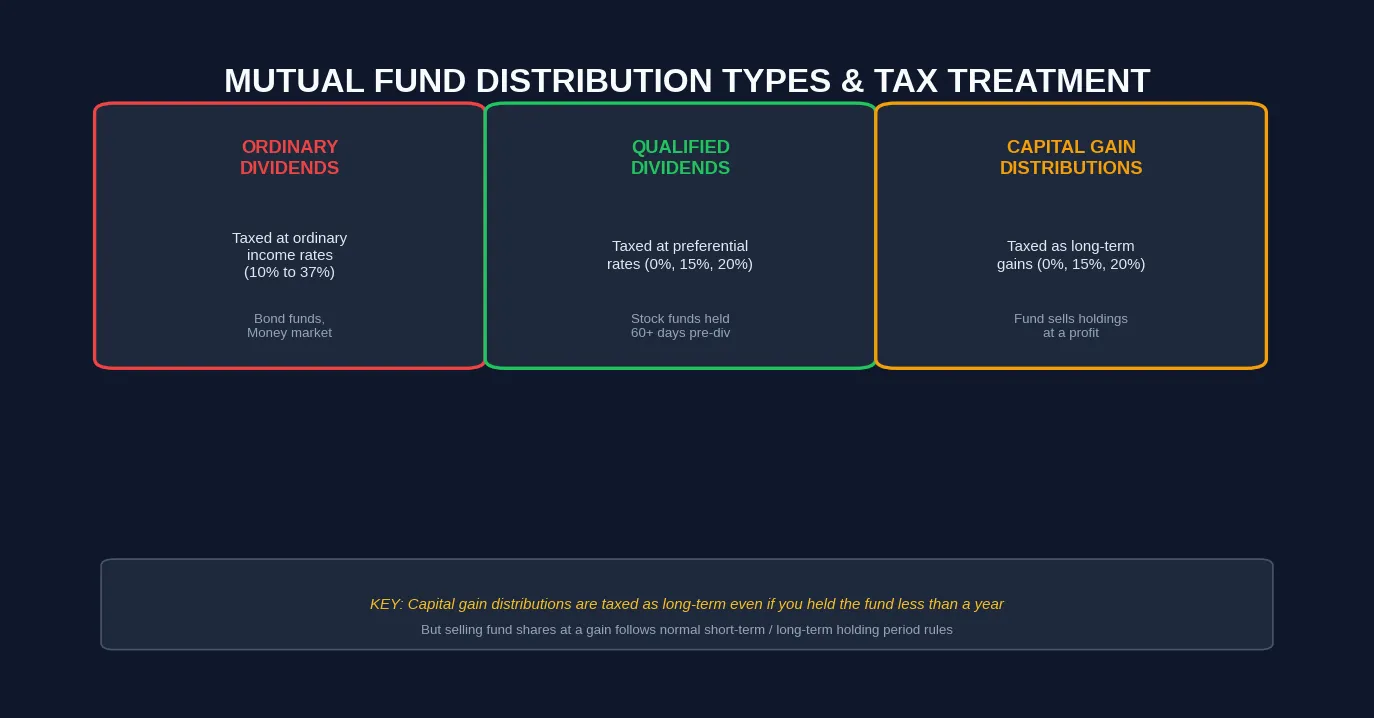
The distribution amount depends on two things: how much trading the fund manager did during the year, and whether those trades produced net gains. A fund with high turnover — meaning the manager buys and sells frequently — will typically generate larger distributions than a fund that buys and holds. Index funds tend to have low turnover and small distributions. Actively managed funds, especially ones that chase performance or have manager changes, can throw off surprisingly large distributions. I saw one small-cap growth fund distribute 15% of its NAV in a single year. That is a huge tax hit for someone who was just sitting there holding the fund.
What Happens When You Reinvest Distributions
If you are like most people, you have your distributions set to automatically reinvest. Good for building your position, but it does not save you from the tax. You owe tax on the distribution in the year it is paid, period. Reinvesting does not defer anything. What it does do is increase your cost basis in the fund, because you are essentially buying new shares with the distribution amount. This matters a lot when you eventually sell, and I will talk about basis tracking in a minute because it is where people make some of their biggest mistakes.
Selling Fund Shares: Where Cost Basis Makes or Breaks You
When you actually sell mutual fund shares, the capital gain or loss is the difference between what you sell them for and your cost basis. Seems simple enough. The problem is that most people buy mutual fund shares at different times and different prices over many years. Each purchase is a separate tax lot with its own basis and holding period. How you choose which shares to sell determines how much tax you owe, and the IRS gives you a few different methods for figuring this out.
FIFO (First In, First Out)
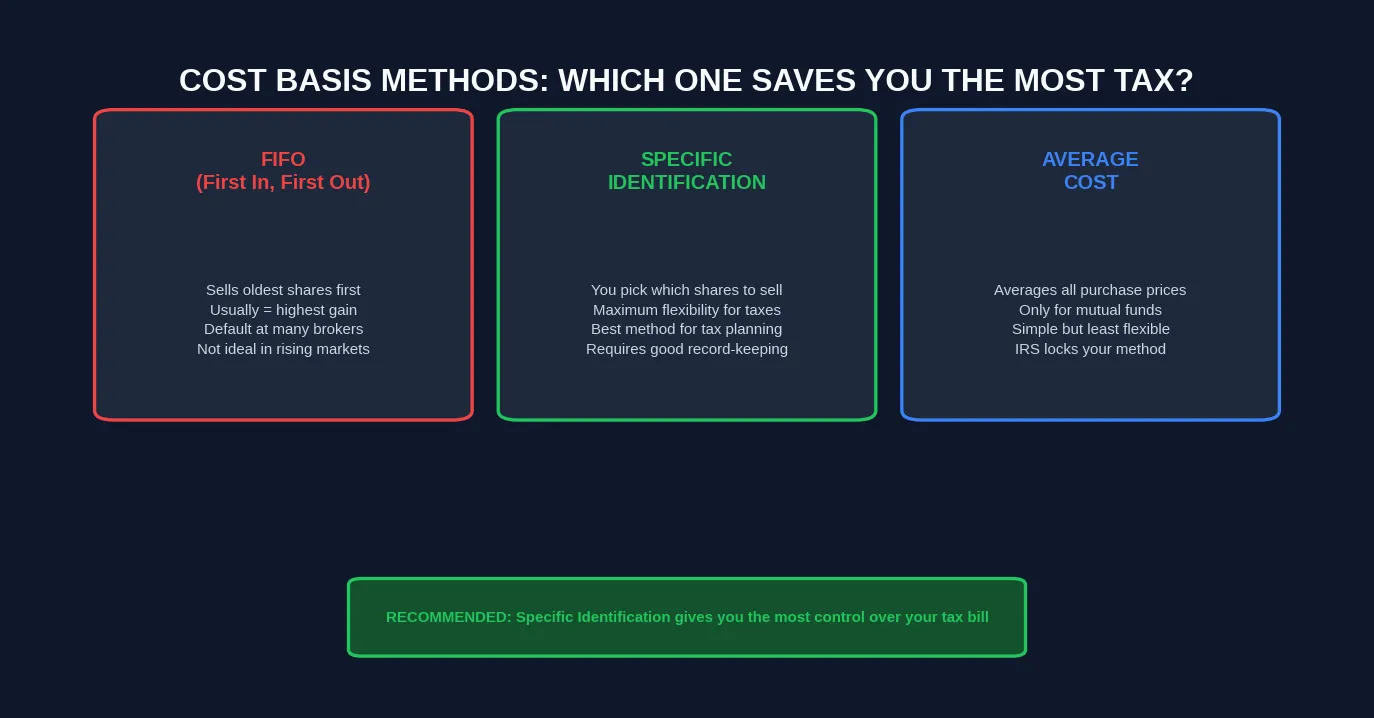
This is the default at many brokerages if you do not specify otherwise. You sell the oldest shares first. In a rising market, your oldest shares usually have the lowest basis, which means the biggest gain and the highest tax bill. FIFO is straightforward, but it is rarely the most tax-efficient choice. I almost never recommend it unless someone has specific reasons to want long-term gains characterized a certain way.
Specific Identification
This is the gold standard for tax planning. You tell your brokerage exactly which tax lots you want to sell — and you pick the ones with the highest basis to minimize your gain or maximize your loss. If you bought 50 shares at $30, another 50 at $45, and another 50 at $60, and the fund is now at $55, selling the $60 lot gives you a $250 loss instead of a $1,250 gain on the $30 lot. Same number of shares sold, wildly different tax outcome. The catch is you need to tell your broker before the trade settles which lots you are selling, and you need to keep good records. Most online brokerages make this easy now — you can select specific lots when you place the sell order.
Average Cost
This method averages all your purchase prices together to create a single per-share basis. It is only available for mutual funds, not individual stocks or ETFs. The appeal is simplicity — you do not have to track individual lots. The downside is you lose all flexibility. Once you sell shares using average cost, the IRS requires you to stick with that method for all future sales of that same fund unless you get permission to change. And you cannot selectively harvest losses because every sale uses the same blended basis. For someone with a simple portfolio who just wants easy bookkeeping, average cost works. For anyone doing active tax planning, it leaves money on the table.
ETFs vs Mutual Funds: The Tax Efficiency Difference
This is where ETFs really shine. The structure of an ETF allows for something called in-kind creation and redemption, which is a fancy way of saying that ETFs can remove low-basis shares from their portfolio without selling them. When institutional investors redeem ETF shares, the ETF hands them the underlying stocks instead of cash. No sale means no realized gain means no capital gain distribution to pass through to shareholders. This is why most broad-market ETFs like VTI, SPY, or IVV distribute virtually nothing in capital gains each year. Some years it is literally zero.
Mutual funds cannot do this as easily. When investors redeem mutual fund shares, the fund has to sell securities to raise cash, which can trigger realized gains that get passed to remaining shareholders. It is one of the structural disadvantages of the mutual fund format, and it is a big reason why ETFs have been eating mutual funds' lunch for the last decade. If you want to read more about how different investments get taxed, our stock tax calculator breaks it down for individual equities.
Now, ETFs are not completely immune. A bond ETF that has to sell appreciated bonds during a rising rate environment can still generate distributions. Commodity ETFs and specialized sector funds can also kick off gains. And when you sell ETF shares yourself, the normal long-term capital gains rate or short-term rate applies just like with any other investment. The advantage is purely about minimizing those unwanted annual distributions.
How Distributions Interact With Your Other Gains and Losses
Capital gain distributions from funds get netted together with all your other capital gains and losses. If you have a $5,000 distribution and a $5,000 loss from selling a stock, they cancel out. This is where tax-loss harvesting strategies become really valuable — you can intentionally realize losses elsewhere in your portfolio to offset unwanted fund distributions. A lot of investors do this in December once they see their estimated distribution numbers, which is why the last two weeks of the year are usually the busiest for tax-loss selling.
If your net capital loss exceeds $3,000 after netting everything, you can deduct $3,000 against ordinary income this year and carry the rest forward indefinitely. That $3,000 deduction is not huge, but it helps, and the carryforward means those losses keep working for you in future years.
The NIIT and State Tax Double Whammy
If your modified adjusted gross income is above $200,000 (single) or $250,000 (married), the Net Investment Income Tax adds 3.8% on top of your capital gains, including fund distributions. So a 15% long-term rate becomes 18.8%, and the 20% rate becomes 23.8%. Fund distributions count as investment income for NIIT purposes, so a large unexpected distribution can push you over the threshold even if you did not see it coming.
Your state capital gains tax rate adds yet another layer. California at 13.3%, New York at over 10% combined state and city, New Jersey around 10.75% — these state taxes sit on top of the federal rate plus NIIT. A fund investor in California with high income can easily face a combined marginal rate above 35% on long-term gains. Knowing your total rate exposure before the distribution hits is the only way to plan properly.
Wash Sale Rules Apply to Fund Investors Too
If you sell a mutual fund at a loss and buy a substantially identical fund within 30 days before or after, the wash sale rule disallows your loss. This is the same rule that applies to individual stocks. But what counts as "substantially identical" for funds? Selling an S&P 500 index fund from Vanguard and buying an S&P 500 index fund from Fidelity two days later? That is a gray area the IRS has not fully clarified. Most tax professionals consider different providers' funds to be different investments even if they track the same index, but there is no guarantee the IRS will agree in an audit.
The safe play is to switch to a fund that tracks a similar but not identical index. Sell a total market fund and buy an S&P 500 fund. Sell a small-cap growth fund and buy a small-cap blend fund. Our complete guide on the wash sale rule covers this in detail, including how it applies across accounts and what the IRS looks for.
Practical Moves to Reduce Your Fund Tax Bill
Switch to Tax-Efficient Funds
If you are holding actively managed funds in a taxable account and getting hammered with distributions every year, take a hard look at index funds or tax-managed funds. Tax-managed funds specifically consider the tax impact of every trade, harvesting losses to offset gains and avoiding short-term gains whenever possible. The difference in after-tax returns between a high-turnover fund and a tax-efficient fund can be 1-2% per year, which compounds into serious money over a decade.
Hold Bonds in Tax-Advantaged Accounts
Bond funds generate ordinary income, which gets taxed at your full marginal rate. Putting bond funds in an IRA or 401(k) where the income grows tax-deferred is one of the simplest and most effective tax moves you can make. Keep your stock funds and ETFs in your taxable account where gains qualify for the lower long-term rate.
Harvest Losses Before Year-End
Check your fund's estimated distribution schedule, usually published in November. If you are looking at a big distribution and you also have unrealized losses in the same fund or similar funds, sell the losing position before the distribution date to lock in the loss. Just watch out for wash sales if you plan to buy back into a similar fund.
Choose Specific Identification as Your Default Method
If your brokerage lets you select specific lots, do it. You can always choose FIFO later if you want, but you cannot switch away from average cost without IRS permission. Setting up specific ID when you first buy a fund preserves all your future tax planning options. Most major brokerages — Schwab, Fidelity, Vanguard — support this now.
Reinvest Distributions Thoughtfully
Automatic reinvestment is convenient, but it creates more tax lots to track. If you are actively managing your basis, consider taking distributions in cash and then manually reinvesting. This gives you clean lot tracking and lets you decide whether reinvesting right now makes sense given the fund's current price and your tax situation.
Reporting Fund Gains on Your Tax Return
You will get a Form 1099-DIV for capital gain distributions and a Form 1099-B for any shares you sold. The 1099-DIV distributions go directly on Schedule D — you do not need Form 8949 for distributions. For shares you actually sold, you report them on Form 8949 just like any other sale, and our guide on how to report capital gains on your tax return walks you through every step.
One thing I see people mess up: when your 1099-B shows "basis not reported to IRS" for older fund purchases, you need to calculate and report the correct basis yourself. If you leave it blank, the IRS assumes your entire sale proceeds are gain. That is a fast way to get a very expensive CP2000 notice in the mail.
The Bottom Line
Mutual fund taxes are sneaky. You can owe capital gains on a fund you never sold. Your cost basis method can save you thousands or cost you thousands depending on what you choose. ETFs have a structural tax advantage that mutual funds simply cannot match. And the combination of federal rates, NIIT, and state taxes can push your marginal rate on fund gains well above 30% if you are a high earner. The fix is not complicated — use tax-efficient funds in taxable accounts, hold bonds in tax-advantaged accounts, choose specific identification for your basis method, and harvest losses strategically. None of this is rocket science. But it does require paying attention, because the IRS is not going to remind you to optimize your basis method before you sell.
Fact-Checked & Reviewed
This article was written by Sarah Mitchell (CPA, MST (Master of Science in Taxation)) and reviewed for accuracy by David Chen (JD, LLM in Taxation (New York University)). Published by Wasim Akram, Founder & Lead Researcher at TaxGainsCalc. All tax rates, thresholds, and rules referenced are based on IRS publications and current tax law as of the date published. Tax laws change frequently — always consult a qualified tax professional for advice specific to your situation.
Certified Public Accountant (CPA)
Sarah Mitchell is a Certified Public Accountant with over 15 years of experience in individual and business taxation. She holds a Master of Science in Taxation from Golden Gate University and specializes in capital gains tax planning, investment tax ...
Tax Attorney & Legal Editor
David Chen is a tax attorney with a Juris Doctor and a Master of Laws in Taxation from New York University School of Law. With over 10 years of legal practice, he specializes in 1031 exchanges, capital gains tax law, and IRS dispute resolution. David...

Founder & Lead Researcher, TaxGainsCalc
Wasim Akram is an independent web publisher and digital entrepreneur based in India. Since 2018, he has been building custom CMS platforms, WordPress plugins, niche websites, and AI-powered digital products with over 8 years of real-world experience....
Disclaimer: This article is for informational purposes only and does not constitute tax, legal, or financial advice. Tax laws and regulations change frequently, and the information presented here may not reflect the most current updates. You should consult with a qualified CPA, tax attorney, or financial advisor before making any tax-related decisions. TaxGainsCalc is not responsible for any actions taken based on the information provided in this article.