Capital Gains Tax on Stock Options & RSU: ISO, NSO, ESPP & When You Actually Owe
Complete guide to capital gains tax on stock options and RSU in 2026. Learn how ISO, NSO, ESPP, and RSU are taxed, when capital gains vs ordinary income applies, holding period requirements for preferential rates, and strategies to minimize your tax bill on equity compensation.
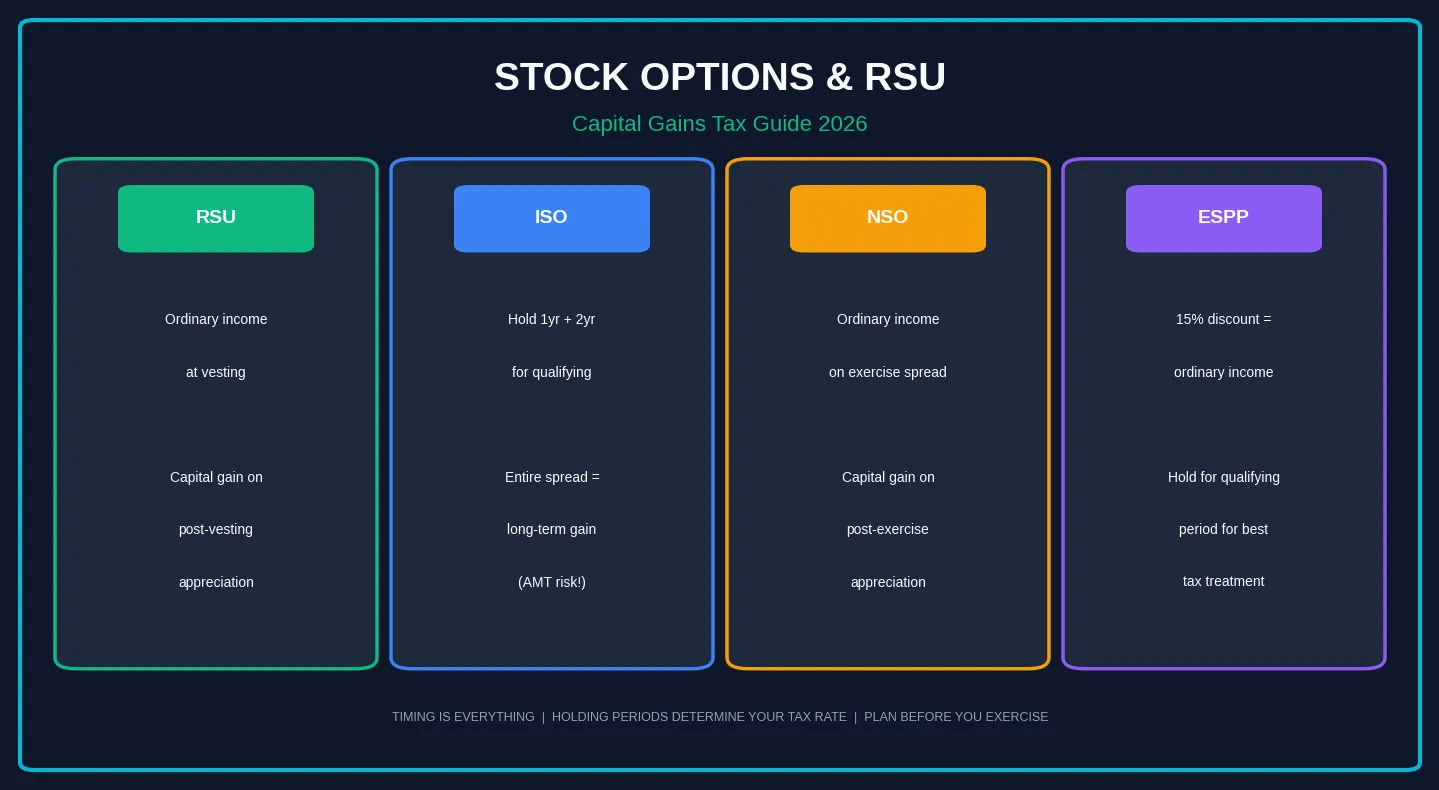
Why Equity Compensation Taxes Catch Smart People Off Guard
I was on a call with a software engineer named Priya last Tuesday. She works at a mid-stage tech company and has been receiving RSU grants for about four years. She also has incentive stock options from her earlier job that she never exercised. When her company got acquired, she suddenly had to figure out what she owed on three different types of equity compensation — all at the same time — and she was completely lost.
She is not alone. Equity compensation is one of the most confusing areas of the tax code. You can owe ordinary income tax, capital gains tax, the alternative minimum tax, and the NIIT all on the same shares if you do not time things right. And the difference between good planning and no planning can easily be tens of thousands of dollars.
The key thing to understand is this: equity compensation is not just "stock." Each type — ISO, NSO, RSU, ESPP — has its own tax rules, its own timing requirements, and its own traps. If you treat them all the same way, you will almost certainly overpay.
The Four Main Types of Equity Compensation
Before we get into the tax mechanics, let me quickly define what we are talking about because people mix these up all the time.
| Type | What It Is | How You Get It |
|---|---|---|
| RSU (Restricted Stock Unit) | Promise of shares after vesting | Most common at public companies |
| ISO (Incentive Stock Option) | Right to buy shares at a fixed price | Common at early-stage startups |
| NSO (Non-Qualified Stock Option) | Right to buy shares at a fixed price | Common when ISO limit is exceeded |
| ESPP (Employee Stock Purchase Plan) | Discounted stock purchases | Offered by many public companies |
Each one is taxed differently. That is not a minor detail — it is the whole ballgame.
RSU Taxation: The Simplest One (But Still Tricky)
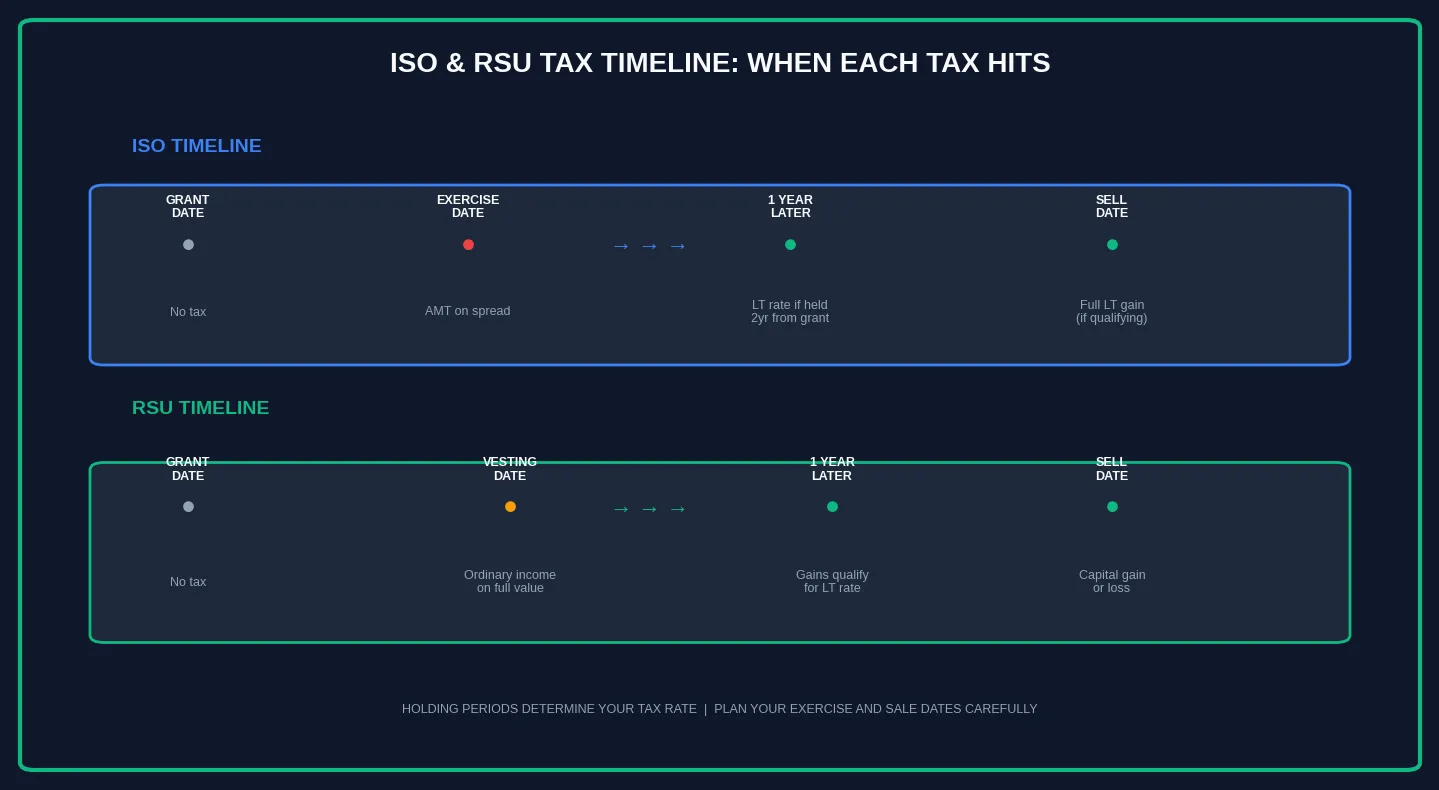
RSUs are the easiest to understand because the tax treatment is straightforward. You owe ordinary income tax on the fair market value of the shares on the vesting date. That is it. The value of the shares at vesting gets added to your W-2 as wages.
- 1At vesting: You owe ordinary income tax on the share value at vesting. Your employer withholds taxes, usually at the supplemental rate of 22% federal (37% for amounts over $1 million).
- 1After vesting: If you hold the shares after they vest and they go up in value, the additional gain is taxed as a capital gain when you sell.
- 1If shares drop after vesting: You already paid income tax on the higher vesting value. If you sell lower, you have a capital loss, not a reduction of the original income tax.
Here is a practical example. Priya had 200 RSU shares vest when her company stock was at $85. She owed ordinary income tax on $17,000 (200 x $85). Her company withheld 22% for federal tax. Six months later, she sold those shares at $110 each. The $25 per share increase ($5,000 total) is a short-term capital gain because she held the shares for less than a year after vesting. If she had waited until the one-year mark, that $5,000 would qualify for the long-term capital gains rate instead.
The RSU Basis Trap
A lot of people double-pay tax on RSUs because they do not understand cost basis. Your basis in RSU shares equals the fair market value on the vesting date — which is the same amount that was already included in your W-2 income. When you sell, you only owe capital gains tax on the difference between the sale price and that vesting-date value.
But here is the problem: some brokerages report the full sale proceeds without subtracting the vesting-date basis on Form 1099-B. The IRS sees the gross proceeds and assumes you owe tax on the entire amount. If you do not adjust the basis on Form 8949, you pay tax twice on the same income. Our guide on how to report capital gains on your tax return walks you through fixing this.
ISO Taxation: The One With the AMT Trap
Incentive stock options are where things get interesting — and dangerous. ISOs give you the right to buy company stock at a fixed price (the strike price) and they offer the possibility of paying only long-term capital gains tax on the entire profit. But you have to meet strict holding period requirements.
The ISO qualifying disposition rules:
- 1You must hold the shares for at least one year after the exercise date
- 2You must hold the shares for at least two years after the grant date
- 3If both conditions are met, the entire spread between the strike price and the sale price is taxed as a long-term capital gain
If you sell before meeting both holding periods, it is a disqualifying disposition. The spread between the strike price and the fair market value at exercise gets taxed as ordinary income. Only any additional gain above the exercise-date value gets capital gains treatment.
The AMT Problem Nobody Warns You About
Here is the trap that catches people every year. When you exercise an ISO, the spread between your strike price and the current fair market value is not subject to regular income tax. But it IS subject to the Alternative Minimum Tax. You do not pay AMT when you exercise, but you have to calculate it on your tax return, and if your AMT liability exceeds your regular tax, you pay the difference.
This means you can owe AMT on paper gains you have not even realized yet. If you exercise a large ISO position and the stock drops before you sell, you could owe AMT on gains that no longer exist. I have seen people owe six-figure AMT bills on stock that later became worthless. It is devastating.
ISO Strategy: Exercise and Hold?
Some people exercise ISOs early and hold for the qualifying period to get full long-term capital gains treatment on the entire spread. This can save a fortune — the difference between 37% ordinary income and 15% or 20% long-term capital gains is massive on a large position.
But the risk is real. You are paying the strike price out of pocket, you might owe AMT, and you are tying up capital in a single stock that could drop. If the stock tanks, you lose your investment AND you still owe the AMT.
The safer approach for many people is to exercise ISOs in batches small enough that the AMT stays below your regular tax liability. This means paying some ordinary income tax through disqualifying dispositions, but avoiding the AMT bomb entirely.
NSO Taxation: Simpler But More Expensive
Non-qualified stock options work differently from ISOs. The key difference is that the spread at exercise is always taxed as ordinary income, regardless of how long you hold the shares afterward.
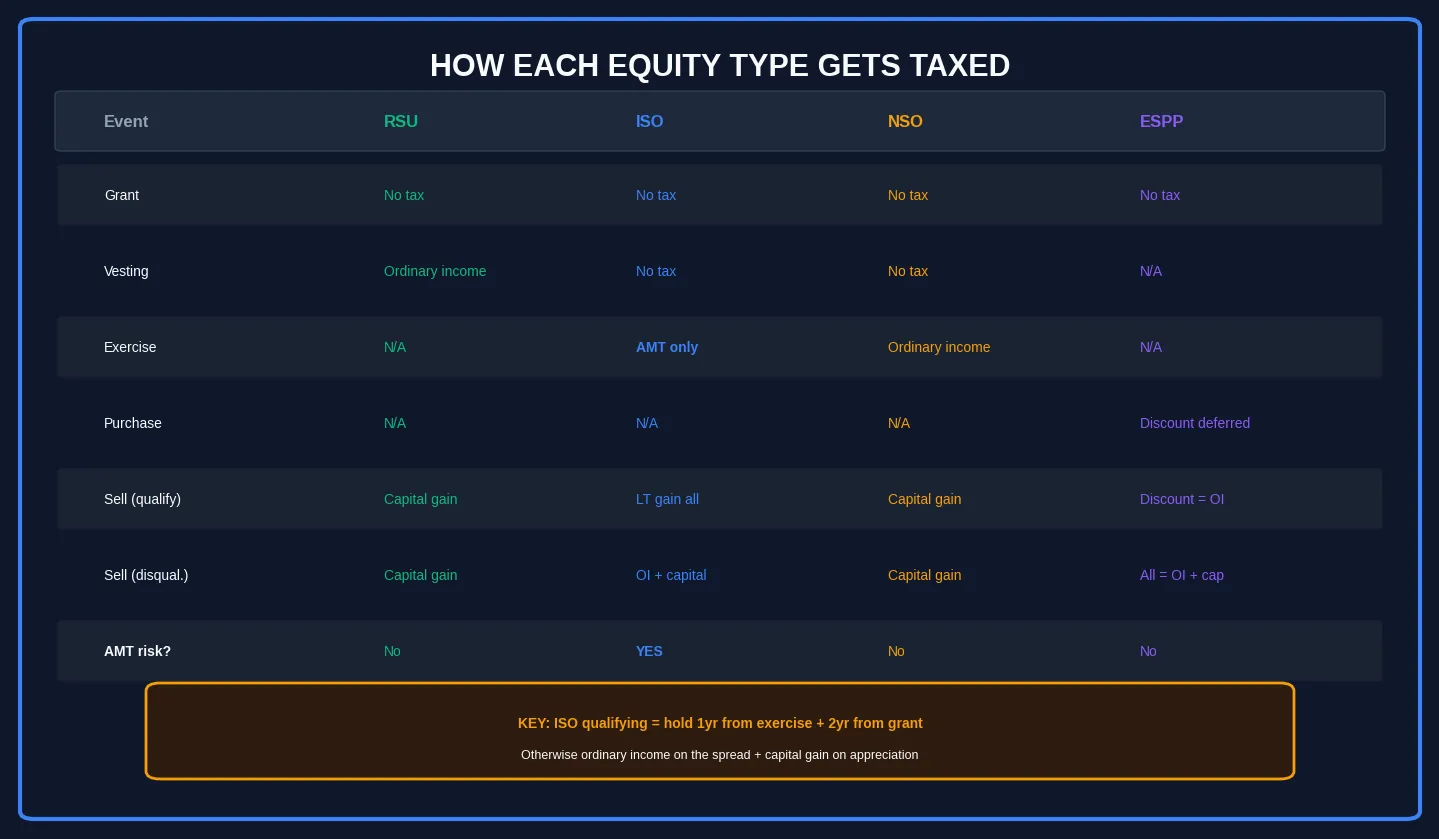
| Event | NSO Tax Impact | ISO Tax Impact |
|---|---|---|
| Grant | No tax | No tax |
| Exercise | Ordinary income on spread | AMT adjustment on spread |
| Sell after holding 1+ year | Capital gain on post-exercise appreciation | Long-term capital gain on entire spread (if qualifying) |
| Sell before 1 year | Short-term capital gain on post-exercise appreciation | Ordinary income on spread + short-term gain on appreciation |
With NSOs, you pay ordinary income tax at exercise on the difference between the strike price and the fair market value. Your employer withholds tax at that point and reports it on your W-2. After exercise, any further gain or loss is capital gain or loss.
Since the exercise-date spread is already taxed as ordinary income, there is no AMT adjustment for NSOs. This makes NSOs simpler than ISOs from a tax perspective, but you lose the potential for converting the entire spread to long-term capital gains.
ESPP Taxation: The Discount Gets Complicated
Employee Stock Purchase Plans let you buy company stock at a discount, usually 15% off the market price. The tax treatment depends on whether you hold the shares long enough for a qualifying disposition.
Qualifying disposition for ESPP:
- 1Hold shares at least one year after the purchase date
- 2Hold shares at least two years after the offering date (the beginning of the enrollment period)
If you meet both holding periods, the discount you received (up to 15%) is taxed as ordinary income on your W-2. Any gain above the purchase price is long-term capital gain. And if the stock went down? You might even have a capital loss.
If you sell before meeting the holding periods, the entire discount plus any gain above the actual purchase price gets taxed as ordinary income. Only appreciation above the fair market value on the purchase date gets capital gains treatment.
The discount amount is usually small enough that the tax difference between qualifying and disqualifying dispositions is modest. But on a large ESPP balance, it can add up.
When Capital Gains Apply to Equity Compensation
Let me consolidate this because it is the question everyone asks. When do you actually get the lower capital gains rates on your equity compensation?
For RSU shares, the clock starts on the vesting date. Hold one year and a day after vesting, and any gain above the vesting-date value qualifies for long-term capital gains rates.
For ISO shares with a qualifying disposition, the entire spread between your strike price and the sale price is long-term capital gain — but only if you meet both holding periods (one year from exercise, two years from grant).
For NSO shares, you pay ordinary income on the exercise spread no matter what. The clock for capital gains starts on the exercise date. Hold one year and a day after exercise, and any gain above the exercise-date value is long-term.
For ESPP shares, qualifying disposition means the discount is ordinary income and the rest is long-term capital gain.
The pattern is consistent: you always owe ordinary income on some portion of your equity compensation (the "compensation element"), and you owe capital gains on any appreciation that happens after the compensation element is fixed. The timing of that division depends on the equity type.
The NIIT Layer on Top
If your modified adjusted gross income exceeds $200,000 (single) or $250,000 (married), the Net Investment Income Tax adds 3.8% to your capital gains. This applies to the capital gains portion of your equity sales, not the ordinary income portion.
For tech workers with large equity positions, NIIT is almost inevitable. A $300,000 capital gain on stock options plus a $180,000 salary easily clears the threshold. The extra 3.8% on $300,000 is $11,400 — not something to ignore.
Your state capital gains tax rate adds even more. In California, where many equity compensation recipients live, the combined federal plus NIIT plus state rate on long-term gains can approach 33%. That is a third of your gain gone before you see a dollar.
Wash Sale Rules and Company Stock
If you sell company stock at a loss and repurchase substantially identical shares within 30 days, the wash sale rule disallows your loss. This can happen with ESPP purchases — you sell shares at a loss, and your next payroll ESPP contribution buys more shares within 30 days. The IRS treats that as a wash sale.
To avoid this, time your ESPP sales carefully. If you want to harvest a loss on company stock, stop your ESPP contributions at least 30 days before the sale and do not restart them for 30 days after. Or use tax-loss harvesting strategies with other investments to offset the gain instead of selling the company stock at all.
Practical Strategies to Reduce Your Equity Tax Bill
Strategy 1: Time Your RSU Sales Around the One-Year Mark
If your RSU shares have appreciated since vesting and you are approaching the one-year holding mark, wait. The difference between short-term and long-term rates can be 15-20 percentage points. On a $100,000 gain, that is $15,000 to $20,000 in tax savings for waiting a few weeks or months.
Strategy 2: Exercise ISOs in AMT-Safe Batches
Calculate your AMT threshold before exercising ISOs. Exercise enough to stay below the AMT trigger point, and spread the rest across future years. This avoids the AMT bomb while still moving toward the qualifying disposition holding periods.
Strategy 3: Make an 83(b) Election on Early Stock
If you receive restricted stock (actual shares, not RSUs) that is subject to vesting, you can make a Section 83(b) election within 30 days of grant to pay ordinary income tax on the value at grant instead of vesting. If the stock is worth very little at grant (common at startups), you pay minimal tax, and all future appreciation starts as capital gain from day one.
Strategy 4: Net Capital Losses Against Gains
If you have losses from other investments, tax-loss harvesting strategies can offset your equity compensation gains. Sell losing positions to generate losses, and use those losses to reduce the capital gains from your RSU or option sales.
Strategy 5: Consider Charitable Giving of Appreciated Shares
If you donate shares that you have held for more than a year to a qualified charity, you deduct the full fair market value and you never pay capital gains tax on the appreciation. For someone with a large ISO position that has appreciated significantly, this can be an efficient way to support causes you care about while avoiding a big tax bill.
Strategy 6: Sell in Low-Income Years
The long-term capital gains rate is 0% for single filers with taxable income up to about $48,350 and married couples up to about $96,700. If you are between jobs, taking a sabbatical, or retiring early, that might be the ideal time to sell long-held equity positions. Zero percent federal tax on your gains is hard to beat.
Reporting Equity Compensation on Your Tax Return
Equity compensation shows up in multiple places on your tax return, and the reporting requirements are easy to mess up.
W-2 income: RSU vesting value, NSO exercise spread, and ESPP discount (on disqualifying dispositions) all appear on your W-2. Your employer handles this, but verify the amounts match your records.
Form 3921: Your employer issues this for ISO exercises. It reports the exercise date, strike price, and fair market value at exercise. You need this for AMT calculations.
Form 3922: Your employer issues this for ESPP purchases. It shows the offering date, purchase date, discount, and fair market value.
Form 8949 and Schedule D: When you sell shares, you report each sale on Form 8949 with the correct cost basis. The gain or loss flows to Schedule D. For stock capital gains reporting, the process is the same as any other stock sale — but the basis calculation can be tricky.
AMT Form 6251: If you exercised ISOs, you must file Form 6251 to calculate whether you owe AMT. Even if you do not owe AMT, you still need to file the form.
Common mistakes: Double-reporting income on RSU sales, forgetting to adjust basis on Form 8949, missing the AMT calculation for ISO exercises, and not filing Form 8949 for ESPP disqualifying dispositions. Each of these can trigger IRS notices or overpayments.
The Bottom Line
Equity compensation can be the biggest wealth-building tool you have, or it can be a tax nightmare — and the difference usually comes down to timing. RSUs are taxed as ordinary income at vesting, and any subsequent gain is capital gain. ISOs offer the possibility of converting the entire spread to long-term capital gains, but the AMT risk is real and the holding period requirements are strict. NSOs always generate ordinary income at exercise. ESPP shares have a modest tax benefit if you hold for the qualifying period. The NIIT and state taxes stack on top of everything. Your best move is to plan your exercises and sales around the holding period requirements, watch your AMT exposure with ISOs, verify your basis reporting on every sale, and harvest losses where possible. Do not wait until tax season to figure this out — by then, most of your options are gone.
Fact-Checked & Reviewed
This article was written by Sarah Mitchell (CPA, MST (Master of Science in Taxation)) and reviewed for accuracy by James Park (EA, CFP (Certified Financial Planner)). Published by Wasim Akram, Founder & Lead Researcher at TaxGainsCalc. All tax rates, thresholds, and rules referenced are based on IRS publications and current tax law as of the date published. Tax laws change frequently — always consult a qualified tax professional for advice specific to your situation.
Certified Public Accountant (CPA)
Sarah Mitchell is a Certified Public Accountant with over 15 years of experience in individual and business taxation. She holds a Master of Science in Taxation from Golden Gate University and specializes in capital gains tax planning, investment tax ...
Enrolled Agent & Tax Researcher
James Park is an Enrolled Agent licensed by the IRS and a Certified Financial Planner with over 12 years of experience in tax research and financial planning. He specializes in capital gains strategies for real estate investors and cryptocurrency tra...

Founder & Lead Researcher, TaxGainsCalc
Wasim Akram is an independent web publisher and digital entrepreneur based in India. Since 2018, he has been building custom CMS platforms, WordPress plugins, niche websites, and AI-powered digital products with over 8 years of real-world experience....
Disclaimer: This article is for informational purposes only and does not constitute tax, legal, or financial advice. Tax laws and regulations change frequently, and the information presented here may not reflect the most current updates. You should consult with a qualified CPA, tax attorney, or financial advisor before making any tax-related decisions. TaxGainsCalc is not responsible for any actions taken based on the information provided in this article.