Capital Gains Tax Deferral Strategies 2026: 1031 Exchanges, Opportunity Zones, Installment Sales & More
Learn every legal strategy to defer capital gains tax in 2026. Covers 1031 like-kind exchanges, Qualified Opportunity Zone Funds, installment sales, charitable remainder trusts, and intra-family loans. Includes real examples, timelines, and common mistakes.
You Do Not Have to Pay the IRS Today
I will never forget the call I got from a client named Brenda back in 2024. She had just sold a rental property for a $420,000 gain. Her accountant told her she owed roughly $63,000 in federal capital gains tax, plus another $18,000 in state tax. Eighty-one thousand dollars gone, just like that. She was devastated.
What her accountant did not tell her was that Brenda could have deferred every penny of that federal tax — legally — by reinvesting the proceeds into another property through a 1031 exchange. Instead of writing an $81,000 check to the government, she could have kept that money working for her. The IRS literally built this option into the tax code, but most people either do not know about it or get scared off by the rules.
This guide covers every major strategy available in 2026 to defer your capital gains tax. Not loopholes. Not gray areas. Legitimate, IRS-approved methods that millions of taxpayers use every year. Some of them can push your tax bill years into the future. Others can eliminate it entirely if you hold the investment long enough.
Why Deferral Is So Powerful
Before we dive into the strategies, let me explain why deferring capital gains tax matters so much. It is not just about delaying a payment. It is about keeping your money invested and growing.
When you pay $75,000 in capital gains tax, that money is gone forever. It is not earning returns. It is not compounding. It went to the Treasury and you will never see it again.
When you defer that $75,000 instead, you keep it invested. If your investment earns 8% a year, that $75,000 grows to $161,924 in ten years. Even if you eventually pay the tax, you earned an extra $86,924 that you would never have seen if you paid the tax upfront. This is called the time value of money, and it is the entire reason deferral strategies exist.
Plus, your long-term capital gains rate might be lower in a future year when your income drops. And if you hold certain investments long enough, the gain can be excluded entirely.
Strategy 1: The 1031 Like-Kind Exchange
The 1031 exchange is probably the most well-known capital gains deferral tool in existence. Named after Section 1031 of the Internal Revenue Code, it allows you to sell an investment property and defer the capital gains tax by reinvesting the proceeds into another like-kind property.
How It Works
The concept is straightforward. You sell Property A, and instead of pocketing the cash and paying tax on the gain, you use the proceeds to buy Property B. The IRS treats this as a continuation of your original investment, so no tax is due until you eventually sell Property B without doing another exchange.
Here are the rules you absolutely must follow:
- 1Like-kind requirement: The new property must be of the same nature or character as the old one. In practice, this means any real estate held for investment or business purposes qualifies. You can exchange a rental condo for a strip mall, or a warehouse for vacant land. What you cannot do is exchange real estate for stocks, bonds, or personal property.
- 145-day identification window: You have exactly 45 calendar days from the date you sell your property to identify potential replacement properties in writing. No exceptions. No extensions. Miss this deadline and the entire exchange fails.
- 1180-day closing window: You must close on the replacement property within 180 days of selling the old property, or by the due date of your tax return (including extensions), whichever is earlier.
- 1Qualified intermediary: You cannot touch the sale proceeds. The money must be held by a qualified intermediary — a neutral third party who handles the paperwork and holds the funds between the two transactions.
- 1Equal or greater value: To defer 100% of the tax, the replacement property must cost at least as much as the net sale price of the old property, and you must reinvest all of the cash proceeds.
For a complete walkthrough of the exchange process, our guide on 1031 like-kind exchange rules covers every deadline, form, and common mistake.
A Real Example
Let me give you a concrete example. Say you bought a rental property in 2018 for $300,000. You sell it in 2026 for $580,000. Your gain is $280,000. At the long-term capital gains rate of 15%, you would owe $42,000 in federal tax plus any state tax.
Instead, you do a 1031 exchange. You hire a qualified intermediary, identify a $600,000 apartment building within 45 days, and close within 180 days. You roll the entire $580,000 in proceeds into the new property. Result? Zero federal tax due. That $42,000 stays in your pocket, compounding.
You eventually pay tax on the gain when you sell the new property — unless you do another 1031 exchange. Some investors chain exchanges for decades, deferring tax indefinitely.
Strategy 2: Qualified Opportunity Zone Funds
Opportunity Zones were created by the Tax Cuts and Jobs Act of 2017 to encourage investment in economically distressed communities. The tax benefits are genuinely remarkable, but the rules are complex and the deadlines matter enormously.
The Three Layers of Benefits
Opportunity Zone investments offer three distinct tax advantages that stack on top of each other:
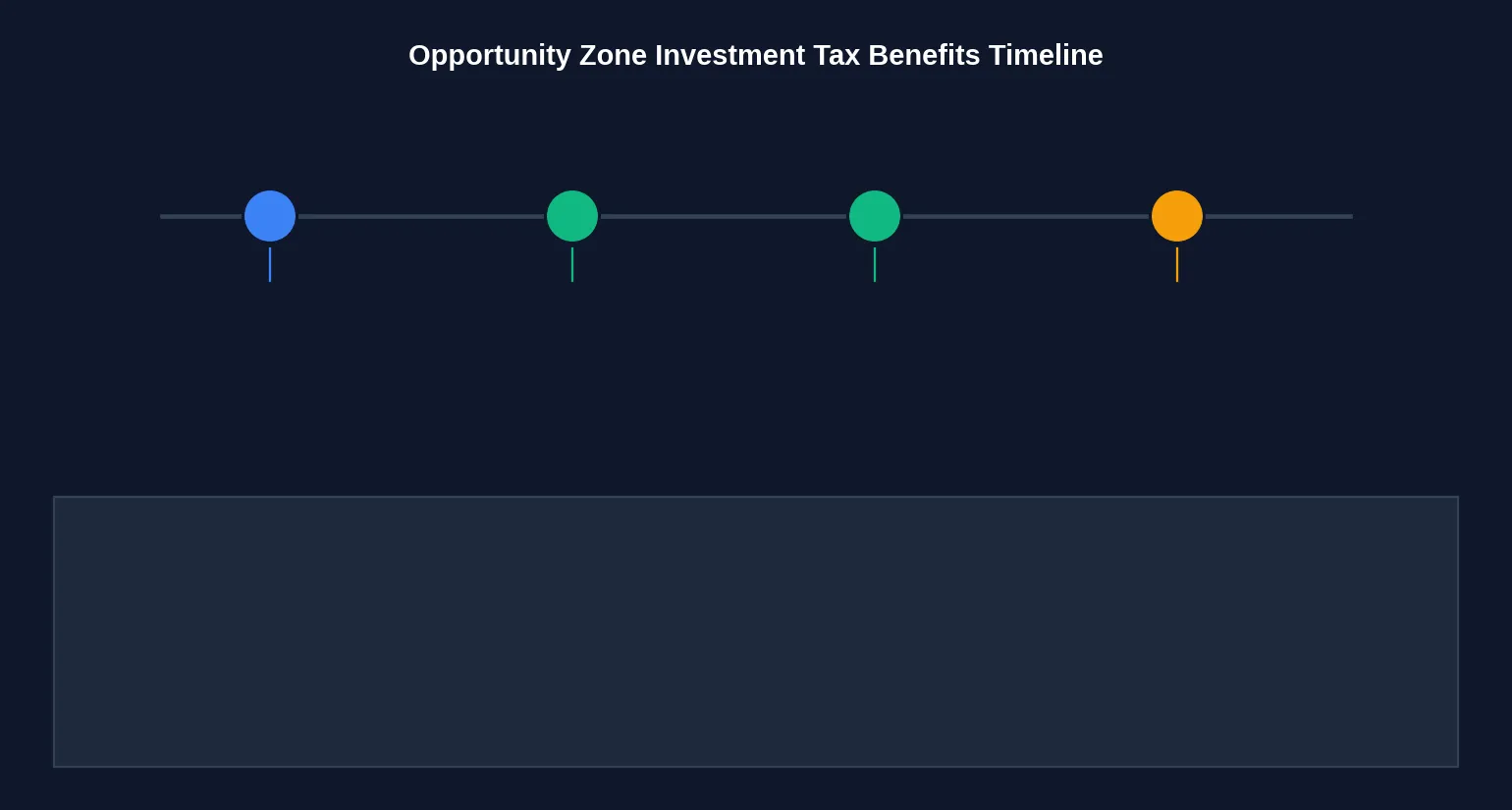
Benefit 1 — Deferral of original gain: When you invest a capital gain into a Qualified Opportunity Fund (QOF) within 180 days of realizing the gain, you can defer paying tax on that original gain until December 31, 2026, or until you sell the QOF investment, whichever comes first.
Benefit 2 — Basis step-up: If you hold the QOF investment for at least five years, your basis in the original gain increases by 10%. Hold it for seven years, and the basis step-up increases to 15%. This means you only pay tax on 85% of your original deferred gain. Note: the seven-year step-up only applies if you invested before certain deadlines, so check current rules carefully.
Benefit 3 — Permanent exclusion of QOF appreciation: This is the big one. If you hold your QOF investment for at least ten years, any appreciation in the QOF itself — not the original deferred gain, but the growth on your QOF investment — is completely tax-free. That is not a deferral. That is a permanent exclusion.
A Concrete Example
Say you sell stock for a $500,000 long-term capital gain. Instead of paying $75,000 in federal tax, you invest the entire $500,000 into a QOF within 180 days.
After 7 years, your basis in the original gain steps up by 15% to $75,000, meaning you only pay tax on $425,000 of the original gain when the deferral period ends. That saves you an additional $11,250.
Now say the QOF investment itself grows from $500,000 to $800,000 over ten years. When you sell, that $300,000 of appreciation is entirely tax-free. At 15%, that is $45,000 you never pay.
The total tax savings: $75,000 deferred (some eventually taxed at a reduced amount) plus $45,000 permanently excluded. That is serious money.
The Catch With Opportunity Zones
These investments are not without risk. Opportunity Zone properties are in designated low-income areas for a reason — they may not appreciate as expected. The QOF must substantially improve the property, which means investing an amount equal to the purchase price within 30 months. And the tax benefits only work if you follow every rule to the letter.
Also, the funds themselves often have high fees and limited liquidity. You might be locking up your money for a decade. Make sure the underlying investment makes sense on its own merits, not just for the tax benefits.
Strategy 3: Installment Sales
An installment sale is one of the simplest deferral strategies available. Instead of receiving the full sale price upfront, you spread the payments over multiple years and pay tax only on the portion you receive each year.
How It Works
When you sell an asset using an installment sale, you report a portion of the gain each year as you receive payments. The gain is prorated based on your gross profit percentage.
Gross profit percentage = (Selling price - adjusted basis) / Selling price
If you sell a property for $600,000 with an adjusted basis of $200,000, your gross profit is $400,000. Your gross profit percentage is 66.67%. Every payment you receive is 66.67% taxable gain and 33.33% return of basis.
If the buyer pays you $120,000 per year over five years, you report $80,000 of gain each year ($120,000 x 66.67%). At the 15% rate, you pay $12,000 per year instead of $60,000 all at once.
When Installment Sales Make Sense
Installment sales work best when you want steady income over time and prefer to spread the tax hit across multiple years rather than taking a big hit all at once. This can be especially useful if a large gain in a single year would push you into a higher capital gains tax bracket or trigger the Net Investment Income Tax.
They also work well when the buyer cannot afford to pay the full price upfront but is creditworthy enough to make payments over time. You essentially become the bank, collecting interest on top of the principal.
Restrictions on Installment Sales
Not every sale qualifies. You cannot use the installment method for inventory sales, securities traded on an established market, or sales where you are a dealer in the property being sold. There are also special rules if the total payments in any year exceed $5 million, which can trigger interest charges under the installment sale rules.
Strategy 4: Charitable Remainder Trusts
A charitable remainder trust (CRT) is a powerful strategy for people who want to defer capital gains tax, generate income, and eventually support a charity. It sounds complicated, but the concept is actually elegant.
How a CRT Works
You transfer an appreciated asset — like stock or real estate — into an irrevocable trust. The trust sells the asset. Because the trust is tax-exempt, no capital gains tax is due on the sale. The trust then invests the full proceeds and pays you an income stream for life or for a set number of years (up to 20).
When the trust ends, whatever remains goes to a charity of your choice. You also get an upfront charitable deduction based on the estimated remainder value that will eventually go to the charity.
Why This Saves Tax
Let us say you have stock with a $400,000 gain. If you sell it yourself, you owe $60,000 in federal tax at 15%, plus possible NIIT and state tax. You only have $340,000 left to reinvest.
If you put the stock into a CRT and the trust sells it, no tax is due. The full $400,000 gets reinvested. You receive annual payments from the trust — typically 5% to 10% of the trust value. A portion of each payment is taxed as ordinary income, a portion as capital gain, and a portion as tax-free return of principal. But the key is that the entire $400,000 keeps compounding from day one.
The Trade-Off
You give up the principal. When you die or the trust term ends, the remaining assets go to charity, not to your heirs. This makes CRTs best suited for people who are charitably inclined and want income during their lifetime but do not need to pass that specific asset to their children.
If leaving an inheritance matters to you, some people pair a CRT with a life insurance policy purchased with the income payments, effectively replacing the wealth that goes to charity. This is sometimes called a "wealth replacement" strategy.
Strategy 5: Intra-Family Loans and Carryforward Basis Planning
This is more of a planning technique than a direct deferral strategy, but it can work hand-in-hand with the others. The idea is to use low-interest loans to family members, letting them invest the money and pay tax at their own potentially lower rate.
How Intra-Family Loans Work
The IRS sets minimum interest rates for family loans, called Applicable Federal Rates (AFRs). These rates are often well below market rates. You lend money to a child or other family member at the AFR, they invest it, and any returns above the AFR are effectively shifted to them.
If your child is in the 0% long-term capital gains bracket and you are in the 20% bracket, the investment gains they realize are taxed at their rate, not yours. This is not technically a deferral — it is a rate-shifting strategy — but the effect is similar. You end up paying less total tax over time.
Step-Up in Basis at Death
Another powerful planning tool is the step-up in basis that occurs when someone dies and leaves appreciated assets to their heirs. The heirs receive the assets with a basis equal to the fair market value on the date of death, wiping out all the unrealized gains.
For inherited property, the stepped-up basis rules mean your heirs could sell immediately and owe zero capital gains tax on the appreciation that occurred during your lifetime. This is why holding highly appreciated assets until death can be one of the best "deferral" strategies of all — the tax is not just deferred, it is eliminated.
Combining Strategies for Maximum Benefit
The real magic happens when you combine these strategies. Here is a hypothetical example that shows how they stack:
Say you sell a commercial property for a $600,000 gain. You do a 1031 like-kind exchange into a new property, deferring the entire federal tax. Five years later, you sell the new property for another gain. This time, you invest the proceeds into a Qualified Opportunity Fund, deferring again and starting the ten-year clock for tax-free appreciation on the QOF growth.
Meanwhile, you use an installment sale for a separate real estate capital gain to spread the tax over five years. And you move some appreciated stock into a charitable remainder trust to generate income while avoiding the tax on the sale.
None of these strategies conflict with each other. Each one handles a different piece of your portfolio. The key is working with a tax advisor who understands all of them and can coordinate the timing.
Common Mistakes That Kill Deferral Strategies
I have seen people blow up their own deferral plans more times than I can count. Here are the most common errors:
Missing the 45-day window in a 1031 exchange. This is the number one killer. People get too picky about replacement properties and run out of time. Always identify backup properties even if you are not sure about them.
Not using a qualified intermediary. In a 1031 exchange, if you touch the money even for one day, the entire exchange is disallowed. I have seen clients who thought they could hold the funds in their own bank account "just for a few days." No. The IRS does not care about a few days.
Ignoring state capital gains tax rates. Some states do not conform to federal deferral rules. California, for example, does not recognize 1031 exchanges for state tax purposes if the replacement property is outside California. You might defer federal tax but still owe state tax.
Waiting too long to invest in a QOF. The 180-day rule for Opportunity Zone investments is strict. If you realize a gain on December 1, you have until late May to invest it. Miss that window and the opportunity is gone.
Forgetting about the wash sale rule. If you are doing tax-loss harvesting to offset gains and then planning to defer the remaining gain, make sure you are not running afoul of the wash sale rule by repurchasing the same security within 30 days.
Reporting Deferral Strategies on Your Tax Return
Each deferral strategy has its own reporting requirements. Here is a quick overview:
- 1031 exchange: Report on Form 8824 (Like-Kind Exchanges). Attach it to your return for the year of the exchange. Even though no tax is due, you must report the exchange.
- Opportunity Zone investment: Report on Form 8949 and Schedule D. Attach Form 8997 to report your initial QOF investment. You also need to file Form 8996 if the fund itself is filing a return.
- Installment sale: Report on Form 6252 (Installment Sale Income) each year you receive a payment.
- CRT: Report on Form 5227 for the trust. You report your income from the trust on your personal return based on the trust's allocation.
For the full walkthrough of reporting capital gains, our guide on how to report capital gains on your tax return covers every form line by line.
The Bottom Line
You have more options than you think. The IRS built deferral strategies into the tax code on purpose — to encourage real estate investment, to stimulate economic development in struggling communities, and to reward charitable giving. Using them is not aggressive tax planning. It is exactly what Congress intended. Whether a 1031 exchange works for your real estate, an Opportunity Zone Fund fits your timeline, or an installment sale spreads your tax hit over several years, the key is planning ahead. Most of these strategies must be set up before or very soon after the sale. Once you have the cash in hand and the tax year closes, your options narrow dramatically. Talk to a tax professional before you sell — not after. And for more strategies and detailed guides, browse our full library of capital gains tax articles and tips.
Fact-Checked & Reviewed
This article was written by Sarah Mitchell (CPA, MST (Master of Science in Taxation)) and reviewed for accuracy by David Chen (JD, LLM in Taxation (New York University)). Published by Wasim Akram, Founder & Lead Researcher at TaxGainsCalc. All tax rates, thresholds, and rules referenced are based on IRS publications and current tax law as of the date published. Tax laws change frequently — always consult a qualified tax professional for advice specific to your situation.
Certified Public Accountant (CPA)
Sarah Mitchell is a Certified Public Accountant with over 15 years of experience in individual and business taxation. She holds a Master of Science in Taxation from Golden Gate University and specializes in capital gains tax planning, investment tax ...
Tax Attorney & Legal Editor
David Chen is a tax attorney with a Juris Doctor and a Master of Laws in Taxation from New York University School of Law. With over 10 years of legal practice, he specializes in 1031 exchanges, capital gains tax law, and IRS dispute resolution. David...

Founder & Lead Researcher, TaxGainsCalc
Wasim Akram is an independent web publisher and digital entrepreneur based in India. Since 2018, he has been building custom CMS platforms, WordPress plugins, niche websites, and AI-powered digital products with over 8 years of real-world experience....
Disclaimer: This article is for informational purposes only and does not constitute tax, legal, or financial advice. Tax laws and regulations change frequently, and the information presented here may not reflect the most current updates. You should consult with a qualified CPA, tax attorney, or financial advisor before making any tax-related decisions. TaxGainsCalc is not responsible for any actions taken based on the information provided in this article.