Capital Gains Tax on Real Estate Investment Property 2026: Depreciation Recapture, 1031 Exchanges & What You Actually Owe
Complete guide to capital gains tax on rental and investment property in 2026. Understand depreciation recapture at 25%, how 1031 exchanges work, calculating adjusted basis, and strategies to reduce your tax bill when selling real estate investments.
The Two-Tax Punch That Ruins Real Estate Exit Plans
I sat down with a client named Patricia last month who had just sold a rental condo she owned for eleven years. She bought it for $220,000, sold it for $410,000. Nice profit, right? She figured she would owe long-term capital gains rate on the $190,000 difference. At 15%, that is roughly $28,500. Annoying but manageable. Then I ran the actual numbers and her jaw dropped. Her real tax bill was over $37,000. Where did the extra nine grand come from? Depreciation recapture. She had been claiming depreciation on that condo for over a decade, and the IRS wants a piece of that back when you sell. Nobody had ever explained this to her, and she is far from alone.
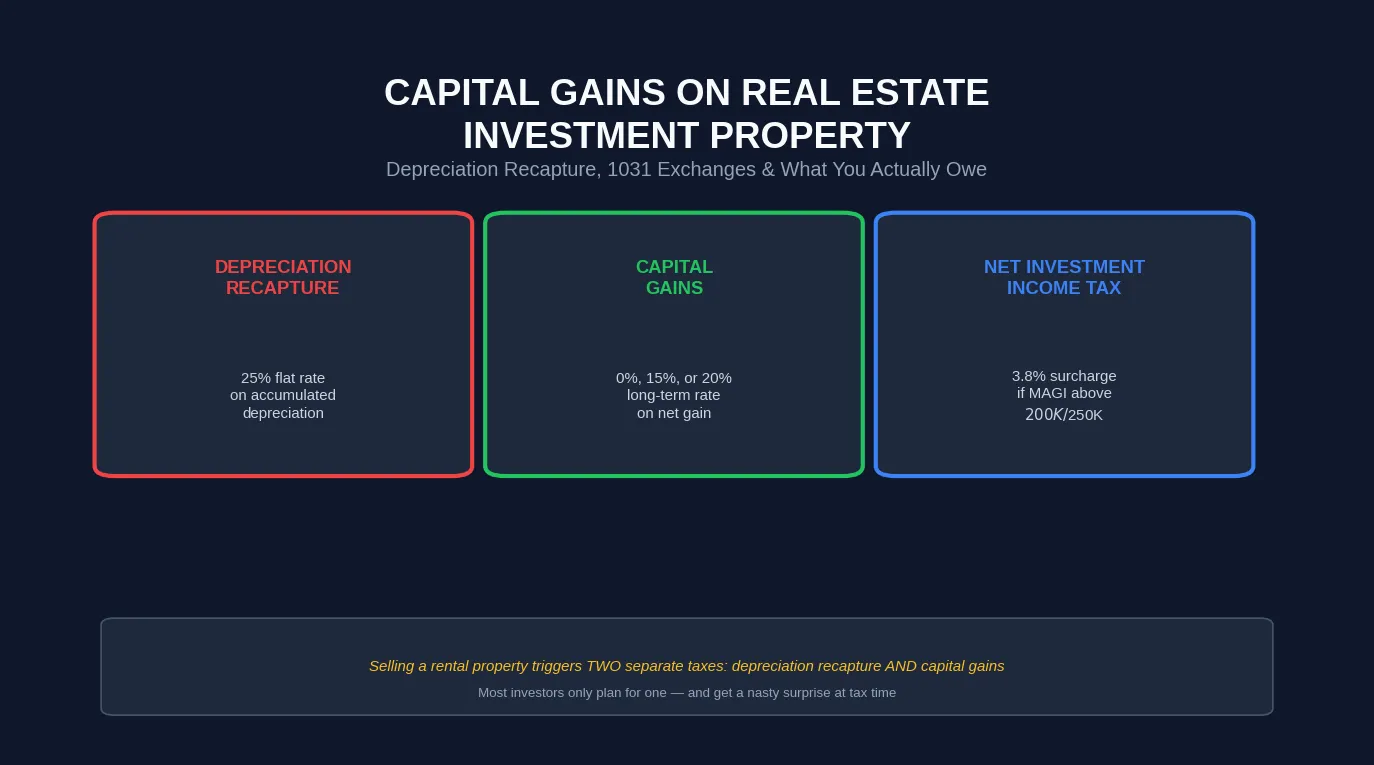
Here is the thing about selling investment real estate that catches people off guard: you are not just paying capital gains tax on your profit. You are also paying a separate tax on all the depreciation you deducted over the years you owned the property. The depreciation recapture rate is a flat 25%, which is higher than the 15% or 20% long-term capital gains rate most investors expect. And the IRS makes you account for the recaptured depreciation before applying the lower capital gains rate to whatever is left. It is a one-two punch, and if you only planned for one of those hits, the other one hurts.
How Depreciation Recapture Actually Works
When you own a rental property, you get to deduct depreciation each year as an expense against your rental income. For residential real estate, the depreciation period is 27.5 years, which works out to about 3.636% of the building's value per year. Land does not depreciate, so you have to separate the land value from the building value when you start. If you bought a property for $300,000 and the land is worth $75,000, your depreciable basis is $225,000, and your annual depreciation deduction is about $8,182.
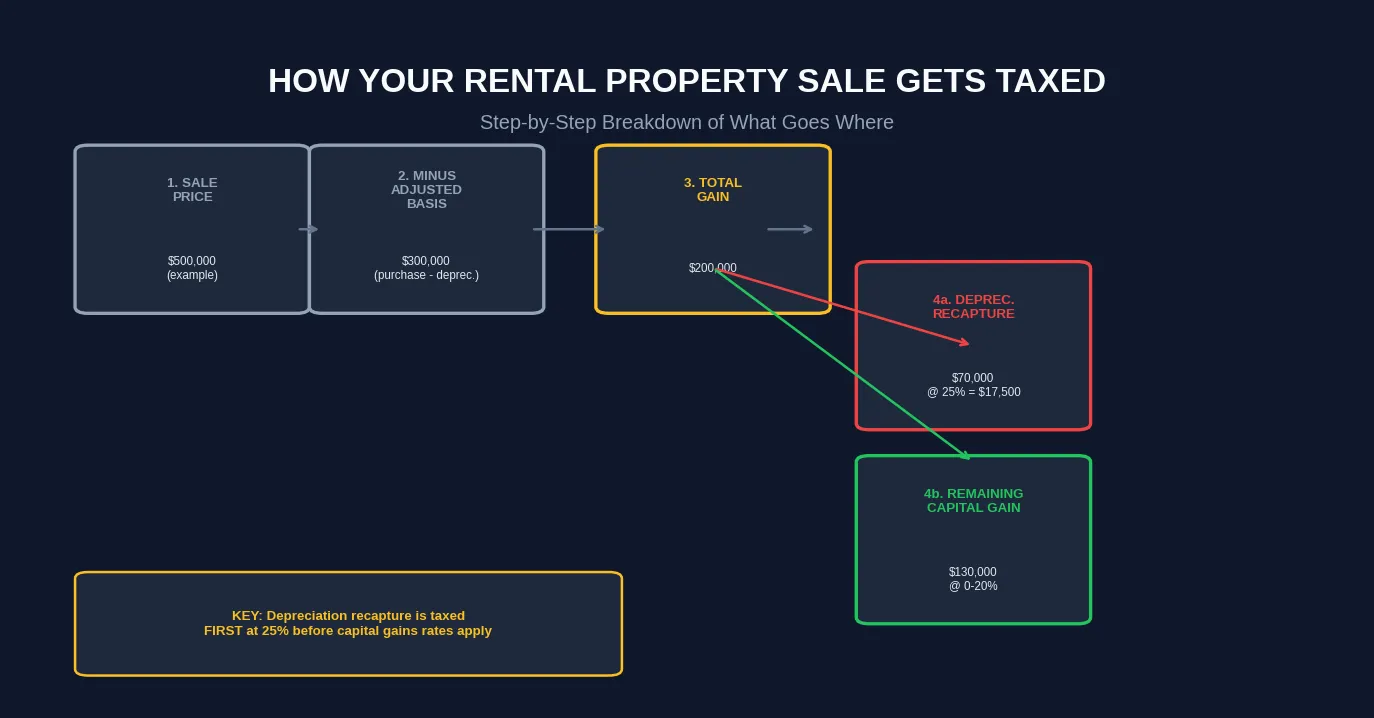
The problem comes when you sell. All that depreciation you deducted over the years reduced your cost basis in the property. Your adjusted basis is your original purchase price plus improvements minus all the depreciation you claimed (or should have claimed — the IRS uses "allowed or allowable," meaning even if you forgot to take the deduction, they still reduce your basis). When you sell, the portion of your gain that corresponds to the accumulated depreciation gets taxed at 25% as depreciation recapture under Section 1250.
Let me walk through Patricia's numbers because they illustrate this perfectly. She bought the condo for $220,000, with about $55,000 allocated to land. That left $165,000 as the building basis, and over eleven years she claimed roughly $66,000 in depreciation. Her adjusted basis dropped to $154,000 ($220,000 minus $66,000). When she sold for $410,000, her total gain was $256,000. Of that, $66,000 is depreciation recapture taxed at 25% ($16,500). The remaining $190,000 is regular capital gain taxed at her 15% rate ($28,500). Total federal tax: $45,000. That is a lot more than the $28,500 she was expecting.
What If You Did Not Claim Depreciation?
This is a nasty gotcha. The IRS calculates recapture based on depreciation that was "allowed or allowable," not just what you actually claimed on your tax return. So if you were supposed to take $8,000 a year in depreciation but you forgot or chose not to, your basis still gets reduced by that amount, and you still get hit with the 25% recapture tax on it when you sell. You essentially paid taxes on more rental income than necessary during the ownership years, and then you pay recapture on depreciation you never benefited from. It is one of the worst outcomes in the tax code, and it happens more often than you would think, especially with accidental landlords who inherited property and never set up proper depreciation schedules.
Calculating Your Adjusted Basis Correctly
Your adjusted basis is the foundation of everything. Get this number wrong and your entire tax calculation falls apart. Here is what goes into it:
Starting basis: What you paid for the property, including closing costs like title insurance, legal fees, and transfer taxes. Not just the purchase price — the full cost of acquiring the property.
Plus improvements: Capital improvements that add value or extend the life of the property. A new roof, a kitchen renovation, adding a deck — these get added to basis. Routine repairs like fixing a leaky faucet or patching drywall do not count. They are already deductible as expenses in the year you pay for them.
Minus depreciation: All depreciation you claimed or could have claimed over the years you owned the property. This is the big one. If you used our real estate capital gains calculator to estimate your gain, make sure you are entering the adjusted basis, not the original purchase price. The difference can be tens of thousands of dollars.
Minus casualty losses: If you deducted casualty losses from fire, flood, or other disasters, those reduce your basis too. Not common, but worth mentioning.
When Patricia and I went through her records, we found she had replaced the HVAC system in year four for $7,200 but never added it to her basis. That would have increased her basis and reduced her gain by $7,200, saving her about $1,080 in taxes. Not a huge amount, but multiply that by five or ten overlooked improvements over a decade of ownership and you are talking real money.
The Capital Gains Portion: Short-Term vs Long-Term
The portion of your gain that is not depreciation recapture gets taxed as a regular capital gain. If you held the property for more than one year, it qualifies for long-term capital gains rates of 0%, 15%, or 20%, depending on your total taxable income. If you held it for one year or less, it is a short-term gain taxed at ordinary income rates up to 37%. Nobody should be flipping rental properties held less than a year unless the profit is so enormous that the tax hit still leaves them ahead. Almost always better to hold at least a year and a day.
One thing that confuses people: the depreciation recapture portion and the capital gains portion are calculated separately and taxed at different rates, but they both show up on the same tax return. The recapture goes on Form 4797 (Sale of Business Property), and the remaining capital gain goes on Form 8949 and Schedule D. If you want the full walkthrough of those forms, our guide on how to report capital gains on your tax return covers every line.
The NIIT and State Tax Layers
If your modified adjusted gross income exceeds $200,000 (single) or $250,000 (married filing jointly), the Net Investment Income Tax piles on another 3.8%. Rental property gains count as investment income for this purpose, so a large sale can easily push you over the threshold. On Patricia's $256,000 gain, the NIIT adds another $9,728 (3.8% of $256,000). Now her total federal bill is over $54,000 on a property she thought would cost $28,500 in tax. That is nearly double what she expected.
Your state capital gains tax rate makes it even worse. In California, you could be looking at 13.3% on top of everything. In New York City, the combined state and city rate can exceed 12%. Even in moderate-tax states, you are probably adding 5-6% to your total rate. In a high-tax state with NIIT, your combined marginal rate on a rental property sale can push past 40%.
1031 Exchange: The Best Way to Defer the Whole Bill
If you are not ready to cash out and you want to keep investing in real estate, a 1031 like-kind exchange lets you defer both the capital gains tax and the depreciation recapture by rolling your proceeds into a replacement property. This is the single most powerful tax tool available to real estate investors, and it is worth understanding thoroughly because the rules are strict.
You have 45 days from the date of sale to identify up to three potential replacement properties, and 180 days to close on one of them. The replacement property must be of equal or greater value to fully defer all gains. You cannot touch the money — it has to go through a qualified intermediary who holds it in escrow between the sale and the purchase. If you take constructive receipt of the funds at any point, the exchange fails and you owe all the tax.
The beauty of a 1031 exchange is that you can keep doing them indefinitely. Buy a property, hold it, exchange it for a larger one, hold that, exchange again. Each time you defer the gain, and the deferred gain plus the new gain compounds in the next property. Some investors build enormous portfolios this way without ever paying a dollar in capital gains tax. Eventually, when you sell without doing another exchange, all those deferred gains come due — but by then you might be in a lower tax bracket, or you might pass the property to heirs who get a stepped-up basis and the entire deferred gain disappears.
What Qualifies for a 1031 Exchange
The property has to be held for investment or used in a business. Rental properties, commercial buildings, land held for investment — all qualify. Your primary residence does not qualify. A property you bought to flip does not qualify if you never held it for investment purposes. The replacement property also has to be real estate held for investment — you cannot exchange an apartment building for a stock portfolio or a coin collection. Both the old and new property need to be "like-kind," which in real estate basically means any real property for any other real property. A condo for a warehouse, a rental house for a strip mall — all fine.
What If You Move Into the Rental Before Selling
Some investors try to convert a rental property into their primary residence to take advantage of the Section 121 exclusion, which shields up to $250,000 (single) or $500,000 (married) of gain from tax. Our home sale capital gains calculator shows you how much you could exclude. This strategy works, but the rules tightened significantly in 2008.
You now have to live in the property as your primary residence for at least two of the five years before selling to qualify for the exclusion. But here is the catch: any depreciation you claimed after 2008 while the property was a rental is not excluded. The IRS calls this "unrecaptured Section 1250 gain," and it is still taxed at 25% even if you qualify for the Section 121 exclusion on the rest. So you can exclude some of your gain, but you cannot exclude the depreciation recapture portion. Still worth doing if your non-depreciation gain is substantial, but it is not the free ride some people think it is.
Selling at a Loss: Not as Simple as You Might Hope
If you sell a rental property for less than your adjusted basis, you have a loss. Whether it is deductible depends on classification. Losses on investment property are deductible as capital losses, which you can use to offset other capital gains. If your total net capital loss exceeds $3,000, the excess carries forward to future years. Tax-loss harvesting strategies work with real estate losses the same way they work with stock losses — you net everything together to minimize your overall tax burden.
However, if the property was considered a personal-use asset rather than an investment — say you let a family member live there at below-market rent for years — the loss may not be deductible at all. The IRS looks at your intent and your rental history to determine classification. Legitimate rental properties with real tenants at market rates generally qualify as investments.
Practical Strategies Before You Sell
Get a cost segregation study done. If you have not already done one, a cost segregation study can front-load depreciation by breaking the property into components with shorter lives — 5, 7, or 15 years instead of 27.5. You cannot retroactively claim more depreciation than you were allowed, but if you have years left to hold the property, a cost segregation study can increase your annual deductions going forward. Just remember that more depreciation now means more recapture later.
Document every improvement you ever made. Go through your records and make sure every capital improvement is added to your basis. I cannot tell you how many sellers forget about the furnace replacement, the new water heater, the fence they put in, the driveway resurfacing. Each one reduces your gain.
Consider an installment sale. If you are carrying a note for the buyer instead of getting all cash at closing, you can spread the gain over the years you receive payments using the installment method under Section 453. This can keep your income below NIIT thresholds and potentially below the 20% capital gains bracket in each year. Works well when the buyer cannot get traditional financing and you are willing to be the bank.
Sell in a low-income year. The capital gains portion of your sale is taxed based on your total income that year. If you are retiring, changing careers, or have a year with unusually low income, that is the time to sell. The difference between the 0% and 15% long-term capital gains rate bracket can save you tens of thousands on a large gain.
Do a 1031 exchange if you are not done investing. This bears repeating because it is the single biggest tax saver in real estate. If the numbers work and you want to stay in the game, exchange into a larger property or a property in a better market. You keep building wealth and you keep deferring tax.
The Bottom Line
Selling a rental property is not like selling a stock. You have got depreciation recapture at 25% hitting you on top of regular capital gains. Your adjusted basis is probably lower than you think because of all the depreciation you claimed. NIIT and state taxes stack on top of the federal rates, and in a high-tax state your combined rate can exceed 40%. The 1031 exchange is your best friend if you want to defer the entire bill, but the rules are strict and the timelines are unforgiving. Plan the sale before you list the property, not after. Once the deal closes, most of your tax-saving options disappear.
Fact-Checked & Reviewed
This article was written by David Chen (JD, LLM in Taxation (New York University)) and reviewed for accuracy by Sarah Mitchell (CPA, MST (Master of Science in Taxation)). Published by Wasim Akram, Founder & Lead Researcher at TaxGainsCalc. All tax rates, thresholds, and rules referenced are based on IRS publications and current tax law as of the date published. Tax laws change frequently — always consult a qualified tax professional for advice specific to your situation.
Tax Attorney & Legal Editor
David Chen is a tax attorney with a Juris Doctor and a Master of Laws in Taxation from New York University School of Law. With over 10 years of legal practice, he specializes in 1031 exchanges, capital gains tax law, and IRS dispute resolution. David...
Certified Public Accountant (CPA)
Sarah Mitchell is a Certified Public Accountant with over 15 years of experience in individual and business taxation. She holds a Master of Science in Taxation from Golden Gate University and specializes in capital gains tax planning, investment tax ...

Founder & Lead Researcher, TaxGainsCalc
Wasim Akram is an independent web publisher and digital entrepreneur based in India. Since 2018, he has been building custom CMS platforms, WordPress plugins, niche websites, and AI-powered digital products with over 8 years of real-world experience....
Disclaimer: This article is for informational purposes only and does not constitute tax, legal, or financial advice. Tax laws and regulations change frequently, and the information presented here may not reflect the most current updates. You should consult with a qualified CPA, tax attorney, or financial advisor before making any tax-related decisions. TaxGainsCalc is not responsible for any actions taken based on the information provided in this article.