Capital Gains Tax for Beginners 2026: A Simple Guide That Actually Makes Sense
A beginner-friendly guide to capital gains tax in 2026. Learn what capital gains are, how they are taxed, the difference between short-term and long-term rates, and simple strategies to lower your tax bill — explained in plain English.
If You Sold Something for a Profit, the IRS Wants to Know About It
Nobody sits you down and explains how capital gains tax works when you open your first brokerage account. You buy a stock, it goes up, you feel great. Then you sell it and discover the IRS takes a piece of your profit. That piece is called capital gains tax.
I remember the first time I owed capital gains tax. I had made about $4,000 selling shares of Apple and had no idea I needed to report it. My tax software flagged it, and I had to scramble to figure out what was going on. If someone had just explained the basics to me upfront, I could have planned better and paid less.
That is exactly what this guide does. No accounting jargon. No confusing IRS language. Just plain English answers to the questions every beginner has about capital gains tax.
What Is a Capital Gain
A capital gain is the profit you make when you sell something for more than you paid for it. That "something" is called a capital asset. It could be stocks, bonds, mutual funds, cryptocurrency, real estate, or even collectibles like coins and art.
The math is simple. You buy a stock for $100. You sell it for $150. Your capital gain is $50. That $50 is what the IRS taxes.
Here is what a capital gain is not. It is not the total sale price. You only pay tax on the profit, not the money you got back from your original investment. If you bought for $100 and sold for $100, there is no gain and no tax.
What About Losses
If you sell something for less than you paid, that is a capital loss. Losses are actually useful because they offset your gains. If you made $5,000 on one stock and lost $3,000 on another, you only pay tax on the net gain of $2,000.
This concept is called tax-loss harvesting, and it is one of the most powerful tools investors have. You can even deduct up to $3,000 in net losses against your regular income each year, with any remaining losses carrying forward to future years.
The Two Types of Capital Gains
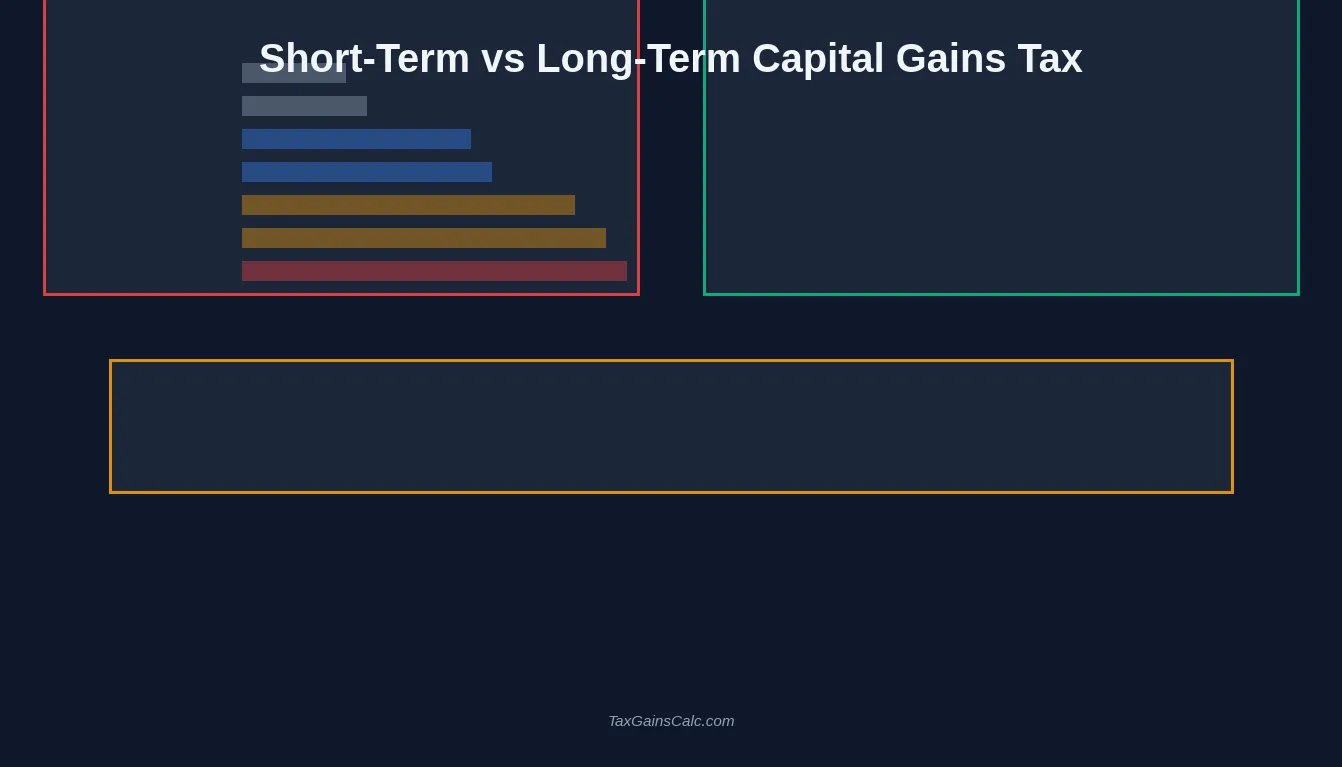
This is the most important thing you will learn in this guide. The IRS divides capital gains into two categories, and the tax rates are wildly different.
Short-Term Capital Gains
If you hold an investment for one year or less before selling, your profit is a short-term capital gain. These are taxed at your ordinary income rate — the same rate as your salary.
| Your Income | Short-Term Rate |
|---|---|
| Low income | 10% - 12% |
| Middle income | 22% - 24% |
| High income | 32% - 37% |
Short-term gains are expensive. If you are in the 32% tax bracket and make a $10,000 short-term gain, you owe $3,200 in federal tax. That stings.
Long-Term Capital Gains
If you hold an investment for more than one year before selling, your profit gets preferential tax treatment. Long-term capital gains are taxed at much lower rates.
| Your Taxable Income | Long-Term Rate |
|---|---|
| Up to $47,025 (Single) | 0% |
| $47,026 - $518,900 | 15% |
| Over $518,900 | 20% |
Read that first line again. If your taxable income is below $47,025 as a single filer, your long-term capital gains are completely tax-free at the federal level. Zero percent. You pay nothing.
The One-Year Rule
The difference between short-term and long-term comes down to one day. If you buy a stock on January 1 and sell it on December 31 of the same year, that is a short-term gain. If you wait until January 2 of the next year — just one extra day — it becomes a long-term gain.
That one day could save you thousands. A $20,000 gain taxed at 32% (short-term) costs you $6,400. The same gain taxed at 15% (long-term) costs you $3,000. Waiting one extra day saves you $3,400.
This is why experienced investors almost never sell a profitable position before the one-year mark unless they have a very good reason.
How to Calculate Your Capital Gain
The calculation itself is straightforward. You need three numbers:
- 1Your purchase price (also called cost basis) — what you paid for the investment, plus any commissions or fees.
- 2Your sale price — what you sold it for, minus any commissions or fees.
- 3Your holding period — how long you owned it.
Your gain equals the sale price minus the purchase price. Your holding period determines whether it is short-term or long-term.
Example
You buy 50 shares of Microsoft at $200 each. Total cost: $10,000. You sell them 14 months later at $300 each. Total sale: $15,000.
Your capital gain is $5,000 ($15,000 minus $10,000). Because you held the shares for more than one year, it is a long-term gain. If you are in the 15% bracket, you owe $750 in federal tax on that gain.
What Counts as a Capital Asset
The IRS considers many things to be capital assets. Here are the most common ones beginners encounter:
- Stocks — Shares of individual companies. See our guide on capital gains tax on stocks for details.
- Bonds — Corporate and government bonds sold at a profit.
- Mutual funds and ETFs — When the fund distributes gains, or when you sell your shares. Our mutual funds and ETFs guide explains the nuances.
- Cryptocurrency — Yes, the IRS taxes crypto gains. Bitcoin, Ethereum, and all other digital assets are treated as property. Our cryptocurrency tax guide covers this.
- Real estate — Including your home and investment property.
- Collectibles — Coins, art, antiques. These have a special 28% rate covered in our collectibles tax guide.
5 Things Every Beginner Must Know

1. You Only Pay Tax When You Sell
This is the most common point of confusion. If your stock doubles in value but you do not sell it, you owe zero tax. The gain is "unrealized." You only owe tax when you sell and "realize" the gain.
This means you can hold winning investments indefinitely without paying a dime in capital gains tax. Warren Buffett has held some of his stocks for decades, and he only pays tax when he sells.
2. Your Holding Period Matters More Than You Think
I cannot stress this enough. The difference between selling on day 364 and day 366 can be enormous. Always check your purchase date before selling. Your brokerage account will show you when you bought each lot of shares.
If you are anywhere close to the one-year mark, think carefully about whether selling now is worth the extra tax. Often it is worth waiting.
3. Losses Are Your Friend
This sounds counterintuitive, but investment losses are a valuable tax tool. If you have gains in one part of your portfolio and losses in another, you can sell the losers to offset the winners.
This is tax-loss harvesting, and it can save you hundreds or thousands of dollars. The one catch is the wash sale rule — you cannot buy the same or a very similar investment within 30 days before or after the sale. If you do, the IRS disallows the loss.
4. Your Total Income Determines Your Rate
Your capital gains tax rate is not based on the gains alone. It is based on your total taxable income, including your salary, dividends, interest, and capital gains all added together.
This is why some people pay 0% on long-term gains. If your total taxable income is below $47,025 as a single filer, your long-term gains fall in the 0% bracket. Retirees and people with lower incomes often pay nothing on their investment gains.
For a deeper comparison of how these rates stack up, our short-term vs long-term capital gains guide has the full breakdown.
5. Your State Wants a Cut Too
Federal tax is only part of the story. Most states also tax capital gains as ordinary income. But nine states have no income tax at all, which means no state capital gains tax.
If you live in Florida, Texas, Nevada, Wyoming, Alaska, South Dakota, Tennessee, New Hampshire, or Washington, you only pay federal capital gains tax. Move to California, and the state adds up to 13.3% on top. Our state capital gains tax rates guide shows the rates for all 50 states.
How to Report Capital Gains on Your Tax Return
When you sell an investment, your brokerage sends you a Form 1099-B at the end of the year. This form shows what you sold, what you paid, and your gain or loss.
You report your capital gains on two forms:
- 1Form 8949 — This is where you list each individual sale. Date bought, date sold, purchase price, sale price, and gain or loss.
- 1Schedule D — This summarizes everything from Form 8949. It calculates your net gain or loss and figures out your tax.
Our complete guide on how to report capital gains on your tax return walks through every line of these forms with examples.
Simple Strategies to Lower Your Capital Gains Tax
You do not need to be a tax expert to save money. Here are the strategies that work for beginners.
Hold for More Than One Year
This is the easiest and most impactful thing you can do. By simply waiting until you have held an investment for more than one year, you cut your tax rate dramatically. Going from 32% to 15% on a $10,000 gain saves you $1,700.
Sell Losers to Offset Winners
If you have investments that are down, consider selling them to offset your gains. Every dollar of loss cancels out a dollar of gain. If your losses exceed your gains, you can deduct up to $3,000 against your ordinary income and carry the rest forward.
Use Tax-Advantaged Accounts
Investments inside an IRA, 401(k), or Roth IRA are not subject to capital gains tax when you sell. In a Roth IRA, your gains are completely tax-free if you follow the withdrawal rules. If you are an active trader or have investments with large unrealized gains, holding them in a tax-advantaged account can save you a fortune.
Consider a 1031 Exchange for Real Estate
If you are selling investment real estate, a 1031 exchange allows you to defer the entire capital gains tax by reinvesting the proceeds into another investment property. This is one of the most powerful deferral tools available, and it is commonly used by real estate investors.
Watch Out for the Net Investment Income Tax
If your income is above $200,000 (single) or $250,000 (married), you may owe an extra 3.8% Net Investment Income Tax on top of your regular capital gains rate. This catches a lot of people by surprise. Plan for it.
Common Beginner Mistakes
Mistake 1: Not Reporting Small Gains
Every gain counts, even if it is only $50 from selling a few shares. The IRS requires you to report all capital gains. Your brokerage reports them to the IRS too, so the government already knows about them.
Mistake 2: Forgetting About Reinvested Dividends
If you automatically reinvest your dividends, each reinvestment creates a new purchase with its own cost basis and holding period. When you eventually sell, you need to account for all those separate purchases. Many beginners just use the original purchase price and end up overpaying on taxes.
Mistake 3: Selling Too Quickly
The urge to take profits quickly is strong, especially for beginners. But selling before the one-year mark means paying short-term rates. If you believe in the investment, patience can save you serious money.
Mistake 4: Ignoring State Taxes
Federal tax is what everyone talks about, but state taxes can add a significant amount to your bill. Before you sell a large position, check your state capital gains tax rate to see the full picture.
Mistake 5: Not Keeping Good Records
Your brokerage keeps records, but it is wise to maintain your own. Save purchase confirmations, track cost basis adjustments, and note holding periods. If your brokerage merges or changes platforms, records can sometimes get lost or confused.
The Bottom Line
Capital gains tax is not as complicated as it seems. You make a profit when you sell an investment for more than you paid. If you held it for more than a year, you pay the lower long-term rate of 0%, 15%, or 20%. If you held it for a year or less, you pay your ordinary income rate, which can be up to 37%.
The single most important thing a beginner can do is hold investments for more than one year. That one decision can cut your tax bill in half or more. Beyond that, use losses to offset gains, take advantage of tax-advantaged accounts, and always consider your state tax rate when planning a sale.
Capital gains tax is a cost of investing, but it is a cost you can manage. With a little planning, you keep a lot more of your profits. For more detailed guides on every aspect of capital gains tax, browse our full collection of tax planning articles and resources.
Fact-Checked & Reviewed
This article was written by David Chen (JD, LLM in Taxation (New York University)) and reviewed for accuracy by Sarah Mitchell (CPA, MST (Master of Science in Taxation)). Published by Wasim Akram, Founder & Lead Researcher at TaxGainsCalc. All tax rates, thresholds, and rules referenced are based on IRS publications and current tax law as of the date published. Tax laws change frequently — always consult a qualified tax professional for advice specific to your situation.
Tax Attorney & Legal Editor
David Chen is a tax attorney with a Juris Doctor and a Master of Laws in Taxation from New York University School of Law. With over 10 years of legal practice, he specializes in 1031 exchanges, capital gains tax law, and IRS dispute resolution. David...
Certified Public Accountant (CPA)
Sarah Mitchell is a Certified Public Accountant with over 15 years of experience in individual and business taxation. She holds a Master of Science in Taxation from Golden Gate University and specializes in capital gains tax planning, investment tax ...

Founder & Lead Researcher, TaxGainsCalc
Wasim Akram is an independent web publisher and digital entrepreneur based in India. Since 2018, he has been building custom CMS platforms, WordPress plugins, niche websites, and AI-powered digital products with over 8 years of real-world experience....
Disclaimer: This article is for informational purposes only and does not constitute tax, legal, or financial advice. Tax laws and regulations change frequently, and the information presented here may not reflect the most current updates. You should consult with a qualified CPA, tax attorney, or financial advisor before making any tax-related decisions. TaxGainsCalc is not responsible for any actions taken based on the information provided in this article.