Capital Gains Tax on Cryptocurrency 2026: Trading, Mining, Staking & What the IRS Actually Tracks
Complete guide to cryptocurrency capital gains tax in 2026. Learn which crypto transactions are taxable, how short-term and long-term rates apply to Bitcoin and altcoins, reporting mining and staking income, DeFi tax implications, and strategies to reduce your crypto tax bill.
The Crypto Tax Wake-Up Call That Keeps Coming
I got an email from a guy named Derek back in April. He had been trading crypto for about three years — mostly Bitcoin, some Ethereum, a few altcoins he picked up during the last bull run. He told me he made roughly $87,000 in profits over that time and was feeling pretty good about himself. Then he sat down to do his taxes and realized he had over 400 separate transactions across three exchanges and two wallets, and he had not tracked a single cost basis for any of them. Not one. He asked me if he could just report the total profit and move on. I had to tell him that the IRS wants to see every single trade, the date you bought, the date you sold, what you paid, what you got, and the gain or loss on each one. Four hundred rows on Form 8949, all calculated manually if you did not keep records. Derek spent an entire weekend with a spreadsheet and a bottle of Advil, and he is not even close to the worst case I have seen.
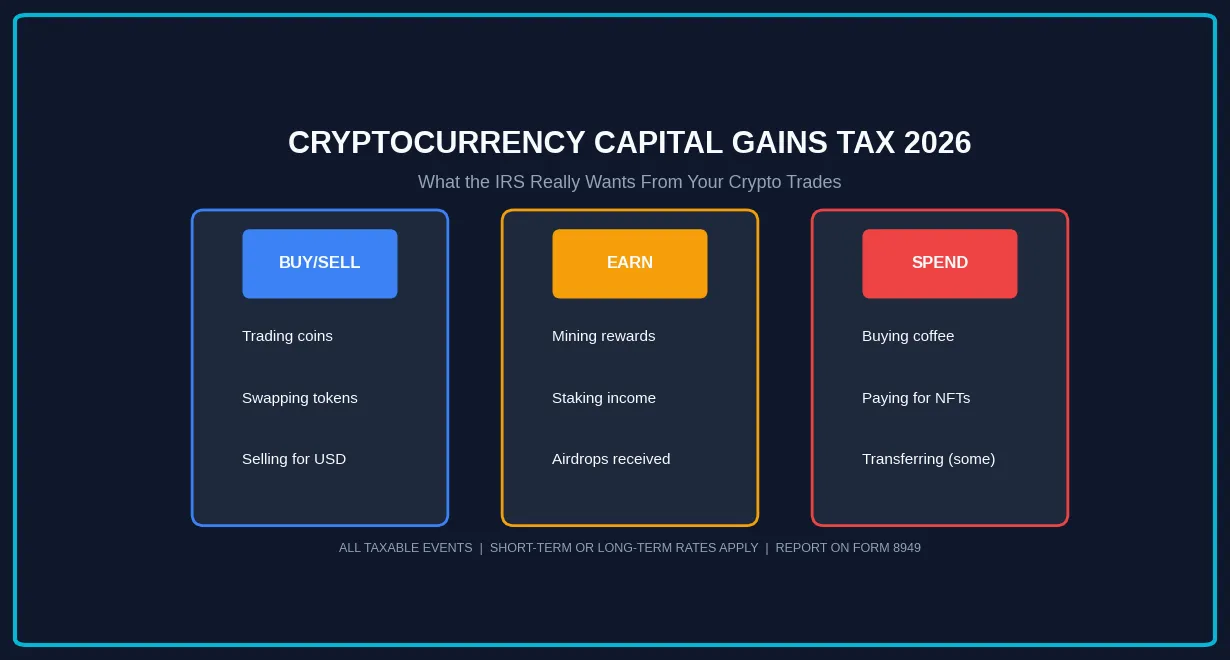
Here is the reality of cryptocurrency taxes that most people do not understand until it is too late. Almost every transaction you make with crypto is a taxable event. Selling for cash? Taxable. Trading one coin for another? Taxable. Using Bitcoin to buy a laptop? Taxable. Earning rewards from staking? Taxable as ordinary income. Even getting an airdrop can trigger a tax obligation. The only thing that is not taxable is buying crypto with fiat currency and holding it. That is it. Everything else potentially creates a reporting requirement. And the IRS has gotten significantly more aggressive about enforcing this over the last few years.
What Counts as a Taxable Crypto Transaction
Let me break this down because this is where people get confused fast. The IRS treats cryptocurrency as property, not currency. That means every time you dispose of crypto — sell it, trade it, spend it — you have a capital gain or loss just like you would with stocks. Here are the specific events that trigger taxes:
Selling crypto for fiat. You buy Bitcoin at $30,000 and sell it at $65,000. You have a $35,000 capital gain. This is the most straightforward one and the one most people do report correctly.
Trading one cryptocurrency for another. This is the big trap. You swap 2 Bitcoin for 60 Ethereum. The IRS says you disposed of Bitcoin at its current market value and acquired Ethereum at that same value. You have to calculate the gain or loss on the Bitcoin you gave up, even though you never touched a dollar. This catches so many people off guard because it does not feel like selling. It feels like swapping. But the IRS does not see it that way, and unlike real estate 1031 exchanges, crypto-to-crypto trades do not qualify for like-kind exchange treatment. The IRS made this crystal clear in Revenue Ruling 2019-243 and in the 2021 Infrastructure Investment and Jobs Act.
Using crypto to buy goods or services. That $5 latte you bought with Bitcoin? You have to calculate the gain or loss between what you paid for that Bitcoin and what it was worth when you spent it. On a small purchase the gain might be pennies, but technically every single one of these is a taxable event. Nobody actually reports their coffee purchases, but if the IRS ever audits your crypto activity and sees wallet transactions, they will ask about all of them.
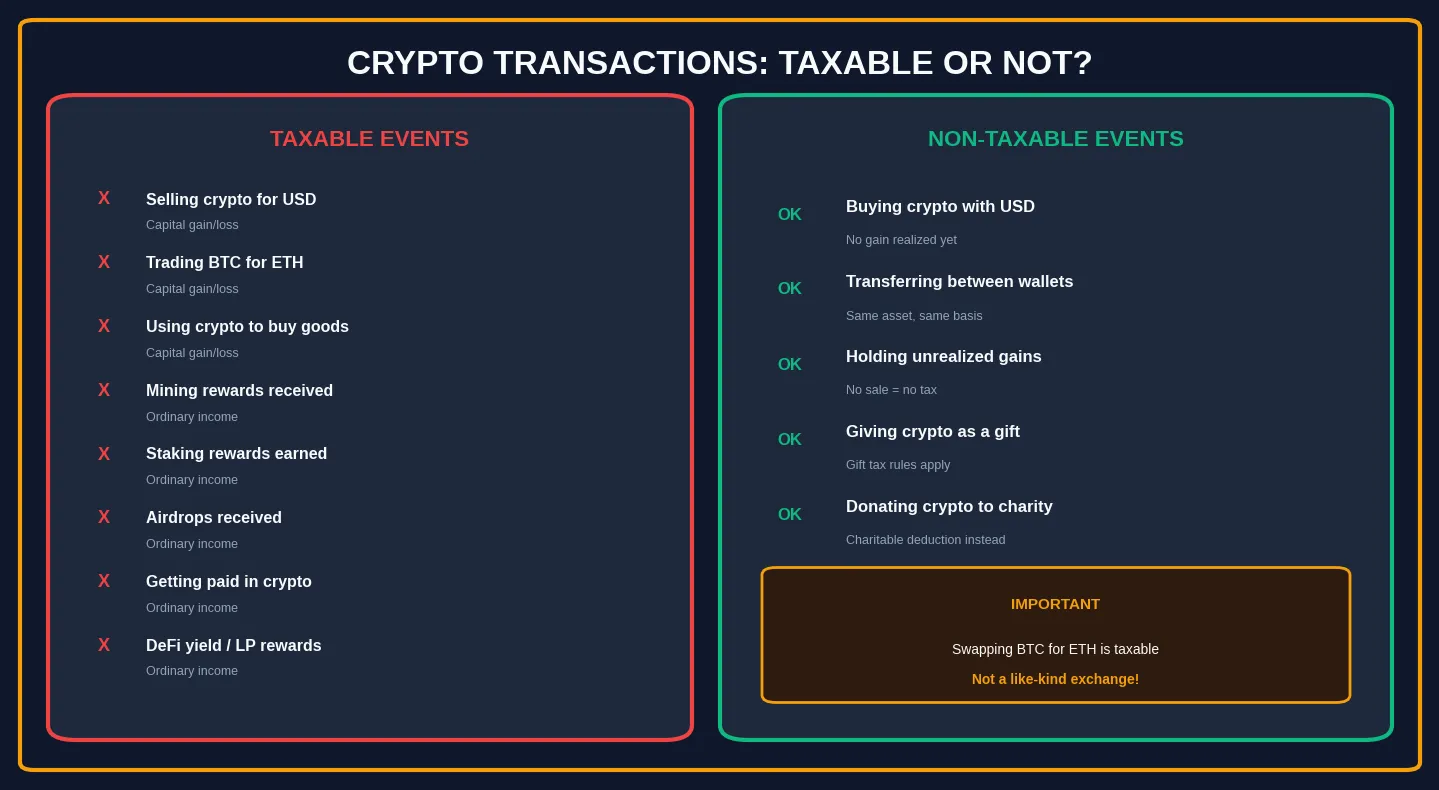
Mining rewards. When you mine cryptocurrency, the fair market value of the coins at the time you receive them counts as ordinary income. Not capital gains — ordinary income. So if you mine 0.1 Bitcoin worth $6,500, you report $6,500 of income. Later, when you sell that Bitcoin, any increase in value from $6,500 gets taxed as a capital gain. Two separate tax events on the same coins.
Staking rewards. Same deal as mining. When you stake Ethereum or any other proof-of-stake coin and earn rewards, those rewards are ordinary income at fair market value on the date you receive them. The IRS ruled on this explicitly in 2023. There was some hope that staking rewards might be treated differently since you are not selling anything when you earn them, but the IRS position is clear: rewards are income when received.
Airdrops and hard forks. If you receive new coins from an airdrop, that is ordinary income at fair market value. Hard forks are trickier — if you receive new coins from a fork and you have dominion and control over them, the IRS says that is income. If the forked coins are not accessible or supported by any exchange, you might have an argument that there is no income yet, but this is a gray area.
DeFi activities. Providing liquidity to a pool, earning yield from lending protocols, receiving governance tokens — all of these generate ordinary income at fair market value when received. And when you withdraw liquidity, you may have capital gains or losses depending on how the value of your LP tokens changed. DeFi tax reporting is a nightmare, honestly. I have clients with thousands of micro-transactions from liquidity pools that are practically impossible to track manually.
Short-Term vs Long-Term: The Rate Difference That Matters
Whether your crypto gains are short-term or long-term capital gains makes an enormous difference in what you owe. If you held the cryptocurrency for one year or less before disposing of it, the gain is short-term and taxed at your ordinary income rate, which can be as high as 37% in 2026. If you held it for more than one year, it is a long-term gain and qualifies for the preferential rates of 0%, 15%, or 20%.
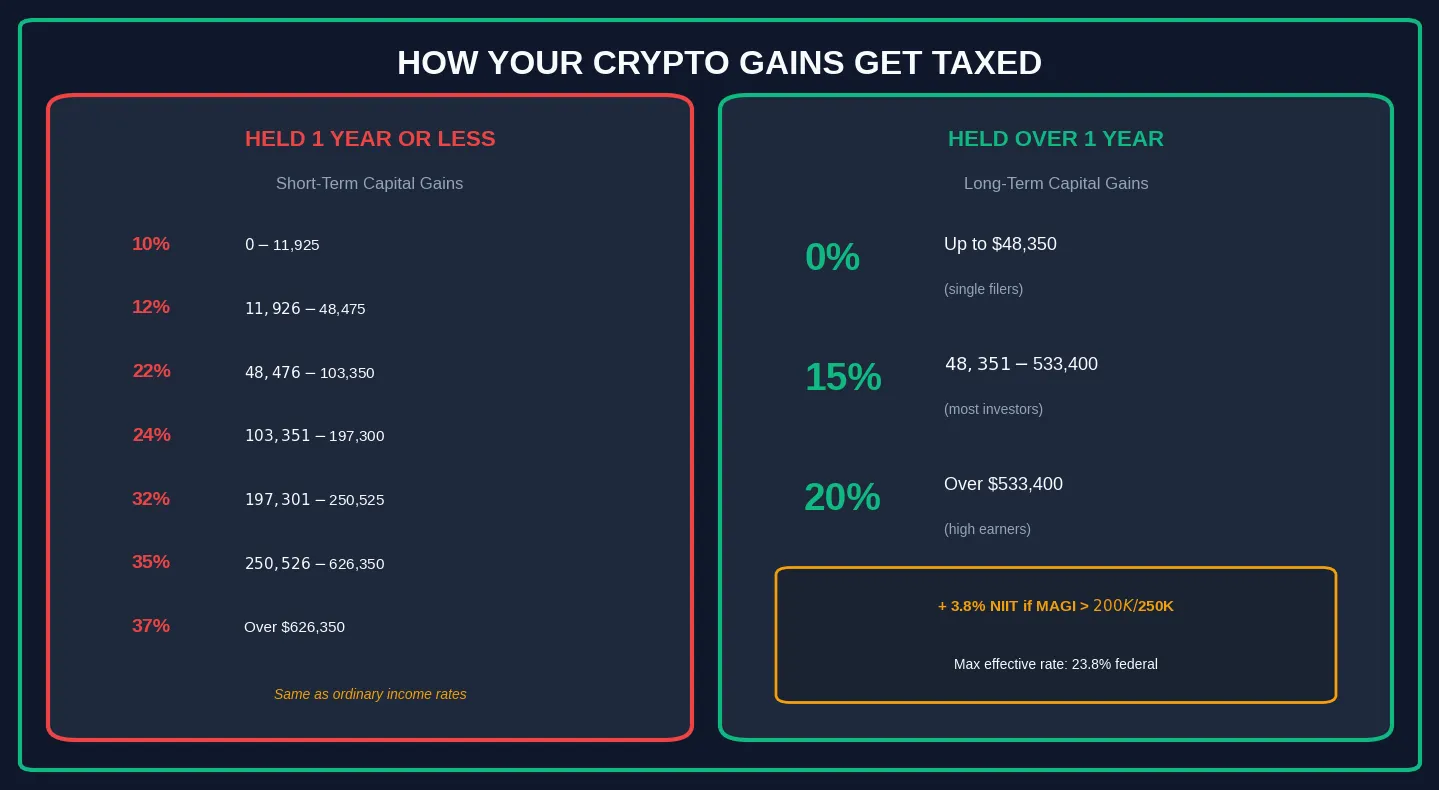
Let me show you how big this gap is with real numbers. Say you bought $20,000 worth of Bitcoin and sold it eleven months later for $50,000. That is a $30,000 short-term gain, and if you are in the 32% bracket, you owe $9,600 in federal tax. But if you wait just one more month — thirteen months total — that same gain becomes long-term. At the 15% rate, you owe $4,500. You save $5,100 by waiting about thirty days. Thirty days. That is a free $5,100 just for being patient.
The 0% long-term rate bracket applies to single filers with taxable income up to about $48,350 and married couples up to about $96,700 in 2026. If your total income including the crypto gain falls within those ranges, your long-term crypto gains are literally tax-free at the federal level. This is a strategy worth planning around, especially if you are considering selling a large position in a year when your income is lower than usual.
Calculating Cost Basis for Crypto
Your cost basis is what you paid for the cryptocurrency plus any fees. Seems straightforward, but with crypto it gets complicated fast because most people buy at different times and different prices. Each purchase is a separate tax lot with its own basis and holding period.
The IRS allows several methods for identifying which shares you sold: specific identification, FIFO (first in, first out), and for some situations, the highest-in-first-out method. Specific identification is almost always the best choice for tax purposes because you can pick which lots to sell to minimize gains or maximize losses, just like with mutual fund cost basis methods. The catch is you need to keep good records and tell your exchange or wallet which lots you are disposing of.
Here is a practical example. You bought Bitcoin in three batches: 0.5 BTC at $28,000, 0.3 BTC at $35,000, and 0.4 BTC at $42,000. Now Bitcoin is at $65,000 and you want to sell 0.3 BTC. Using FIFO, you sell from the first lot and have a gain of ($65,000 - $28,000) times 0.3 = $11,100. Using specific identification, you sell from the last lot and have a gain of ($65,000 - $42,000) times 0.3 = $6,900. Same transaction, $4,200 less in taxable gain. That is real money, and it adds up fast if you are an active trader.
What If You Did Not Track Your Basis?
This is where a lot of people find themselves, and it is not a great place to be. If you cannot document what you paid for your crypto, the IRS assumes your basis is zero. That means your entire sale proceeds are treated as gain. On a $100,000 Bitcoin sale where you actually invested $60,000, you would be paying tax on $100,000 of gain instead of $40,000. At 15% long-term rate, that is an extra $9,000 in tax you should not owe.
Exchange records can help reconstruct your basis, but many people trade across multiple platforms or move coins between wallets, which breaks the paper trail. If you transferred Bitcoin from Coinbase to a hardware wallet and then later sent it to Binance to sell, neither Coinbase nor Binance has the complete picture. You need your own records connecting all those movements.
How to Report Crypto on Your Tax Return
Capital gains from crypto go on Form 8949 and then flow to Schedule D, exactly like stock capital gains. Each sale or trade gets its own line: description, date acquired, date sold, proceeds, basis, and gain or loss. If you have hundreds of transactions, you can attach a statement with the details instead of filling in each line manually, but the totals still need to match on Form 8949 and Schedule D.
Mining and staking income gets reported differently. It goes on Schedule C if you are doing it as a business, or on Schedule 1 as other income if it is more of a hobby. Business treatment lets you deduct expenses like electricity, equipment, and internet, which can significantly reduce your taxable income. But it also means you owe self-employment tax of 15.3% on the net income. Hobby treatment avoids self-employment tax but you cannot deduct expenses beyond your income from the activity.
For the full walkthrough of these forms, our guide on how to report capital gains on your tax return covers every line and box. One thing I want to emphasize: you need to check the box on Form 8949 indicating whether your basis was reported to the IRS. Most crypto exchanges now issue Form 1099-DA (starting in 2025 under the Infrastructure Act reporting requirements), but the basis on those forms may be incomplete if you transferred coins in from another platform. Always verify the 1099 against your own records before filing.
The NIIT Stacking on Top
If your modified adjusted gross income exceeds $200,000 (single) or $250,000 (married filing jointly), the Net Investment Income Tax adds 3.8% on top of your capital gains rate. Crypto gains count as investment income for NIIT purposes. So your effective long-term rate becomes 18.8% or 23.8% instead of 15% or 20%. And your state capital gains tax rate sits on top of that. In California, a high earner with large crypto gains can face a combined federal plus NIIT plus state rate approaching 40%. That is a massive chunk of your profit gone to taxes.
Wash Sale Rules and Crypto
Here is something that catches crypto traders constantly. The wash sale rule disallows a loss if you buy a substantially identical security within 30 days before or after the sale. For stocks, this is pretty clear — selling Apple at a loss and buying Apple back the next day is a wash sale. But for crypto? Until recently, the IRS did not apply wash sale rules to cryptocurrency at all. You could sell Bitcoin at a loss, buy it back five minutes later, and claim the loss deduction. That was one of the few tax advantages crypto had over traditional investments.
The Inflation Reduction Act of 2022 changed this. Starting in 2023, wash sale rules apply to cryptocurrency. If you sell Bitcoin at a loss and buy Bitcoin within 30 days, the loss is disallowed and added to the basis of your new position. Our detailed guide on the wash sale rule explains how the 30-day window works and what substantially identical means. The short version for crypto: selling one coin and buying the same coin back is a wash sale. Selling Bitcoin and buying Ethereum is not — they are different assets. Selling a Bitcoin ETF and buying actual Bitcoin? That might be a wash sale depending on how the IRS interprets substantially identical for ETFs versus direct holdings, and we are still waiting for clear guidance on that one.
Tax-Loss Harvesting With Crypto
Even with wash sale rules now in play, tax-loss harvesting strategies still work with crypto — you just have to be more careful about what you buy back. The key is switching to a different cryptocurrency that is not substantially identical. Sell your losing Ethereum position and buy Solana or Cardano instead. You lock in the loss for tax purposes, you stay invested in the crypto market, and you avoid the wash sale disallowance because you bought a different asset.
Crypto is actually a better candidate for tax-loss harvesting than stocks in one way: the volatility creates more opportunities. In a typical year, Bitcoin might swing 50-70% between its high and low. That means frequent dips where you can harvest losses, especially if you are dollar-cost averaging and have multiple tax lots at different basis levels. I had a client who harvested about $35,000 in crypto losses in a single year by systematically selling losing positions in December and rotating into different coins with similar market exposure. Those losses offset his gains from selling some winning stock positions, and his total tax bill dropped by over $7,000.
Strategies That Actually Reduce Your Crypto Tax Bill
Hold for Over a Year
I know I sound like a broken record, but the rate difference between short-term and long-term is so dramatic that it overshadows every other strategy. Wait the full year. If you are up 200% on a coin and the one-year mark is three weeks away, just wait. The tax savings alone justify the patience.
Harvest Losses Strategically
Go through your portfolio in late November or early December. Identify positions that are underwater. Sell them to lock in the loss, then buy a different cryptocurrency if you want to maintain market exposure. You can deduct up to $3,000 in net capital losses against ordinary income each year, and excess losses carry forward indefinitely.
Offset Gains With Losses Across Asset Classes
Crypto losses can offset stock gains and vice versa. Capital gains and losses are netted together across all your investments, so if you had a great year in the stock market but some crypto losses, those crypto losses directly reduce your stock gain tax bill.
Use Tax-Advantaged Accounts
A growing number of retirement platforms now allow you to buy Bitcoin and other cryptocurrencies in a self-directed IRA. Gains inside an IRA are tax-deferred — no capital gains tax, no reporting, no Form 8949. You still owe income tax when you withdraw in retirement, but you avoid the annual tax drag on trades. Not ideal for everyone, but worth considering if you are a frequent crypto trader.
Track Everything From Day One
Seriously. Use a crypto tax software like CoinTracker, Koinly, or TaxBit. Connect all your exchanges and wallets. Let the software track your basis, your gains, your income from staking and mining. Trying to reconstruct three years of crypto transactions from scratch is a nightmare I would not wish on anyone. The cost of the software is deductible as a tax preparation expense, and it pays for itself many times over in accurate basis tracking alone.
Report Everything, Even If You Did Not Get a 1099
The IRS receives more information about crypto transactions than ever before. The 2021 Infrastructure Act requires exchanges to report transaction data, and the IRS has also used John Doe summons to obtain customer records from major exchanges. If you had taxable crypto transactions and you do not report them, the IRS is increasingly likely to find out. The penalties for underreporting can be 20% of the tax owed for negligence or 40% for fraud. Not reporting is not a strategy. It is a risk.
The Bottom Line
Cryptocurrency taxes are more complex than most investors expect because almost every transaction is taxable, the record-keeping burden is heavy, and the rules keep evolving. The biggest thing you can do for yourself is hold positions for over a year to qualify for long-term rates, track your cost basis from the moment you buy, and harvest losses strategically. Swapping coins is not a tax-free move — it is a disposal event, and the IRS expects you to report it. Mining and staking income is ordinary income at fair market value when you receive it. NIIT and state taxes can push your combined rate past 40% if you are a high earner. And wash sale rules now apply to crypto, so you cannot sell and immediately rebuy the same coin to claim a loss. Plan your trades, keep your records, and file accurately. The IRS is watching this space more closely than ever.
Fact-Checked & Reviewed
This article was written by James Park (EA, CFP (Certified Financial Planner)) and reviewed for accuracy by David Chen (JD, LLM in Taxation (New York University)). Published by Wasim Akram, Founder & Lead Researcher at TaxGainsCalc. All tax rates, thresholds, and rules referenced are based on IRS publications and current tax law as of the date published. Tax laws change frequently — always consult a qualified tax professional for advice specific to your situation.
Enrolled Agent & Tax Researcher
James Park is an Enrolled Agent licensed by the IRS and a Certified Financial Planner with over 12 years of experience in tax research and financial planning. He specializes in capital gains strategies for real estate investors and cryptocurrency tra...
Tax Attorney & Legal Editor
David Chen is a tax attorney with a Juris Doctor and a Master of Laws in Taxation from New York University School of Law. With over 10 years of legal practice, he specializes in 1031 exchanges, capital gains tax law, and IRS dispute resolution. David...

Founder & Lead Researcher, TaxGainsCalc
Wasim Akram is an independent web publisher and digital entrepreneur based in India. Since 2018, he has been building custom CMS platforms, WordPress plugins, niche websites, and AI-powered digital products with over 8 years of real-world experience....
Disclaimer: This article is for informational purposes only and does not constitute tax, legal, or financial advice. Tax laws and regulations change frequently, and the information presented here may not reflect the most current updates. You should consult with a qualified CPA, tax attorney, or financial advisor before making any tax-related decisions. TaxGainsCalc is not responsible for any actions taken based on the information provided in this article.