State Capital Gains Tax Rates 2026: Every State Compared, Ranked & Explained
Complete 50-state comparison of capital gains tax rates for 2026. See which states charge zero tax, which hit you hardest, and how combined federal plus state rates can push past 33%. Includes strategies for reducing your state tax burden.
Why Your State Can Cost You More Than the IRS
Last week, a client named Marcus called me in a panic. He had just sold stock options from his tech company and walked away with a $340,000 gain. He figured the federal tax would be around $51,000 at the 15% rate. What he did not figure was that California was going to take another $34,000. That is right — his state tax bill was almost as painful as the federal one.
Here is the thing most people do not realize. The federal government takes its cut of your capital gains, and then your state takes its cut on top. In some states, that means your combined rate can push past 33%. In others, you pay zero at the state level. The difference between selling investments in California versus selling them in Florida can literally be tens of thousands of dollars on the same transaction.
This guide breaks down every single state — all 50 — so you know exactly what you owe. No guessing. No surprises when you file. Just the real numbers, explained in plain English.
How State Capital Gains Tax Actually Works
Your total tax on a capital gain is not just the federal rate. It is a stack of taxes that pile on top of each other. Let me show you the layers:
- 1Federal capital gains tax: 0%, 15%, or 20% for long-term gains, depending on your taxable income. Your long-term capital gains rate depends on which bracket you fall into.
- 1Net Investment Income Tax: An extra 3.8% hits you if your modified adjusted gross income goes above $200,000 (single) or $250,000 (married). This is the Net Investment Income Tax and it applies on top of your regular capital gains rate.
- 1State income tax: Most states tax capital gains as ordinary income. A few states have special rates or no income tax at all. Your state capital gains tax rate can vary wildly depending on where you live.
- 1Local taxes: Some cities and counties add their own income tax on top of the state rate. New York City residents, for example, pay an additional 3.876% city tax.
All of these stack. They do not replace each other. If you are in the 15% federal bracket, paying the NIIT, and live in a high-tax state, your combined rate can easily exceed 30%.
States With Zero Capital Gains Tax
Nine states have no personal income tax at all. That means no state-level capital gains tax. If you live in one of these, you only owe federal tax and NIIT if it applies:
| State | State Income Tax | Notes |
|---|---|---|
| Alaska | 0% | No state income tax, no tax on capital gains |
| Florida | 0% | Popular retirement destination for tax reasons |
| Nevada | 0% | No state income tax |
| New Hampshire | 0% | Taxes dividends and interest only, not capital gains |
| South Dakota | 0% | No state income tax |
| Tennessee | 0% | Taxes dividends and interest only, not capital gains |
| Texas | 0% | No state income tax, popular for business relocation |
| Washington | 0%* | See note below on WA capital gains tax |
| Wyoming | 0% | No state income tax |
Important note on Washington state: Starting in 2022, Washington introduced a 7% capital gains tax on long-term gains above $270,000. This only applies to long-term capital gains, not short-term. It is also being challenged in court, so check the current status before filing.
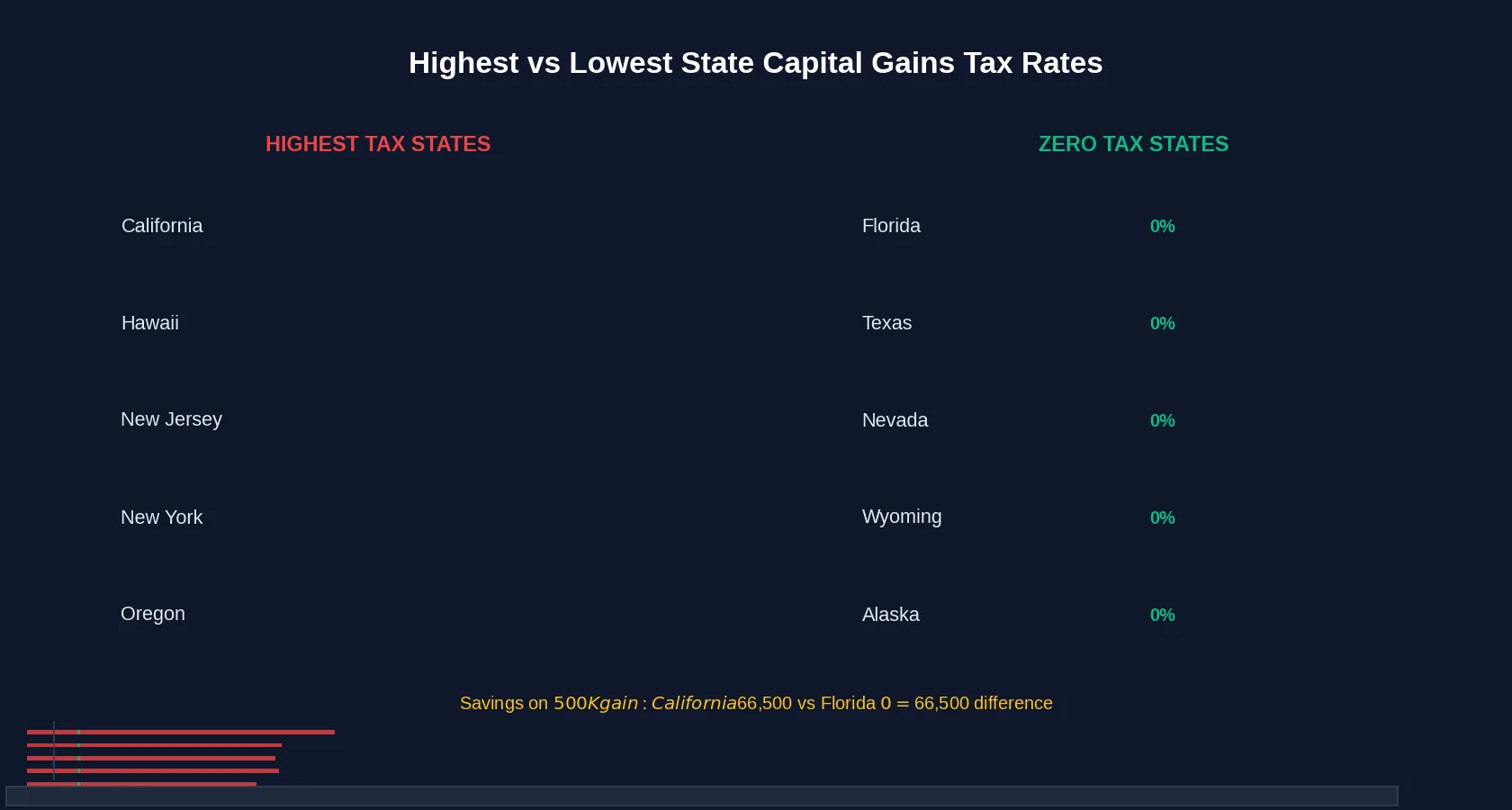
If you are considering a move, these states offer significant savings on large capital gains. A $500,000 gain that would cost $49,500 in California costs $0 at the state level in Florida. That is not a trivial difference.
The Highest-Tax States for Capital Gains
Now let me show you where it hurts the most. These states tax capital gains at the highest rates in the country:
| State | Top Marginal Rate | Approximate Tax on $500K Gain |
|---|---|---|
| California | 13.3% | ~$49,500 |
| Hawaii | 11% | ~$41,000 |
| New Jersey | 10.75% | ~$38,500 |
| District of Columbia | 10.75% | ~$38,500 |
| Oregon | 9.9% | ~$36,500 |
| Minnesota | 9.85% | ~$36,000 |
| New York | 10.9% (incl. NYC) | ~$40,500 |
| Vermont | 8.75% | ~$31,500 |
| Iowa | 8.53% | ~$30,500 |
| Wisconsin | 7.65% | ~$28,000 |
California is in a league of its own. At 13.3%, the top marginal rate is nearly three times what some other states charge. And since California does not give any special treatment to capital gains — they are taxed exactly like ordinary income — a large gain can push you right into the top bracket.
New York City double whammy: If you live in New York City, you pay both the state income tax (up to 10.9% top rate including the millionaire's tax surcharge) and the city income tax (3.876%). On a $1,000,000 capital gain, that is roughly $147,600 in state and city tax alone. Add federal and NIIT and your combined rate can top 37%.
States With Special Capital Gains Treatment
Most states simply tax capital gains at the same rate as ordinary income. But a handful offer reduced rates or partial exclusions for long-term gains:
Arkansas provides a partial exclusion of capital gains. As of 2026, you can exclude a portion of long-term capital gains from state income tax, effectively reducing the state rate on those gains.
Colorado previously had a special capital gains subtraction for gains from Colorado assets held for certain periods, though rules have changed over the years. Check current law before filing.
Delaware allows a deduction for a portion of long-term capital gains, effectively lowering the state rate below the top ordinary income rate.
Montana offers a credit for taxes paid on capital gains, which effectively reduces the rate below the standard ordinary income rate.
New Mexico has provided a capital gains deduction in some tax years, allowing taxpayers to exclude a portion of long-term gains from state taxable income.
These special treatments can save you meaningful money. If you live in one of these states and have significant gains, make sure your tax preparer knows about the special provisions — I have seen plenty of returns where the accountant missed the state-level exclusion and the taxpayer overpaid by thousands.
The Full 50-State Capital Gains Tax Rate Table
Here is every state, its top marginal income tax rate (which applies to capital gains unless noted), and whether it offers any special treatment:
| State | Top Rate | Special Treatment |
|---|---|---|
| Alabama | 5% | None |
| Alaska | 0% | No income tax |
| Arizona | 2.5% | Flat rate, no special treatment |
| Arkansas | 4.4% | Partial exclusion for long-term gains |
| California | 13.3% | None — highest in the US |
| Colorado | 4.4% | Previously had special subtraction |
| Connecticut | 6.99% | None |
| Delaware | 6.6% | Partial deduction for long-term gains |
| Florida | 0% | No income tax |
| Georgia | 5.49% | None |
| Hawaii | 11% | None |
| Idaho | 5.8% | None |
| Illinois | 4.95% | Flat rate |
| Indiana | 3.05% | Flat rate |
| Iowa | 8.53% | None |
| Kansas | 5.7% | None |
| Kentucky | 4% | Flat rate |
| Louisiana | 4.75% | None |
| Maine | 7.15% | None |
| Maryland | 5.75% | County taxes add 1.75% to 3.2% |
| Massachusetts | 5% | None |
| Michigan | 4.25% | Flat rate |
| Minnesota | 9.85% | None |
| Mississippi | 4.7% | None |
| Missouri | 4.8% | None |
| Montana | 5.9% | Credit reduces effective rate |
| Nebraska | 6.64% | None |
| Nevada | 0% | No income tax |
| New Hampshire | 0% | No tax on capital gains |
| New Jersey | 10.75% | None |
| New Mexico | 5.9% | Possible deduction for long-term gains |
| New York | 10.9% | Millionaire's tax surcharge applies |
| North Carolina | 4.5% | Flat rate |
| North Dakota | 2.5% | Lowest rate among taxing states |
| Ohio | 3.5% | Plus local school district taxes |
| Oklahoma | 4.75% | None |
| Oregon | 9.9% | None |
| Pennsylvania | 3.07% | Flat rate |
| Rhode Island | 5.99% | None |
| South Carolina | 6.4% | None |
| South Dakota | 0% | No income tax |
| Tennessee | 0% | No tax on capital gains |
| Texas | 0% | No income tax |
| Utah | 4.65% | Flat rate |
| Vermont | 8.75% | None |
| Virginia | 5.75% | None |
| Washington | 7% | Only on long-term gains above $270K |
| West Virginia | 5.12% | None |
| Wisconsin | 7.65% | None |
| Wyoming | 0% | No income tax |
Use our state-by-state capital gains calculator to see the exact numbers for your specific situation and gain amount.
How Moving States Can Save You a Fortune
This is one of the most powerful — and most misunderstood — tax strategies out there. If you are sitting on a large unrealized gain, moving to a no-tax state before you sell can save you an enormous amount of money. But the IRS and state tax authorities are not stupid. They know people try this, and they have rules to prevent it.
What Actually Works
The key is establishing genuine residency in the new state before you sell. Here is what that looks like in practice:
- 1Move for real. Not a paper move. You need to actually live in the new state. Get a driver's license there. Register to vote. Open bank accounts with the new address. Move your furniture, your pets, your whole life.
- 1Spend time there. Most states use a 183-day test. If you spend more than half the year in the new state, you have a strong case for residency.
- 1Cut ties with the old state. Sell or rent out your old home. Cancel memberships. Close local accounts. The fewer connections you maintain, the harder it is for the old state to claim you are still a resident.
- 1File as a resident of the new state. Your tax return should reflect your new domicile.
What Does NOT Work
You cannot just rent a mailbox in Florida, sell your California stocks, and call yourself a Florida resident. High-tax states like California and New York are notoriously aggressive about auditing former residents. They will look at your phone records, credit card transactions, EZ Pass data, where your doctors and dentists are, where your children go to school, and where you keep valuable personal property.
California even has a special form — Schedule CA — that asks about your residency status. If they determine you never truly left, they will send you a bill for the full state tax, plus interest and penalties.
How State Taxes Hit Different Types of Gains
Not all capital gains are created equal, and your state might treat them differently depending on the source:
Stock and Investment Gains
Most states treat stock capital gains exactly the same as ordinary income. You sell shares, you pay the state's regular income tax rate on the profit. No special treatment, no reduced rate. This is true in California, New York, New Jersey, and most other high-tax states.
Real Estate Gains
Selling property triggers state tax on the gain, but there are nuances. If you sell your primary residence, the federal Section 121 exclusion ($250K/$500K) usually reduces your state taxable gain too — most states conform to this federal provision. For investment property, your real estate capital gains are taxed at the state level, and depreciation recapture may apply.
If you are looking at a large gain on investment property, a 1031 like-kind exchange lets you defer both federal and state tax by reinvesting into another property. This works in most states, though a few like California require additional withholding on the sale proceeds.
Crypto Gains
Yes, cryptocurrency capital gains are taxable at the state level just like stock gains. If you sold Bitcoin at a profit, your state wants its cut. Most states have not issued specific crypto guidance, so the default is to treat crypto like any other capital asset.
The Combined Tax Rate Reality Check
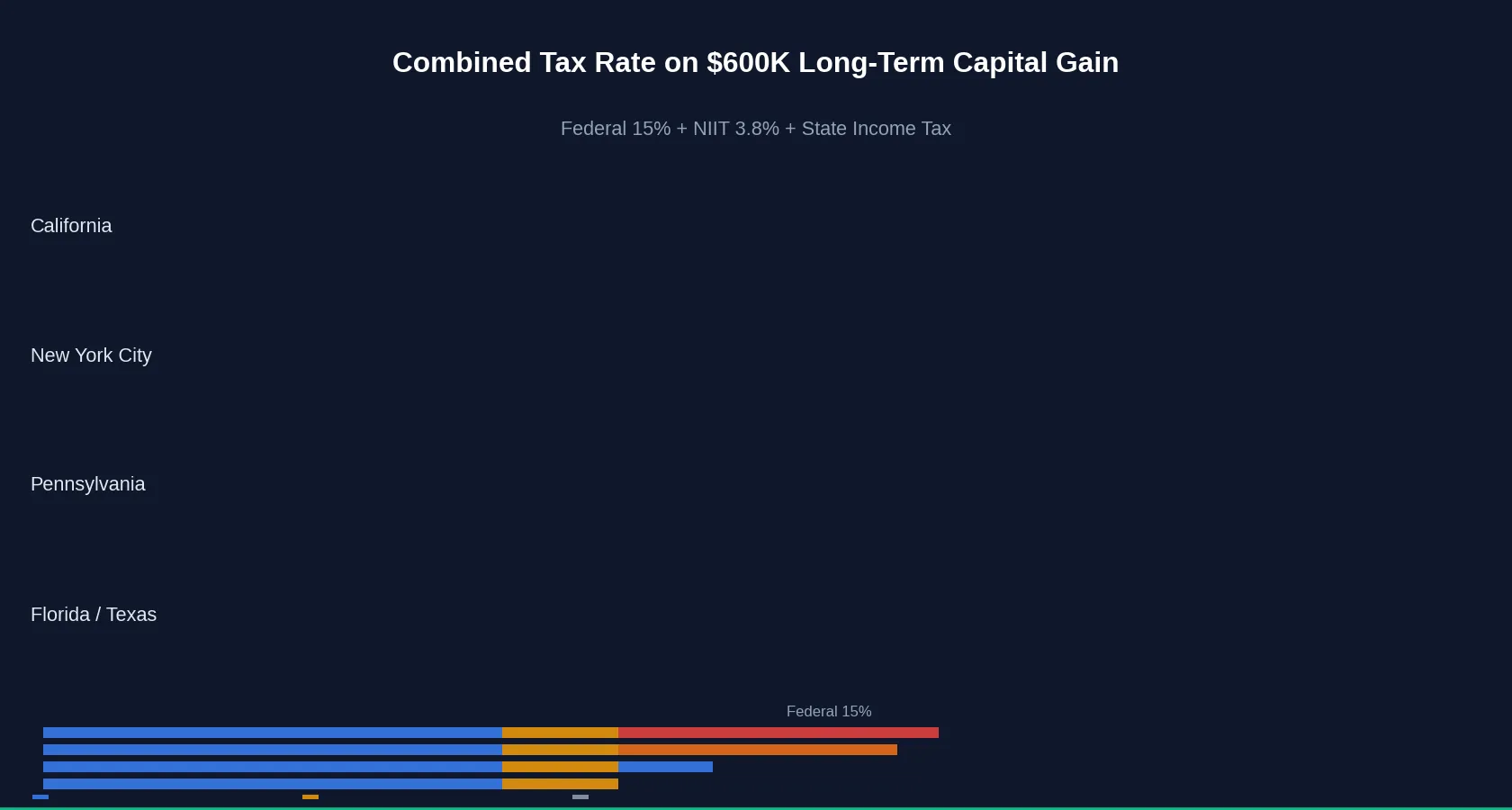
Let me put this all together with a real example. Say you are married filing jointly with $600,000 in long-term capital gains and $50,000 in ordinary income. Here is what your combined tax looks like in different states:
| Location | Federal (15%) | NIIT (3.8%) | State Tax | Combined Rate | Total Tax |
|---|---|---|---|---|---|
| California | $90,000 | $22,800 | $62,700 | ~29.3% | $175,500 |
| New York City | $90,000 | $22,800 | $54,600 | ~27.9% | $167,400 |
| Pennsylvania | $90,000 | $22,800 | $18,420 | ~21.9% | $131,220 |
| Texas | $90,000 | $22,800 | $0 | ~18.8% | $112,800 |
| Florida | $90,000 | $22,800 | $0 | ~18.8% | $112,800 |
The difference between California and Florida on the exact same $600,000 gain is $62,700. That is not a rounding error. That is a down payment on a house.
Reporting State Capital Gains on Your Return
If you have capital gains and live in a state with income tax, you report them on your state return. Most states start with your federal adjusted gross income and then make modifications from there. The process looks like this:
- 1Start with federal AGI — Your state return usually begins with the AGI from your federal Form 1040. This already includes your capital gains.
- 1Add state-specific adjustments — Some states allow deductions that the feds do not, or require additions for items excluded federally.
- 1Calculate state tax — Apply your state's tax rates to the modified income.
If you moved during the year, you may need to file part-year returns in both states. Each state will tax the income you earned while you were a resident there. For detailed help with the federal side, our guide on reporting capital gains on your tax return walks through every form and schedule.
Tax-Loss Harvesting at the State Level
Here is something most people miss. Tax-loss harvesting strategies work at the federal level, but they also reduce your state taxable income in most states. If you harvest $30,000 in losses, that offsets $30,000 in gains for both federal and state purposes.
But there is a catch. The $3,000 annual deduction cap on net capital losses applies at the federal level. Some states conform to this limit, while others allow larger deductions. And the wash sale rule — which disallows a loss if you buy the same or substantially identical security within 30 days — applies at the federal level and most states follow it, but not all.
Do Not Forget About Your Home Sale
If you are selling your primary residence, most states conform to the federal Section 121 exclusion, meaning up to $250,000 of gain ($500,000 married) is excluded from state tax too. But if your gain exceeds those thresholds, the excess is taxed at your state's ordinary income rate. Our guide on capital gains tax when selling your home explains the federal exclusion rules in detail.
For investment properties, the situation is different. There is no Section 121 exclusion for investment real estate, and your capital gains on investment property are fully taxable at the state level. State rates on real estate gains follow the same rates as other income in that state.
The Bottom Line
State capital gains taxes are the silent budget killer. Most people focus on the federal rate and forget that their state takes another bite — sometimes a very large one. The spread between California at 13.3% and Florida at 0% can mean the difference between paying $66,500 and paying nothing in state tax on a $500,000 gain. Know your state's rate. Understand how it stacks with federal and NIIT. And if you are sitting on a large unrealized gain, think carefully about whether a move to a lower-tax state makes sense — just make sure you do it right, because high-tax states are watching. Use our state capital gains tax calculator to run the exact numbers for your situation, and check out more capital gains tax guides and tips to stay ahead of every rule change.
Fact-Checked & Reviewed
This article was written by James Park (EA, CFP (Certified Financial Planner)) and reviewed for accuracy by Sarah Mitchell (CPA, MST (Master of Science in Taxation)). Published by Wasim Akram, Founder & Lead Researcher at TaxGainsCalc. All tax rates, thresholds, and rules referenced are based on IRS publications and current tax law as of the date published. Tax laws change frequently — always consult a qualified tax professional for advice specific to your situation.
Enrolled Agent & Tax Researcher
James Park is an Enrolled Agent licensed by the IRS and a Certified Financial Planner with over 12 years of experience in tax research and financial planning. He specializes in capital gains strategies for real estate investors and cryptocurrency tra...
Certified Public Accountant (CPA)
Sarah Mitchell is a Certified Public Accountant with over 15 years of experience in individual and business taxation. She holds a Master of Science in Taxation from Golden Gate University and specializes in capital gains tax planning, investment tax ...

Founder & Lead Researcher, TaxGainsCalc
Wasim Akram is an independent web publisher and digital entrepreneur based in India. Since 2018, he has been building custom CMS platforms, WordPress plugins, niche websites, and AI-powered digital products with over 8 years of real-world experience....
Disclaimer: This article is for informational purposes only and does not constitute tax, legal, or financial advice. Tax laws and regulations change frequently, and the information presented here may not reflect the most current updates. You should consult with a qualified CPA, tax attorney, or financial advisor before making any tax-related decisions. TaxGainsCalc is not responsible for any actions taken based on the information provided in this article.