Capital Gains Tax on Gold and Precious Metals: What You Owe and How to Save
Complete guide to capital gains tax on gold, silver, platinum, and palladium. Learn why physical gold gets taxed at 28%, how ETFs are taxed differently, reporting forms, and smart strategies to cut your tax bill.
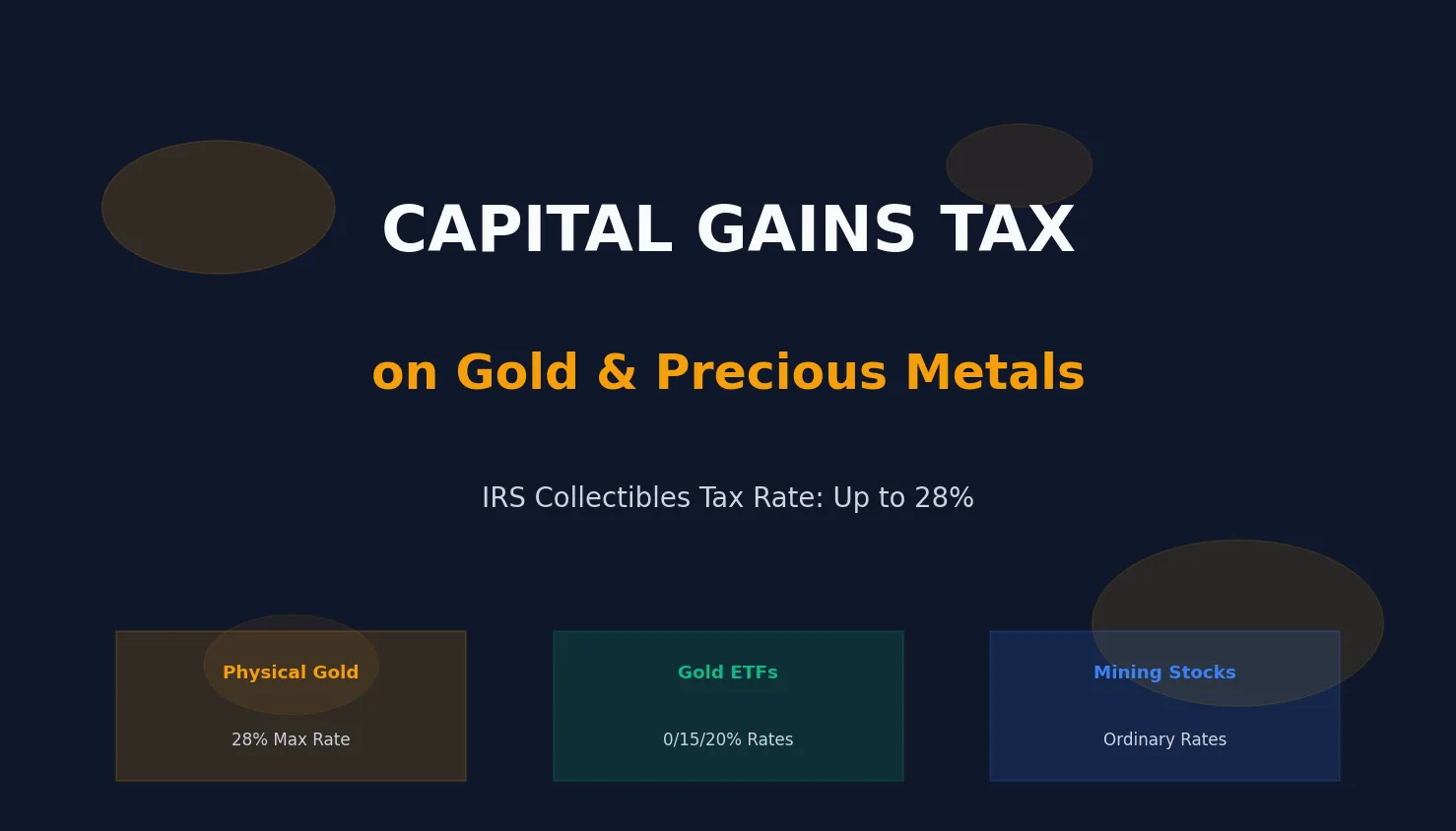
Gold Prices Are Surging — But Do You Know the Tax Bill Waiting for You?
Gold has been on an absolute tear lately. Prices keep climbing to new highs, and investors who bought gold years ago are sitting on some serious gains. But here is the thing most people miss: when you sell that gold, the IRS does not treat it like a regular stock. Not even close.
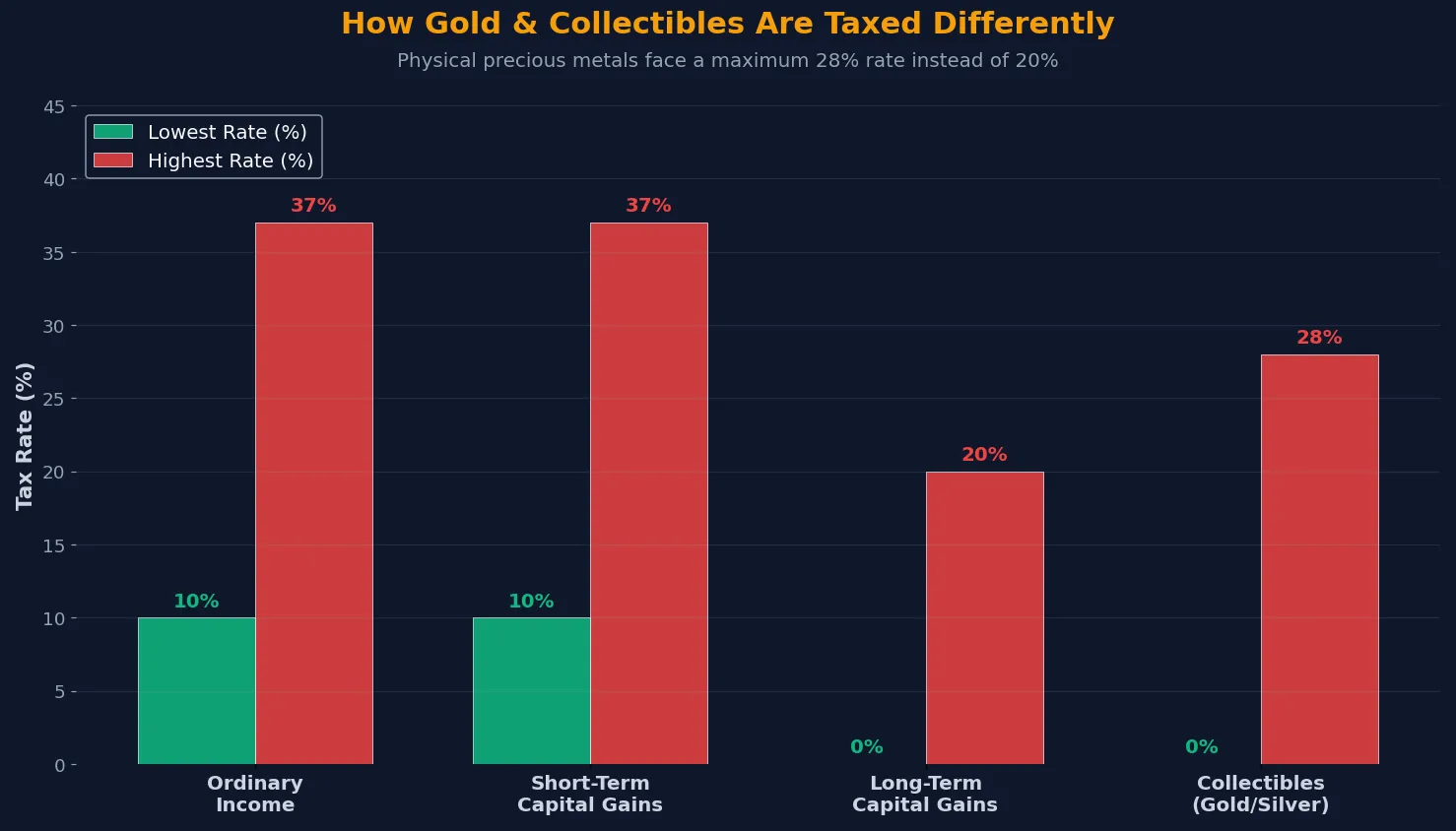
Physical gold — coins, bars, bullion — falls under a special IRS category called "collectibles." And collectibles get hit with a maximum tax rate of 28% on long-term gains. That is a full eight percentage points higher than the 20% top rate that applies to long-term capital gains on stocks. If you are sitting on a big gold profit, that difference alone could cost you thousands.
I learned this the hard way years ago. A client of mine had bought gold bars back in 2008 when prices were around $800 an ounce. When he sold in 2020 at over $1,900, he figured he would owe the standard 15% or 20% capital gains rate. Nope. Because physical gold is a collectible, his long-term gains were subject to that special 28% rate. The look on his face when I told him was something I will never forget.
This guide covers everything you need to know about taxes on gold, silver, platinum, and palladium. I will explain the different rates, the different forms of investing, and the strategies that can legally reduce what you owe.
Why the IRS Calls Gold a "Collectible"
This is the single most important thing to understand about gold taxes. The IRS classifies physical precious metals as collectibles under Section 408(m) of the Internal Revenue Code. This category also includes art, antiques, stamps, and rare coins.
What makes collectibles different? The maximum long-term capital gains rate on collectibles is 28%, not the usual 20%. That is the law. It has been the law since 1986 when the Tax Reform Act set the collectibles rate, and it has not changed since.
Now, before you panic, let me clarify something important. The 28% rate is a ceiling, not a floor. If your ordinary income tax bracket is lower than 28%, you pay your regular bracket rate on collectible gains instead. So if you are in the 12% or 22% bracket, your long-term gold gains get taxed at that lower rate, not at 28%. The 28% rate only kicks in for taxpayers in the 28% bracket or higher.
Our guide to capital gains tax on collectibles goes even deeper into which assets qualify as collectibles and how the rates work, if you want more detail on the broader category.
Short-Term vs Long-Term: The Holding Period Still Matters
Just like with stocks and other investments, the holding period determines whether your gold gains are short-term or long-term. This distinction is just as critical for precious metals as it is for any other asset.
If you hold gold for one year or less before selling, your gain is short-term. Short-term gains on collectibles are taxed at your ordinary income rate, which can be as high as 37%. That is the same as short-term capital gains on any other asset.
If you hold gold for more than one year, your gain is long-term. Long-term gains on physical gold and other collectibles get the special collectible rate, capped at 28% but potentially as low as your regular bracket rate.
The lesson here is simple: if you are close to the one-year mark, wait. The difference between a 37% short-term rate and a 15% or 20% long-term collectible rate is enormous. Our comparison of short-term versus long-term capital gains breaks down the math with real examples that show just how much holding longer can save you.
Physical Gold: Coins, Bars, and Bullion
Let me start with the most common way people invest in gold — buying the physical metal. This includes gold coins like American Gold Eagles and Canadian Gold Maple Leafs, gold bars from various refineries, and gold bullion in any form.
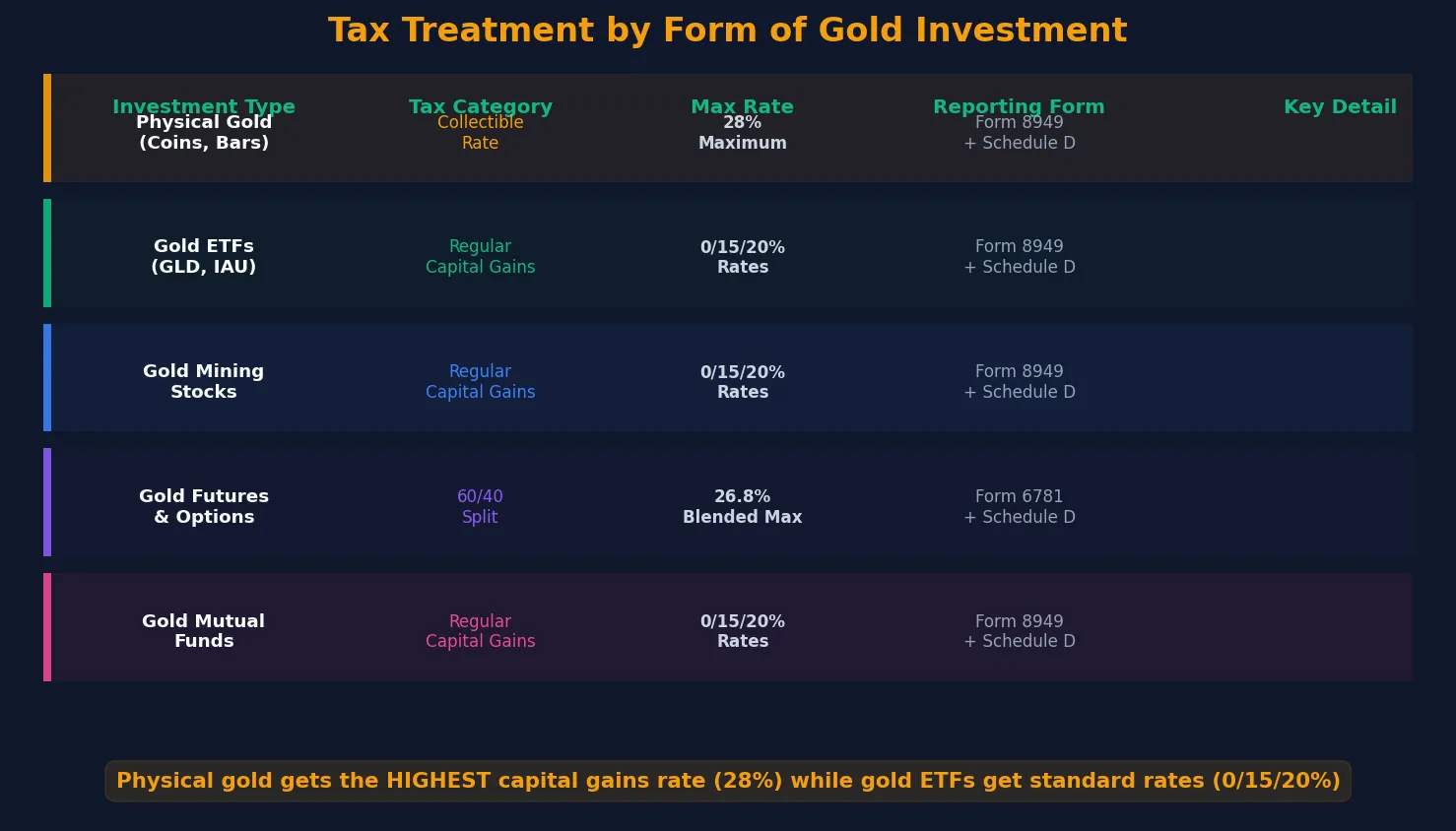
When you sell physical gold at a profit, the gain is always taxed as a collectible gain, regardless of the form. It does not matter whether you bought coins, bars, or rounds. If it is physical metal, it is a collectible.
Your cost basis is what you paid for the gold, including any dealer markup or premium over spot price. If you inherited the gold, your basis is generally the fair market value on the date of the previous owner's death, which is a stepped-up basis. This can be a huge benefit because it wipes out all the unrealized gains that accumulated during the previous owner's lifetime.
Keep your receipts. I cannot stress this enough. The IRS requires you to report the cost basis for each sale, and if you cannot prove what you paid, the IRS may assume your basis is zero. That means the entire sale price becomes taxable gain. I have seen this happen, and it is not pretty.
Selling physical gold also means you need to report it on Form 8949 and Schedule D, just like stock sales. We will cover the reporting details later in this guide.
Silver, Platinum, and Palladium: Same Rules Apply
The collectibles tax treatment is not limited to gold. Silver, platinum, and palladium are all treated exactly the same way by the IRS when they are in physical form.
Silver coins like American Silver Eagles, platinum bars, and palladium rounds all fall under the collectibles category. The 28% maximum long-term rate applies to all of them.
This catches silver investors off guard frequently. Silver is often called "the poor man's gold," and many middle-income investors buy silver coins without realizing they will face the collectible tax rate when they sell. If you are in the 32% or 35% ordinary income bracket, the 28% collectible rate is still better than your short-term rate, but it is worse than the 20% rate you would get on a stock held for the same period.
One thing to note: numismatic coins, which are coins valued primarily for their rarity and collector appeal rather than their metal content, are also collectibles. But their tax treatment gets complicated because part of the gain may be attributable to the metal content and part to the collectible value. In practice, the entire gain is treated as a collectible gain.
Gold ETFs: A Completely Different Tax Story
Here is where things get interesting. Gold ETFs like SPDR Gold Shares (GLD) and iShares Gold Trust (IAU) are not taxed as collectibles. They are taxed as regular investments, with the standard 0%, 15%, or 20% long-term capital gains rates.
Why the difference? Because when you buy a gold ETF, you are buying shares of a trust that holds gold. You do not own physical gold directly. The IRS treats your ETF shares as securities, not as collectibles, even though the underlying asset is gold.
This creates a genuine tax advantage for ETF investors over physical gold investors. If you are in the top bracket and hold both for more than a year, your physical gold gains get taxed at up to 28% while your ETF gains top out at 20%. On a $50,000 gain, that is a $4,000 difference. That is real money.
However, there is a catch with gold ETFs. If the fund sells gold and distributes capital gains to shareholders, you owe tax on those distributions in the year they are made, even if you did not sell any shares. In practice, most gold ETFs have been good about minimizing distributions, but it is something to watch.
The tax treatment of gold ETFs is similar to what we cover in our guide to capital gains tax on mutual funds and ETFs, where we explain how fund-level distributions work and why they matter.
Gold Mining Stocks: Taxed Like Any Other Stock
Gold mining stocks like Newmont, Barrick Gold, and Franco-Nevada are just regular stocks. They are not collectibles, and they do not get the special 28% rate.
When you sell mining stocks at a profit, the gains are taxed at the standard long-term capital gains rates of 0%, 15%, or 20%, depending on your taxable income. Short-term gains are taxed at ordinary income rates, same as any other short-term stock sale.
Dividends from mining companies are also taxed as qualified dividends if you meet the holding period requirement, which means they get the preferential 0%, 15%, or 20% rate rather than ordinary income rates. Our guide to capital gains tax on dividends explains the qualified dividend rules in detail.
Mining stocks also carry company-specific risk, which is very different from the risk of holding physical gold. A mining company can have management problems, operational issues, or debt troubles that have nothing to do with the price of gold. So while the tax treatment is better, the investment risk profile is different.
Gold Futures and Options: The 60/40 Split
Gold futures and options have their own unique tax treatment that is actually quite favorable compared to other forms of gold investing. Under Section 1256 of the tax code, regulated futures contracts are subject to the 60/40 rule.
Here is how it works: 60% of your gain is treated as a long-term capital gain, and 40% is treated as a short-term capital gain, regardless of how long you actually held the contract. Even if you bought and sold a futures contract on the same day, the 60/40 split applies.
This blended rate works out to a maximum of about 26.8% (60% times 20% plus 40% times 37%), which is lower than the 28% collectible rate on physical gold and lower than the 37% ordinary rate on short-term stock gains.
Gold futures are reported on Form 6781, not Form 8949. The 60/40 split is calculated automatically on this form, and the resulting long-term portion flows to Schedule D while the short-term portion also goes to Schedule D in the appropriate section.
The catch is that futures trading requires a specialized account, significant margin, and a much higher risk tolerance. This is not suitable for most casual gold investors, but for active traders, the tax treatment is genuinely advantageous.
How to Report Gold and Precious Metals on Your Tax Return
Reporting gold sales on your tax return follows the same basic framework as reporting stock sales, with a few key differences depending on the form of your investment.
Physical gold and coins go on Form 8949, with the proceeds, cost basis, and holding period for each sale. Check Box C if your brokerage did not report the basis to the IRS, which is common for coin dealers. The long-term portion flows to Schedule D. Remember, even though the rate is different, the forms are the same.
Gold ETFs are reported exactly like stock sales on Form 8949. Your brokerage will send you a 1099-B with the proceeds and basis. The long-term gains qualify for the standard 0/15/20% rates.
Gold futures go on Form 6781, which applies the 60/40 split automatically. The resulting amounts flow to Schedule D.
Gold mining stocks are reported on Form 8949, just like any other stock. Your 1099-B from your brokerage covers the proceeds and basis.
If you want a complete walkthrough of every form and every line, our step-by-step guide to reporting capital gains on your tax return covers it all with screenshots and examples.
The Net Investment Income Tax Hits Gold Too
Do not forget about the 3.8% net investment income tax. If your modified adjusted gross income exceeds $200,000 (single) or $250,000 (married filing jointly), you owe this additional surtax on your investment income, including capital gains from gold.
This means your effective maximum rate on physical gold gains could be 28% plus 3.8%, totaling 31.8%. On gold ETF gains, it could be 20% plus 3.8%, totaling 23.8%. That is a significant extra burden that many investors forget to plan for.
Our complete guide to the net investment income tax explains the thresholds, calculations, and strategies for minimizing this surtax. If you are anywhere near the income threshold, it is worth reading carefully.
State Taxes on Gold: Another Layer to Consider
On top of federal taxes, most states also tax capital gains, including gains from precious metals. Some states have no income tax at all, like Florida, Texas, Nevada, and Washington. Others, like California and New York, tax capital gains at the same rate as ordinary income, which can add another 9% to 13% on top of the federal rate.
A few states offer special treatment for gold. For example, some states exempt the sale of precious metals from sales tax, but that is different from income tax on the gains. Always check your specific state rules.
Our state capital gains tax rates guide provides a complete breakdown of every state's rates and rules, so you can see exactly what you owe where you live.
5 Smart Strategies to Reduce Your Gold Tax Bill
1. Hold Physical Gold for Over One Year
This is the most basic and most important strategy. If you sell physical gold within one year of buying it, your gain is short-term and taxed at ordinary income rates up to 37%. Wait just one day past the one-year mark, and your maximum rate drops to 28%. On a $100,000 gain, that could save you $9,000 or more.
2. Consider Gold ETFs Instead of Physical Gold
As we discussed earlier, gold ETFs are taxed at the standard 0/15/20% long-term rates instead of the collectible rate. For investors in higher tax brackets, this can save 8 percentage points on the maximum rate. If you do not need to hold physical gold specifically, ETFs offer a genuine tax advantage.
3. Use Tax-Loss Harvesting
If you have gold investments that have lost value, you can sell them to realize the loss and use it to offset gains from other investments. This works the same way as tax-loss harvesting with stocks. You can offset up to $3,000 of ordinary income per year with net capital losses, and any excess carries forward indefinitely.
Be careful about the wash sale rule, though. If you buy substantially identical gold within 30 days before or after the sale, the IRS disallows the loss. Our wash sale rule guide explains how this works and how to avoid triggering it.
4. Gift Appreciated Gold to Charity
If you have physical gold that has appreciated significantly, consider donating it directly to a qualified charity instead of selling it and donating the cash. You get a deduction for the full fair market value, and you avoid paying capital gains tax on the appreciation entirely.
This strategy works best with gold that you have held for more than one year, because donations of collectibles held one year or less are limited to your cost basis for the deduction amount. The charity pays no tax when it sells the gold, so both you and the charity come out ahead.
5. Use a Gold IRA for Tax-Deferred Growth
A Gold IRA allows you to hold physical gold in a tax-advantaged retirement account. Contributions may be tax-deductible (traditional IRA) or withdrawals may be tax-free (Roth IRA), and all trading within the account is tax-deferred.
The catch is that Gold IRAs have strict requirements for the types of gold allowed and how it must be stored. You also cannot take physical possession of the gold while it is in the IRA. But for long-term investors who want to hold physical gold without the annual tax drag, a Gold IRA can be an excellent vehicle.
For more strategies that go beyond gold, our capital gains tax deferral strategies guide covers opportunity zones, installment sales, and other advanced techniques.
Special Rules for Gold Jewelry
Gold jewelry occupies a gray area in tax law. If you sell gold jewelry that you wore personally, it is considered a personal-use asset. Gains are taxable as collectible gains, but losses are not deductible. That is right — if you sell your gold necklace at a loss, you cannot claim that loss on your tax return.
If you are a jeweler or dealer who buys and sells gold jewelry as part of a business, the treatment is different. The gains and losses are treated as ordinary business income, not capital gains. Inventory is always ordinary income, regardless of the asset type.
Another consideration: if you melt down gold jewelry and sell the raw metal, the IRS still treats it as a collectible. The form of the gold does not change its tax classification.
Common Mistakes People Make With Gold Taxes
Mistake 1: Assuming gold is taxed like stocks. This is the biggest one. So many investors buy gold coins and have no idea they will face the 28% collectible rate when they sell. By the time they find out, it is too late to change their strategy.
Mistake 2: Not keeping purchase records. Without proof of your cost basis, the IRS may treat your entire sale proceeds as taxable gain. Keep every receipt, every invoice, every bank statement related to your gold purchases.
Mistake 3: Forgetting about state taxes. Federal taxes are only part of the picture. Many states tax gold gains at their full income tax rate, which can add significant cost on top of the federal bill.
Mistake 4: Misclassifying gold ETF gains as collectible gains. Gold ETFs are taxed at standard capital gains rates, not the 28% collectible rate. Make sure you or your tax preparer gets this right, because overpaying is just as bad as underpaying.
Mistake 5: Ignoring the 3.8% NIIT. If your income is above the threshold, you owe the net investment income tax on top of everything else. Always factor this into your calculations when estimating your total tax bill.
What About Silver ETFs and Other Precious Metal Funds?
Silver ETFs like iShares Silver Trust (SLV) follow the same logic as gold ETFs. They are taxed as regular securities, not collectibles, even though the underlying metal is silver. The standard 0/15/20% long-term rates apply.
Platinum and palladium ETFs work the same way. As long as you are buying fund shares rather than physical metal, you avoid the collectible tax classification entirely.
Broad precious metals ETFs that hold a mix of gold, silver, platinum, and palladium are also taxed as regular securities. The underlying composition does not change the tax treatment of the fund shares.
The Bottom Line on Gold and Precious Metals Taxes
Understanding how gold and precious metals are taxed can save you serious money. The key takeaways are simple but powerful.
Physical gold, silver, platinum, and palladium are collectibles with a maximum long-term rate of 28%. Gold ETFs are regular securities with a maximum long-term rate of 20%. Gold mining stocks are taxed like any other stock. Gold futures get the favorable 60/40 split.
Your holding period matters enormously. Always hold for more than one year if you can. The difference between short-term and long-term rates is the single biggest tax saving available to most investors.
Do not forget about the 3.8% NIIT and your state taxes. These add up fast on large gold gains.
And keep good records. Your cost basis is your defense against overpaying taxes. Without it, the IRS will assume you paid nothing and tax you on the full sale price.
For more tax planning strategies and tools, explore our complete library of capital gains tax guides and calculators.
Fact-Checked & Reviewed
This article was written by Sarah Mitchell (CPA, MST (Master of Science in Taxation)) and reviewed for accuracy by David Chen (JD, LLM in Taxation (New York University)). Published by Wasim Akram, Founder & Lead Researcher at TaxGainsCalc. All tax rates, thresholds, and rules referenced are based on IRS publications and current tax law as of the date published. Tax laws change frequently — always consult a qualified tax professional for advice specific to your situation.
Certified Public Accountant (CPA)
Sarah Mitchell is a Certified Public Accountant with over 15 years of experience in individual and business taxation. She holds a Master of Science in Taxation from Golden Gate University and specializes in capital gains tax planning, investment tax ...
Tax Attorney & Legal Editor
David Chen is a tax attorney with a Juris Doctor and a Master of Laws in Taxation from New York University School of Law. With over 10 years of legal practice, he specializes in 1031 exchanges, capital gains tax law, and IRS dispute resolution. David...

Founder & Lead Researcher, TaxGainsCalc
Wasim Akram is an independent web publisher and digital entrepreneur based in India. Since 2018, he has been building custom CMS platforms, WordPress plugins, niche websites, and AI-powered digital products with over 8 years of real-world experience....
Disclaimer: This article is for informational purposes only and does not constitute tax, legal, or financial advice. Tax laws and regulations change frequently, and the information presented here may not reflect the most current updates. You should consult with a qualified CPA, tax attorney, or financial advisor before making any tax-related decisions. TaxGainsCalc is not responsible for any actions taken based on the information provided in this article.