Capital Gains Tax on Foreign Investments: PFIC Rules, Currency Gains and What the IRS Really Wants
Complete guide to capital gains tax on foreign investments. Learn how foreign stocks, foreign mutual funds (PFIC), foreign real estate, and currency gains are taxed, reporting forms, and strategies to reduce your international tax bill.

Foreign Investments Can Create Tax Surprises You Never Saw Coming
Investing beyond US borders is smarter than ever. International stocks, foreign real estate, overseas mutual funds — they all offer diversification that can protect your portfolio when American markets stumble. But the IRS has a whole different set of rules for foreign investments, and if you do not understand them, you could end up paying far more tax than you expected.
I learned this lesson through a client named Anita. She had been investing in European mutual funds for years through her Swiss bank account. When she came to me for tax help, she had no idea those funds were classified as PFICs — Passive Foreign Investment Companies. The tax bill we calculated together was nearly double what she would have owed on equivalent US-based funds. She was stunned. Nobody had warned her.
The three big things that make foreign investments different from domestic ones are PFIC rules, currency gains taxation, and reporting requirements. Each one adds complexity, and each one can cost you money if you handle it wrong. This guide covers all three, plus the strategies that can help you stay compliant while keeping more of your returns.
How Foreign Stocks Are Taxed: The Good News First
Let me start with the straightforward part. If you buy individual foreign stocks — shares of Toyota, Samsung, Nestle, or any other non-US company traded on a foreign exchange — the capital gains tax treatment is actually the same as for US stocks.
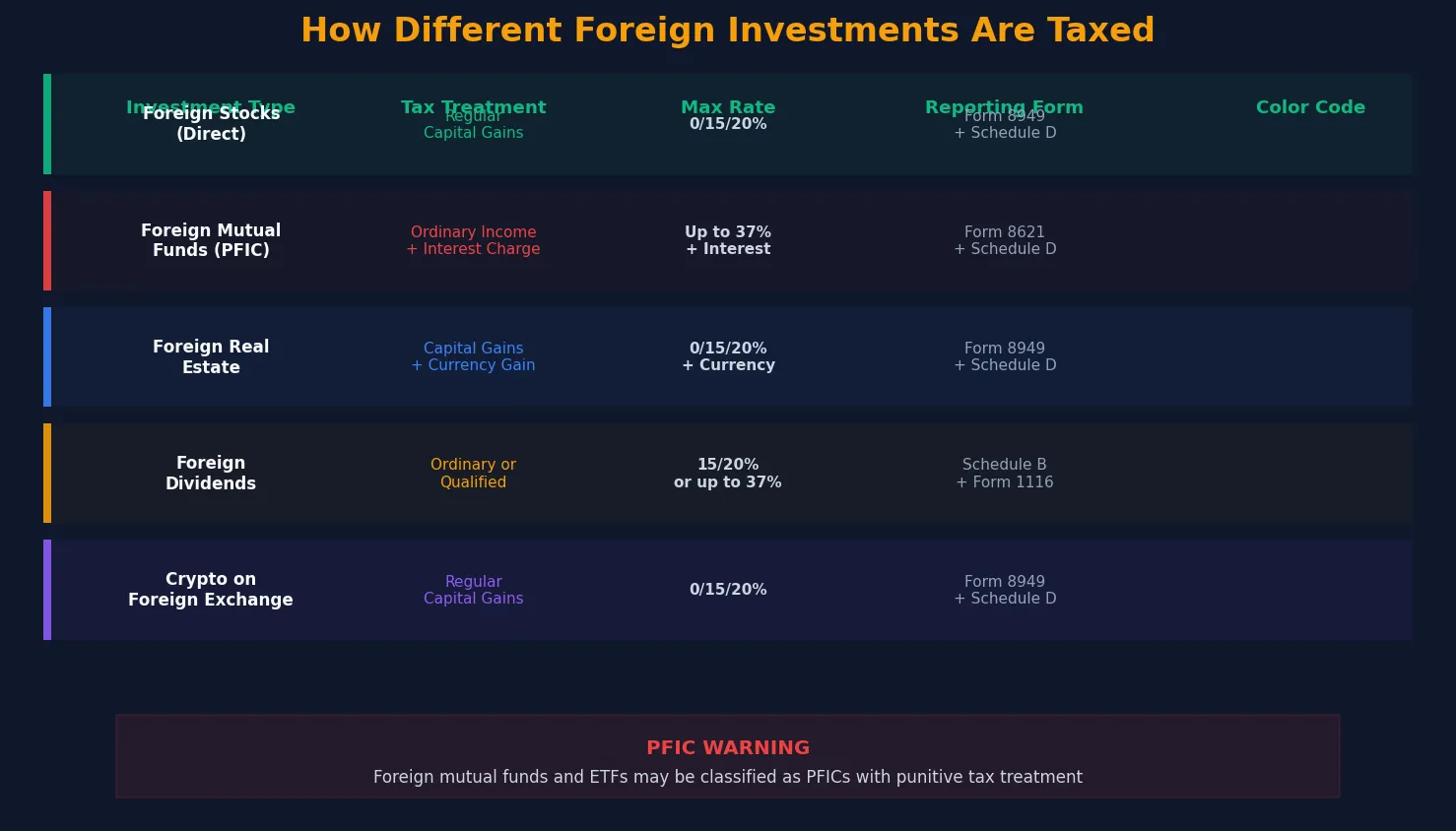
When you sell foreign stocks at a profit after holding them for more than one year, the gain qualifies for the long-term capital gains rates of 0%, 15%, or 20%. Short-term gains from foreign stocks held one year or less are taxed at ordinary income rates, just like short-term gains on domestic stocks. The preferential rate system works the same way regardless of where the company is headquartered.
There is one important catch: you must calculate everything in US dollars. The IRS requires you to convert your purchase price and sale proceeds into US dollars using the exchange rate on each transaction date. This means exchange rate fluctuations can create additional taxable gains or losses, which I will explain in detail later.
Foreign dividends are also taxable, and their treatment depends on whether they qualify as qualified dividends. Most dividends from foreign corporations qualify if the company is incorporated in a US treaty country or if the stock trades on a recognized US exchange as an ADR. Our guide to capital gains tax on dividends explains the qualified dividend rules in detail.
The PFIC Trap: Foreign Mutual Funds and ETFs
This is where foreign investing gets painful. If you invest in foreign mutual funds, foreign ETFs, or certain foreign holding companies, you may be subject to the PFIC rules — and these rules are genuinely punitive.
A Passive Foreign Investment Company is any foreign corporation where at least 75% of its income is passive (investment income like dividends, interest, and capital gains) or where at least 50% of its assets produce passive income. Most foreign mutual funds and ETFs fall squarely into this definition.
Why does PFIC status matter? Because PFICs are not eligible for the preferential capital gains rates. Instead, you face one of two tax treatments, both of which are far less favorable than the regular capital gains system.
The Default Method (Section 1291): Under the default excess distribution method, gains on PFIC shares are allocated back to each year you held the investment. The allocated amounts are taxed at the highest ordinary income rate for that year (37% for recent years), plus an interest charge to compensate the IRS for the deferred tax. This can easily result in an effective tax rate well above 37% when the interest charge is included.
The Mark-to-Market Election (Section 1296): If you make this election, you report the change in value of your PFIC shares each year as ordinary income, whether you sell them or not. The upside is you avoid the interest charge and the look-back allocation. The downside is you pay ordinary income rates on all gains, including gains that would normally qualify for capital gains treatment.
The Qualified Electing Fund (QEF) Election: This is the best option if available. If the foreign fund provides the necessary information, you can elect to be taxed on your share of the fund's income each year as if you earned it directly. This preserves the capital gains character of long-term gains inside the fund. The problem is that most foreign funds do not provide the information needed to make this election, leaving you stuck with the punitive default treatment.
The PFIC rules are so harsh that many tax advisors recommend avoiding foreign mutual funds entirely. Instead, consider buying individual foreign stocks or using US-domiciled international funds like Vanguard FTSE All-World ex-US ETF, which are not subject to PFIC rules because they are US corporations.
Our guide to capital gains tax on mutual funds and ETFs explains the tax treatment of domestic funds, which is far more favorable than the PFIC treatment.
Currency Gains: The Hidden Second Layer of Tax
When you buy and sell foreign investments, you are actually making two bets: one on the investment itself, and one on the currency. The IRS taxes both.
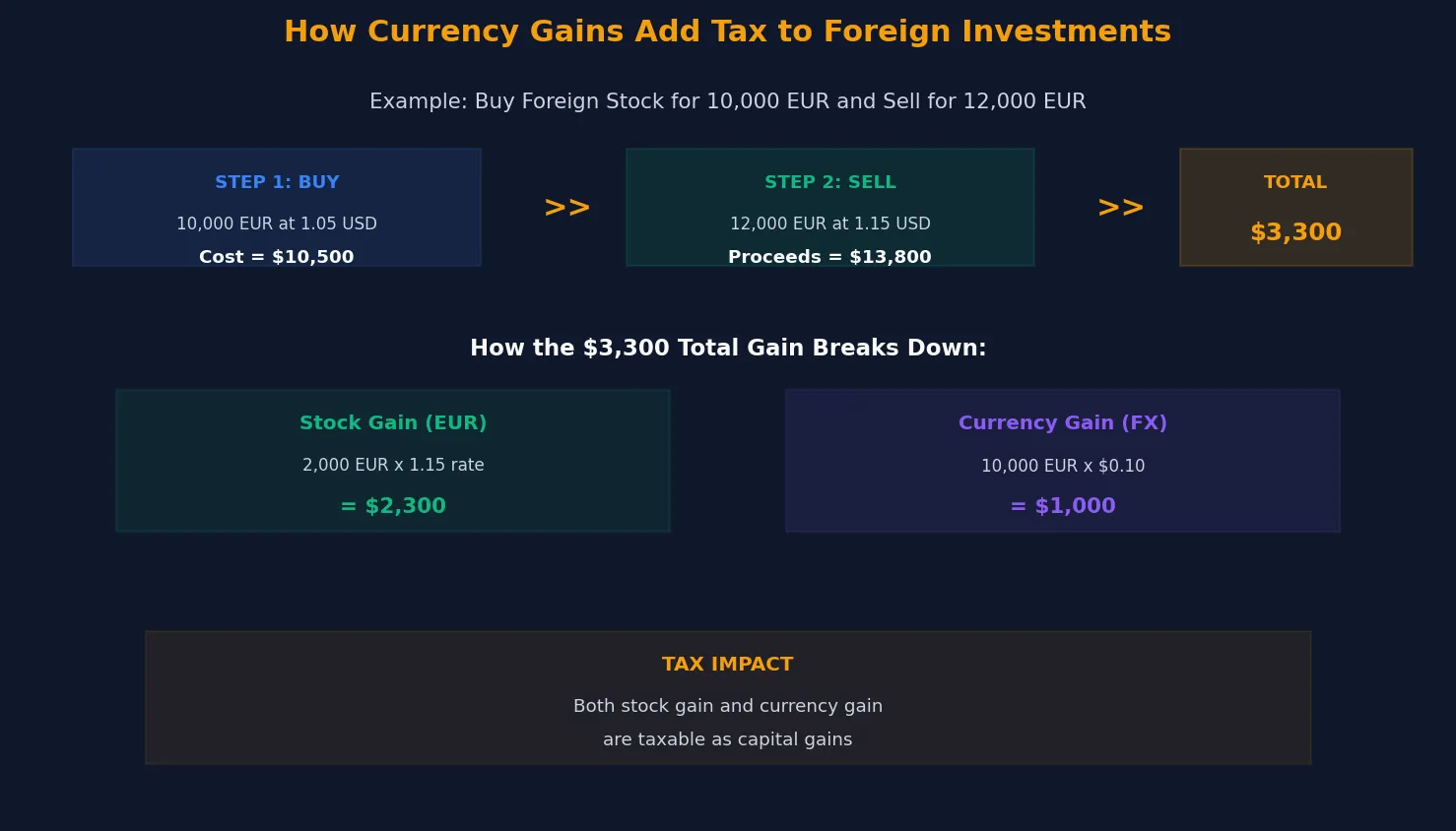
Here is how it works. You must convert every foreign currency amount into US dollars at the exchange rate prevailing on the date of each transaction. If the exchange rate changes between your purchase date and your sale date, the currency movement creates a separate gain or loss that is taxable.
Let me walk you through an example. Suppose you buy 1,000 shares of a German stock for 50 euros per share, when the exchange rate is 1.05 dollars per euro. Your cost basis in dollars is $52,500 (1,000 x 50 x 1.05).
Two years later, you sell the shares for 55 euros per share, when the exchange rate is 1.15 dollars per euro. Your proceeds in dollars are $63,250 (1,000 x 55 x 1.15).
Your total gain is $10,750. But this gain has two components. The stock itself went from 50 to 55 euros, which is a 5,000 euro gain. Converted at the selling rate of 1.15, that stock gain is $5,750. The remaining $5,000 comes from currency appreciation — your original 50,000 euro cost basis was worth $52,500 when you bought it, but that same 50,000 euros would be worth $57,500 at the selling exchange rate. The difference is your currency gain.
Both the stock gain and the currency gain are treated as capital gains. If you held the stock for more than a year, both components qualify for the preferential long-term capital gains rates. This is actually favorable treatment — currency gains could theoretically be taxed as ordinary income, but under current IRS rules, they take on the character of the underlying asset.
The reverse is also true. If the foreign currency depreciates against the dollar during your holding period, you may have a currency loss that reduces your overall capital gain, or even creates a deductible capital loss.
Foreign Real Estate: Capital Gains Plus Currency Considerations
Buying property overseas — a vacation home in Spain, a rental unit in Mexico, or land in India — is increasingly popular. The capital gains tax rules for foreign real estate follow the same principles as domestic real estate, with the currency conversion layer added on top.
When you sell foreign real estate at a profit after holding it for more than one year, the gain is a long-term capital gain. The calculation is done entirely in US dollars, converting the purchase price and sale price at the exchange rates on the respective dates. This means currency fluctuations can increase or decrease your taxable gain, just like with foreign stocks.
Unlike your primary residence in the US, foreign real estate does not qualify for the Section 121 exclusion (the $250,000/$500,000 tax-free gain). The home sale exclusion only applies to your main home in the United States. A vacation property abroad, even if you use it regularly, does not qualify.
If the foreign property is a rental, you may have claimed depreciation deductions over the years. When you sell, those depreciation deductions are recaptured at a 25% rate, the same as for domestic rental property. Our real estate investment property tax guide covers the depreciation recapture rules in detail.
Foreign real estate transactions may also trigger taxes in the country where the property is located. Many countries impose their own capital gains tax or transfer tax on the sale. The US allows you to claim a foreign tax credit for taxes paid to a foreign country on the same income, which prevents double taxation. But the credit is limited to the US tax attributable to that foreign income, so you cannot always fully offset both taxes.
Foreign Tax Credit: Avoiding Double Taxation
The United States taxes its citizens and residents on their worldwide income, regardless of where it is earned. This creates the risk of double taxation — paying tax to both the foreign country and the IRS on the same income.
The foreign tax credit solves this problem, at least partially. You can claim a credit on Form 1116 for income taxes paid to a foreign country on foreign-source income. The credit is limited to the US tax that applies to that foreign income, so you cannot use foreign taxes to offset US taxes on US-source income.
For capital gains, the foreign tax credit works like this. If a foreign country taxes your capital gain at 15% and the US rate is also 15%, the credit eliminates your US tax on that gain entirely. If the foreign rate is 25% and the US rate is 15%, you still pay no US tax, but you cannot claim a refund for the extra 10% paid to the foreign country. If the foreign rate is 10% and the US rate is 20%, you pay the 10% to the foreign country and the remaining 10% to the IRS.
Some countries have tax treaties with the United States that reduce or eliminate withholding taxes on investment income. These treaties can significantly reduce your foreign tax burden, which means less foreign tax credit available to offset US taxes — but also less total tax paid overall.
Reporting Requirements: FATCA, FBAR, and Form 8938
Foreign investments come with extra reporting obligations that carry severe penalties for non-compliance. This is not an area where you want to make mistakes.
FBAR (FinCEN Form 114): If you have foreign financial accounts with an aggregate value exceeding $10,000 at any time during the year, you must file an FBAR. This includes foreign bank accounts, brokerage accounts, and mutual fund accounts. The penalty for willful failure to file is up to $100,000 or 50% of the account balance, whichever is greater.
FATCA (Form 8938): If you have specified foreign financial assets exceeding certain thresholds ($50,000 on the last day of the year or $75,000 at any point for single filers living in the US, higher thresholds for those abroad), you must report them on Form 8938 attached to your tax return. The penalty for failure to file is $10,000.
Form 8621: If you own shares in a PFIC, you must file Form 8621 for each PFIC you own. This form calculates the tax and interest under the excess distribution method or reports the mark-to-market income. Failing to file this form can result in penalties and extended statutes of limitations.
These reporting requirements apply regardless of whether you owe any tax. You can have zero tax liability and still face enormous penalties for failing to file the informational returns. Take this seriously.
How to Report Foreign Capital Gains on Your Tax Return
Reporting foreign capital gains follows the same basic process as domestic gains, with additional forms for the foreign-specific issues.
Foreign stock sales go on Form 8949 and Schedule D, just like domestic stock sales. Convert all amounts to US dollars using the exchange rate on each transaction date. Our step-by-step guide to reporting capital gains walks you through the forms.
PFIC distributions and gains go on Form 8621, with the results flowing to Schedule D and your Form 1040.
Foreign real estate sales go on Form 8949 and Schedule D. Claim any foreign taxes paid as a credit on Form 1116.
Foreign dividends are reported on Schedule B and qualify for the foreign tax credit on Form 1116.
Currency gains are reported as part of the capital gain on Form 8949 — they are not reported separately.
The Net Investment Income Tax Applies to Foreign Gains Too
Do not forget about the 3.8% net investment income tax. If your modified AGI exceeds $200,000 (single) or $250,000 (married filing jointly), this surtax applies to your foreign capital gains just like your domestic ones.
This means your maximum effective rate on foreign long-term capital gains can be 23.8% (20% plus 3.8%), and your maximum effective rate on PFIC gains under the default method can exceed 40% (37% plus interest charge plus 3.8% NIIT). Our complete guide to the net investment income tax explains the calculations in detail.
State Taxes on Foreign Gains
Your state also taxes foreign capital gains. Most states tax capital gains at the same rate as ordinary income, with no preferential rate for long-term gains. California, New York, and other high-tax states can add 9% to 13% on top of your federal tax bill.
Some states allow a credit for taxes paid to foreign countries, but many do not. Check your specific state rules or consult a tax professional who understands your state's treatment of foreign income. Our state capital gains tax rates guide has the breakdown for every state.
5 Strategies to Reduce Taxes on Foreign Investments
1. Use US-Domiciled International Funds Instead of Foreign Funds
This is the single most important strategy. US-domiciled ETFs that hold foreign stocks — like VXUS, VEA, or IEFA — are not PFICs because they are organized under US law. You get international exposure with the tax treatment of a regular US investment, including the preferential capital gains rates.
2. Make the QEF Election When Possible
If your foreign fund provides the necessary information, make the Qualified Electing Fund election on Form 8621. This preserves the capital gains character of long-term gains and avoids the punitive excess distribution method with its interest charges.
3. Time Your Sales Around Exchange Rates
Since currency gains are part of your total taxable gain, consider the exchange rate when deciding when to sell. If the dollar has strengthened against the foreign currency, your currency loss might offset some of your investment gain, reducing your total tax bill.
4. Claim the Foreign Tax Credit
Never forget to claim the foreign tax credit on Form 1116 for taxes paid to foreign countries. This credit directly reduces your US tax bill, dollar for dollar, up to the amount of US tax attributable to your foreign income.
5. Use Tax-Loss Harvesting on Foreign Investments
Foreign investments are eligible for tax-loss harvesting just like domestic ones. If you have foreign investments trading below your cost basis, selling them generates a capital loss you can use to offset gains from other investments. Our wash sale rule guide explains how to avoid triggering wash sale violations when repurchasing.
Common Mistakes With Foreign Investment Taxes
Mistake 1: Ignoring PFIC rules. Many investors buy foreign mutual funds without realizing they are PFICs. By the time they discover the issue, they are stuck with years of punitive tax treatment and interest charges.
Mistake 2: Not converting to US dollars. Every transaction must be calculated in US dollars. Using the foreign currency amounts directly will produce incorrect gain calculations and can trigger IRS penalties.
Mistake 3: Forgetting FBAR and FATCA filings. These informational returns carry severe penalties for non-compliance, even if you owe no tax. File them every year if you meet the thresholds.
Mistake 4: Overlooking currency gains. The currency component of your gain is taxable, even though it feels like you are being taxed on something you did not really earn. Track exchange rates on both your purchase and sale dates.
Mistake 5: Not claiming foreign tax credits. If you paid tax to a foreign country on your investment income, you are entitled to a credit against your US tax. Many taxpayers leave this money on the table.
The Bottom Line
Foreign investments offer excellent diversification, but they come with tax complications that domestic investors never face. PFIC rules can turn a modest gain into a tax nightmare. Currency fluctuations add a second layer of taxation that catches many investors off guard. And the reporting requirements carry penalties that can exceed the tax itself.
The most important takeaway: use US-domiciled international funds whenever possible. They give you the same foreign exposure without the PFIC headache. If you do invest directly in foreign funds, make the QEF election if available, and always file the required informational returns.
For more tax planning strategies, explore our complete library of capital gains tax guides and calculators.
Fact-Checked & Reviewed
This article was written by David Chen (JD, LLM in Taxation (New York University)) and reviewed for accuracy by Sarah Mitchell (CPA, MST (Master of Science in Taxation)). Published by Wasim Akram, Founder & Lead Researcher at TaxGainsCalc. All tax rates, thresholds, and rules referenced are based on IRS publications and current tax law as of the date published. Tax laws change frequently — always consult a qualified tax professional for advice specific to your situation.
Tax Attorney & Legal Editor
David Chen is a tax attorney with a Juris Doctor and a Master of Laws in Taxation from New York University School of Law. With over 10 years of legal practice, he specializes in 1031 exchanges, capital gains tax law, and IRS dispute resolution. David...
Certified Public Accountant (CPA)
Sarah Mitchell is a Certified Public Accountant with over 15 years of experience in individual and business taxation. She holds a Master of Science in Taxation from Golden Gate University and specializes in capital gains tax planning, investment tax ...

Founder & Lead Researcher, TaxGainsCalc
Wasim Akram is an independent web publisher and digital entrepreneur based in India. Since 2018, he has been building custom CMS platforms, WordPress plugins, niche websites, and AI-powered digital products with over 8 years of real-world experience....
Disclaimer: This article is for informational purposes only and does not constitute tax, legal, or financial advice. Tax laws and regulations change frequently, and the information presented here may not reflect the most current updates. You should consult with a qualified CPA, tax attorney, or financial advisor before making any tax-related decisions. TaxGainsCalc is not responsible for any actions taken based on the information provided in this article.