Capital Gains Tax Estimated Payments 2026: When to Pay, How Much & How to Avoid Penalties
Complete guide to estimated tax payments on capital gains in 2026. Quarterly deadlines, safe harbor rules, penalty calculations, and step-by-step instructions to pay the right amount at the right time.
Why Estimated Tax Payments on Capital Gains Matter More Than You Think
I learned about estimated tax payments the hard way. A few years ago, I sold a stock position that netted me a healthy six-figure gain in March. I figured I would just settle up when I filed my tax return the following April. Big mistake. The IRS hit me with an underpayment penalty that cost me hundreds of dollars — money I could have easily avoided paying if I had just sent in quarterly payments.
The truth is, the US tax system is a pay-as-you-go system. The government does not want to wait until April to collect what you owe. They want their money throughout the year. When you work a regular job, your employer withholds taxes from every paycheck. But when you earn money through investment gains, nobody is withholding anything for you. That is where estimated tax payments come in.
If you have significant capital gains during the year — whether from selling stocks, crypto, real estate, or mutual funds — you probably need to make estimated payments. Ignoring this obligation is one of the most common and easily avoidable tax mistakes investors make.
What Are Estimated Tax Payments?
Estimated tax payments are quarterly payments you send directly to the IRS (and usually your state) to cover income that is not subject to withholding. Think of them as a do-it-yourself version of paycheck withholding.
The IRS requires you to pay taxes as you earn income throughout the year. If you wait until you file your return to pay everything, and you owe more than $1,000 beyond what has already been withheld, you will likely face an underpayment penalty.
These payments cover all types of income, but they are especially important for capital gains because gains often come in large, unpredictable lump sums. You might sell a stock in February and have zero gains the rest of the year. Without an estimated payment, you would be behind on your tax obligation from day one.
Who Needs to Make Estimated Payments on Capital Gains?
Not everyone with a capital gain needs to make estimated payments. But if any of these situations apply to you, you probably should:
You expect to owe more than $1,000 in taxes beyond what your employer withholds from your paycheck. This is the threshold the IRS uses to determine whether a penalty applies.
You had a large, one-time gain from selling stocks, crypto, or real estate. Even a single big sale can push you over the threshold, especially if it is a short-term capital gain taxed at your ordinary income rate.
You do not have enough withholding from wages or other sources to cover your total tax liability. This is common for self-employed people and retirees who receive income without withholding.
You sold investments early in the year. The earlier in the year you realize gains, the more quarters you go without paying tax on them, which increases your penalty.
The key question is always the same: will you owe more than $1,000 above what has already been withheld? If the answer is yes, you need to make estimated payments or increase your withholding.
The Four Quarterly Deadlines You Cannot Miss
Estimated tax payments follow a strict quarterly schedule. Missing a deadline — even by a few days — can trigger a penalty for that quarter.
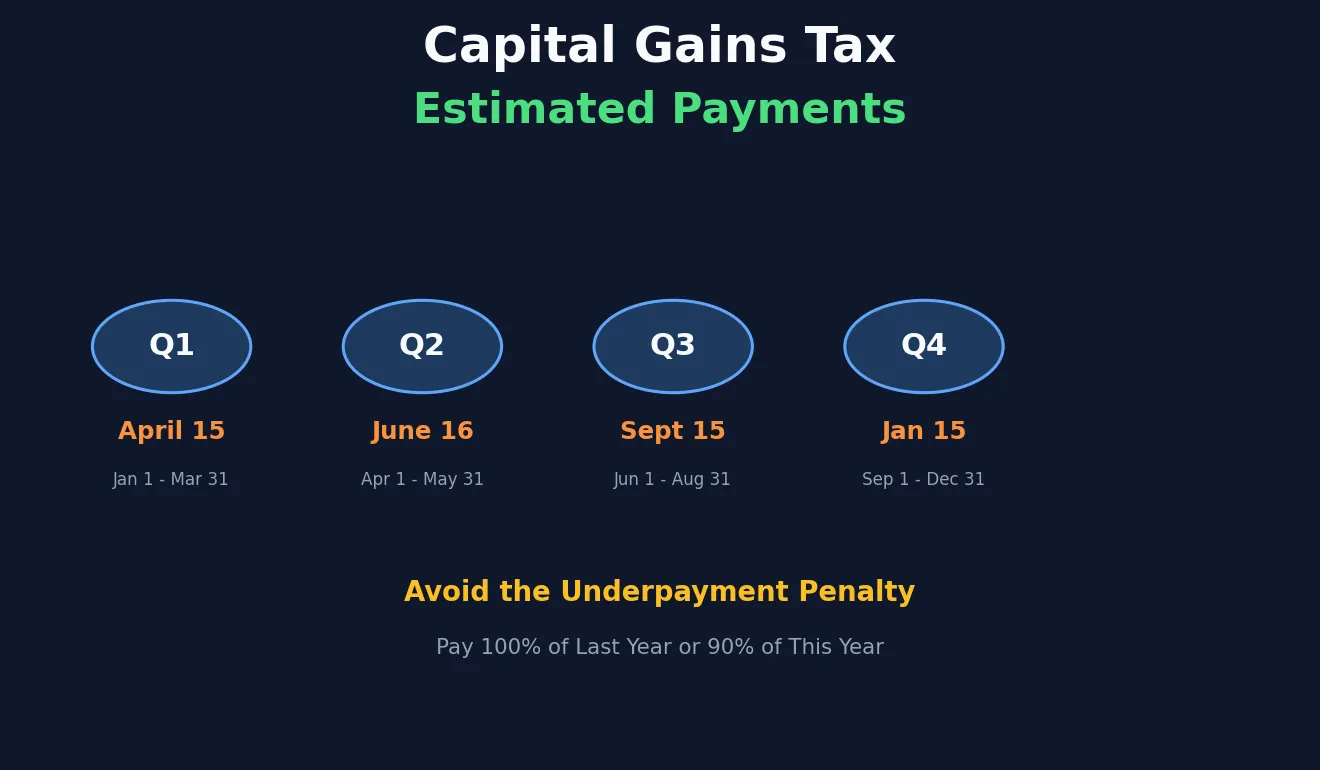
Q1 Payment: April 15 — Covers income earned from January 1 through March 31. This is the first deadline of the year and often catches people off guard because it is the same day as the regular tax filing deadline.
Q2 Payment: June 16 — Covers income earned from April 1 through May 31. Notice this period is only two months, not three, which is why this deadline comes just two months after Q1.
Q3 Payment: September 15 — Covers income earned from June 1 through August 31. This one gives you a bit more breathing room after the Q2 payment.
Q4 Payment: January 15 (of the following year) — Covers income earned from September 1 through December 31. This is the only deadline that falls in the next calendar year.
If a deadline falls on a weekend or holiday, it shifts to the next business day. I always recommend setting calendar reminders for all four dates at the start of each year. Missing even one payment can result in a penalty for that specific quarter.
How to Calculate Your Estimated Tax Payment
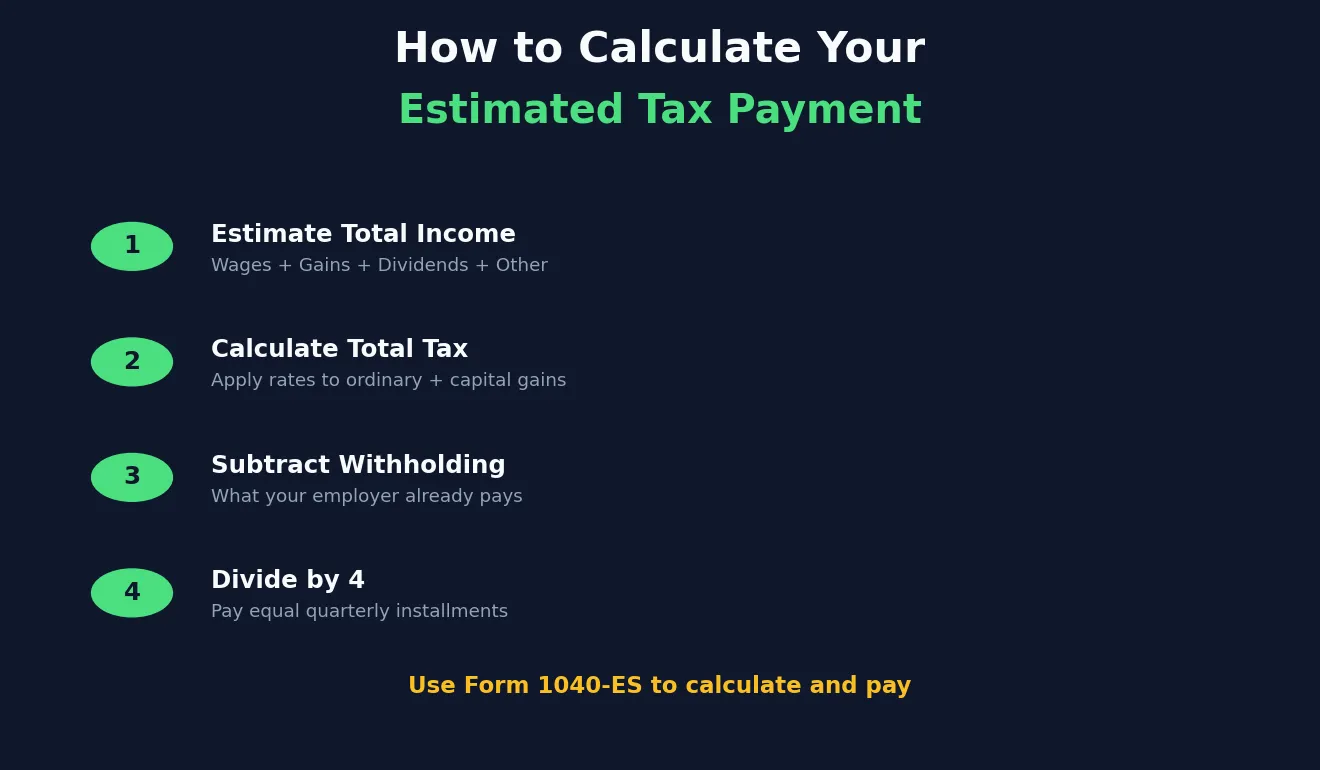
Calculating your estimated payment is not as complicated as it sounds. You basically need to figure out how much total tax you will owe for the year and then subtract what has already been paid through withholding. The remainder gets divided into quarterly payments.
Step 1: Estimate Your Total Income
Start by estimating your total income for the year. This includes wages, self-employment income, interest, dividends, and — most importantly for our purposes — capital gains. Be realistic. If you have already realized gains, include them. If you plan to sell more investments before year-end, estimate those gains too.
Remember that your long-term capital gains tax rates are significantly lower than short-term rates. If you are not sure which category your gains fall into, check the holding period. Assets held for more than one year qualify for the preferential long-term rates of 0%, 15%, or 20%.
Step 2: Calculate Your Total Tax Liability
Once you have your estimated income, calculate the total tax you will owe. This includes income tax on wages and short-term gains, the preferential rates on long-term gains, self-employment tax if applicable, and the net investment income tax of 3.8% if your modified AGI exceeds the threshold.
Do not forget about state taxes. Many states have their own estimated payment requirements, and your state capital gains tax rates can add a significant amount to your total obligation. California, for example, taxes capital gains as ordinary income with rates up to 13.3%.
Step 3: Subtract Withholding and Credits
Subtract what has already been paid through withholding from your paychecks, plus any tax credits you expect to claim. If your spouse works and has withholding, you can include that too if you file jointly.
Some people choose to increase their W-2 withholding instead of making separate estimated payments. This is a perfectly valid strategy because the IRS treats withholding as if it was paid evenly throughout the year, regardless of when it was actually withheld. You can adjust your W-4 at any time.
Step 4: Divide by Four
Take the remaining amount and divide it into four equal quarterly payments. You can send different amounts for different quarters if your income is uneven, but equal payments are simpler and less likely to trigger errors.
The Safe Harbor Rules That Save You from Penalties
This is the most important section of the entire article. The IRS gives you two safe harbor rules. If you meet either one, you will not owe an underpayment penalty — no matter how much you actually owe when you file your return.
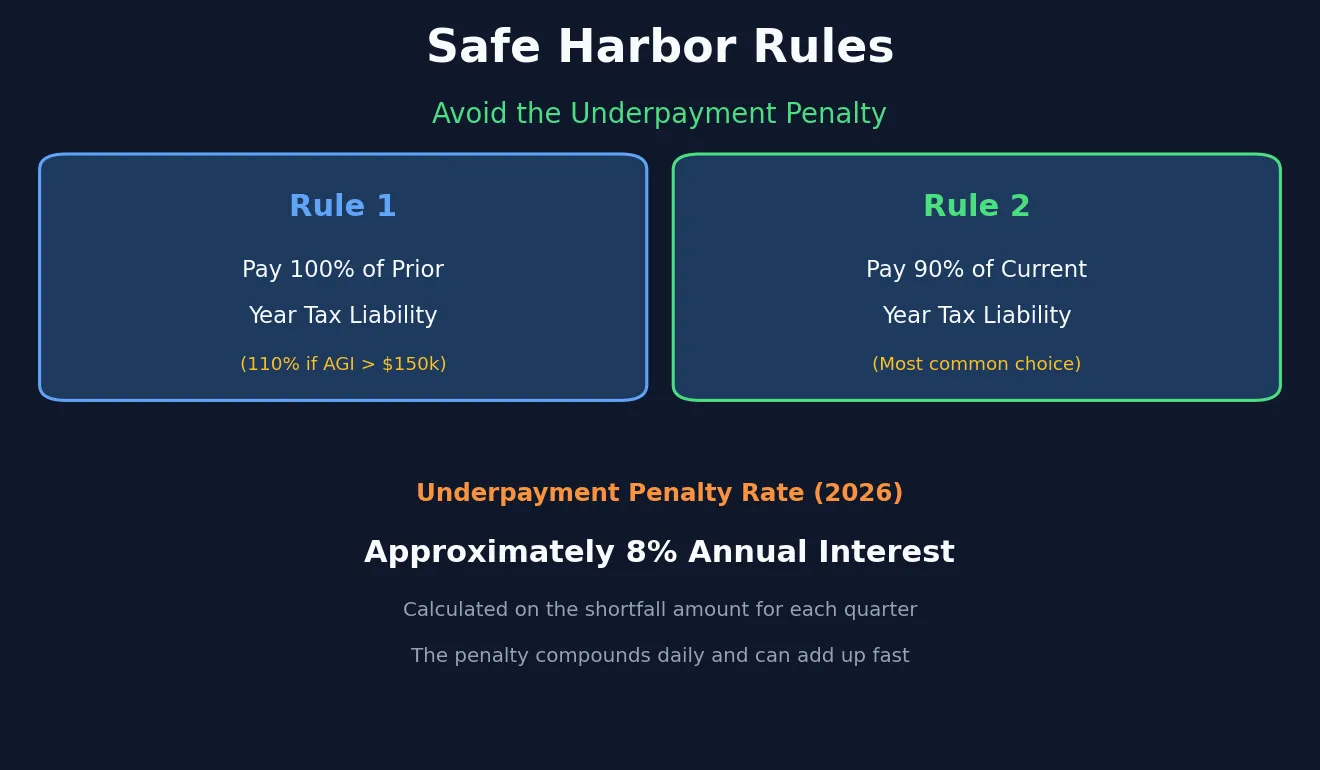
Safe Harbor 1: Pay 100% of your prior year tax liability. If your adjusted gross income on last year's return was $150,000 or less, you simply need to pay 100% of what you owed last year through a combination of withholding and estimated payments. If you owed $20,000 last year, you need to pay $20,000 this year ($5,000 per quarter) to be safe.
Safe Harbor 2: Pay 110% of your prior year tax liability. If your AGI exceeded $150,000 on last year's return, the threshold goes up to 110%. So if you owed $20,000 last year and your AGI was above $150,000, you need to pay $22,000 this year ($5,500 per quarter) to be protected.
Alternative: Pay 90% of your current year tax liability. Instead of using last year's tax as your benchmark, you can aim to pay 90% of what you will actually owe this year. This is often the better choice if your income is significantly lower than last year. But it requires you to accurately estimate your current year tax, which can be tricky.
Most tax professionals recommend using the prior-year safe harbor because it is simple and certain. You already know what you owed last year. You do not have to guess what you will owe this year.
How the Underpayment Penalty Is Calculated
If you do not meet a safe harbor and you underpay your estimated taxes, the IRS calculates your penalty using Form 2210. The penalty is essentially interest charged on the amount you should have paid but did not, for each quarter that the payment was short.
The interest rate the IRS uses is the federal short-term rate plus 3 percentage points. For 2026, this rate is approximately 8% annually. The penalty is calculated on a daily basis, which means it compounds quickly.
Here is what makes the penalty particularly painful: it is not calculated on the total annual shortfall. It is calculated quarter by quarter. So if you skipped the Q1 payment but caught up by Q4, you still owe a penalty for the Q1 shortfall for the entire period from April 15 to whenever you finally made up the difference.
The IRS assumes that estimated payments were made in four equal installments unless you file Form 2210 with the annualized income method to show that your income was earned unevenly throughout the year. This form is complicated, but it can save you a significant amount if most of your gains came later in the year.
Different Strategies for Different Situations
Strategy 1: Increase Your W-2 Withholding
If you or your spouse has a job with a paycheck, the easiest way to cover capital gains is to increase your W-2 withholding. File a new W-4 with your employer requesting additional withholding. The IRS treats all withholding as if it was paid evenly throughout the year, even if you increase it in December. This can retroactively save you from a penalty.
Strategy 2: Make Unequal Quarterly Payments
If your gains were concentrated in one quarter, you can make a larger payment for that quarter and smaller payments for the others. You will need to file Form 2210 with the annualized income method to avoid a penalty on the quarters where you paid less. This takes extra paperwork but can be worth it if your income is very uneven.
Strategy 3: Use tax-loss harvesting to Reduce Gains
Before making an estimated payment, consider whether you can reduce your gains by selling losing investments. Harvesting losses offsets gains dollar for dollar, which directly reduces the tax you owe and therefore the estimated payment you need to make. This strategy works best when you have both winners and losers in your portfolio.
Strategy 4: Pay Based on Last Year's Tax
As I mentioned earlier, the simplest and most reliable approach is to base your estimated payments on last year's tax liability. You know the number, you do not have to estimate anything, and the IRS guarantees no penalty if you meet the safe harbor. For most investors, this is the best strategy.
How to Actually Make the Payment
The IRS makes it relatively easy to submit estimated payments. Here are your options:
IRS Direct Pay: Go to irs.gov/payments and use Direct Pay to transfer money directly from your bank account. It is free and you get immediate confirmation. This is my preferred method.
Electronic Federal Tax Payment System (EFTPS): This is the government's official payment system. You need to enroll in advance, which takes a few days, but once you are set up, you can schedule payments in advance and track your payment history.
Pay by credit or debit card: The IRS allows payments through approved payment processors, but they charge a fee (usually around 2% for credit cards). This is convenient but expensive for large payments.
Mail a check: You can still mail a check with Form 1040-ES. This works, but it is slow, and you have no proof of timely payment unless you send it certified mail. I would not recommend this for time-sensitive estimated payments.
Always keep records of every payment you make — the date, the amount, and the confirmation number. You will need this information when you file your tax return.
Special Situations That Trip People Up
You Sold Crypto
Cryptocurrency gains are treated exactly like other capital gains for estimated tax purposes. If you sold Bitcoin, Ethereum, or any other crypto at a profit, you need to account for that gain in your estimated payments. The cryptocurrency capital gains tax rules are the same as for stocks — the holding period and tax rate depend on how long you held the asset before selling.
You Sold Investment Real Estate
Real estate gains can be particularly tricky because they may include depreciation recapture, which is taxed at a flat 25% rate, in addition to regular capital gains. If you sold an investment property, review the real estate capital gains rules to make sure you are calculating your total tax correctly before making estimated payments.
You Had a Big Gain Early in the Year
A large gain in Q1 means you should have been making payments starting in April. If you wait until Q3 or Q4 to start paying, the IRS will charge a penalty for the quarters you missed. This is one of the most common mistakes I see.
You Are Over 65 and Living on Investment Income
Retirees often have little or no withholding because they are not drawing paychecks. If your income comes primarily from investments, you almost certainly need to make estimated payments. Even seniors and retirees can face underpayment penalties if they do not plan ahead.
Common Mistakes to Avoid
Mistake 1: Waiting until tax season to pay. The IRS charges penalties quarter by quarter. Waiting until April to pay what you should have paid in April of the previous year means four quarters of penalties.
Mistake 2: Forgetting about state estimated payments. Most states have their own estimated tax requirements with their own deadlines and penalty rules. Do not focus so much on the federal payment that you forget about your state obligation.
Mistake 3: Not adjusting after a big gain. If you had a large gain in Q1 and were planning to make estimated payments based on last year's modest income, you need to recalculate. A big gain can push you well past the safe harbor threshold.
Mistake 4: Ignoring the net investment income tax. If your modified AGI exceeds $200,000 (single) or $250,000 (married filing jointly), you owe an additional 3.8% on your net investment income. This tax is easy to overlook but it adds up fast on large gains.
The Bottom Line
Estimated tax payments on capital gains are not optional if you owe more than $1,000 beyond your withholding. The penalties are real, they compound daily, and they are completely avoidable with a little planning.
The simplest approach is to use the prior-year safe harbor. Figure out what you owed last year, divide it by four, and send those payments on time. If your income is significantly higher this year due to capital gains, you may need to pay more than the safe harbor amount — but at least you will not owe a penalty on the base amount.
If you have already missed a payment, make it up as soon as possible. The penalty is calculated daily, so the sooner you catch up, the less you will owe. And if most of your income came late in the year, talk to a tax professional about filing Form 2210 with the annualized income method — it could save you a significant amount.
For more guidance on managing your capital gains tax liability, explore our complete collection of tax planning guides and strategies.
Fact-Checked & Reviewed
This article was written by Sarah Mitchell (CPA, MST (Master of Science in Taxation)) and reviewed for accuracy by David Chen (JD, LLM in Taxation (New York University)). Published by Wasim Akram, Founder & Lead Researcher at TaxGainsCalc. All tax rates, thresholds, and rules referenced are based on IRS publications and current tax law as of the date published. Tax laws change frequently — always consult a qualified tax professional for advice specific to your situation.
Certified Public Accountant (CPA)
Sarah Mitchell is a Certified Public Accountant with over 15 years of experience in individual and business taxation. She holds a Master of Science in Taxation from Golden Gate University and specializes in capital gains tax planning, investment tax ...
Tax Attorney & Legal Editor
David Chen is a tax attorney with a Juris Doctor and a Master of Laws in Taxation from New York University School of Law. With over 10 years of legal practice, he specializes in 1031 exchanges, capital gains tax law, and IRS dispute resolution. David...

Founder & Lead Researcher, TaxGainsCalc
Wasim Akram is an independent web publisher and digital entrepreneur based in India. Since 2018, he has been building custom CMS platforms, WordPress plugins, niche websites, and AI-powered digital products with over 8 years of real-world experience....
Disclaimer: This article is for informational purposes only and does not constitute tax, legal, or financial advice. Tax laws and regulations change frequently, and the information presented here may not reflect the most current updates. You should consult with a qualified CPA, tax attorney, or financial advisor before making any tax-related decisions. TaxGainsCalc is not responsible for any actions taken based on the information provided in this article.