Tax Loss Harvesting: The Complete Guide to Turning Investment Losses Into Real Tax Savings
Complete guide to tax loss harvesting. Learn how to intentionally sell losing investments to offset capital gains, reduce your tax bill by thousands, avoid the wash sale rule, and use the $3,000 ordinary income deduction. Step-by-step strategy with real examples.
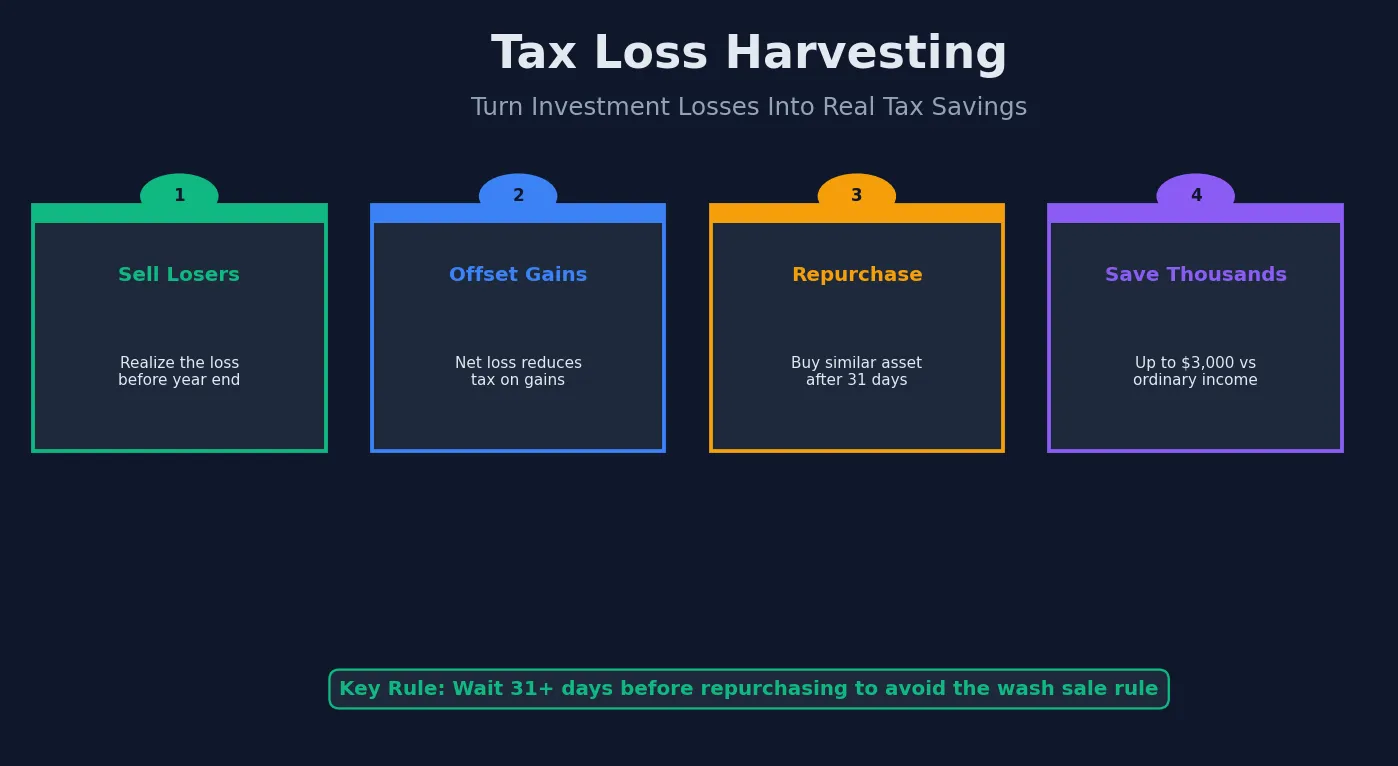
Most Investors Hate Losses. Smart Investors Use Them to Save Tax.
Nobody enjoys watching their portfolio drop. When a stock tanks, when a fund underperforms, when an investment that looked promising turns into a loser — it feels like failure. But there is a silver lining that most people completely overlook: those losses can directly reduce your tax bill.
Tax loss harvesting is the strategy of intentionally selling investments at a loss to offset capital gains from your winners. The concept is simple, but the execution has details that can cost you money if you miss them. Done correctly, harvesting can save you hundreds or even thousands of dollars in federal and state tax every year. Done wrong, the wash sale rule can disallow your loss entirely, leaving you with the same investment position but no tax benefit.
I have been using tax loss harvesting with my clients for over fifteen years. A typical client with a diversified portfolio saves between $1,500 and $6,000 per year through systematic harvesting. One client, a retired engineer named Michael, saved $4,200 in a single year by harvesting losses in his underperforming sector funds and immediately reinvesting in broadly similar but not identical alternatives. He never changed his investment strategy, never took on more risk, and never missed a day of market exposure. The only thing that changed was his tax bill.
This guide covers everything: what tax loss harvesting is, how it works step by step, the wash sale rule traps to avoid, how losses interact with your capital gains tax brackets, the $3,000 ordinary income deduction, loss carryover for future years, and the specific strategies that maximize your savings.
What Is Tax Loss Harvesting?
Tax loss harvesting means selling an investment that has lost value since you bought it, specifically to realize the capital loss for tax purposes. The loss then offsets your capital gains from other investments, reducing the amount of gain that gets taxed.
The key word is "realize." A loss does not exist for tax purposes until you actually sell. If your stock drops 30% but you hold it, you have an unrealized loss — the IRS does not care. Only when you sell does the loss become deductible.
This distinction matters enormously. Many investors sit on losing positions hoping they will recover. While that may be a valid investment strategy, it means they are leaving a tax benefit on the table. You can harvest the loss now, claim the tax savings, and reinvest in a similar position so your portfolio stays on track. The only thing you lose is the specific stock you were holding — not the sector, not the market exposure, not the long-term growth potential.
Our tax loss harvesting calculator lets you estimate how much you can save by harvesting losses in your portfolio this year.
How Tax Loss Harvesting Works: The Basic Mechanism
Let me walk through the mechanism so you can see exactly how the tax savings flow.
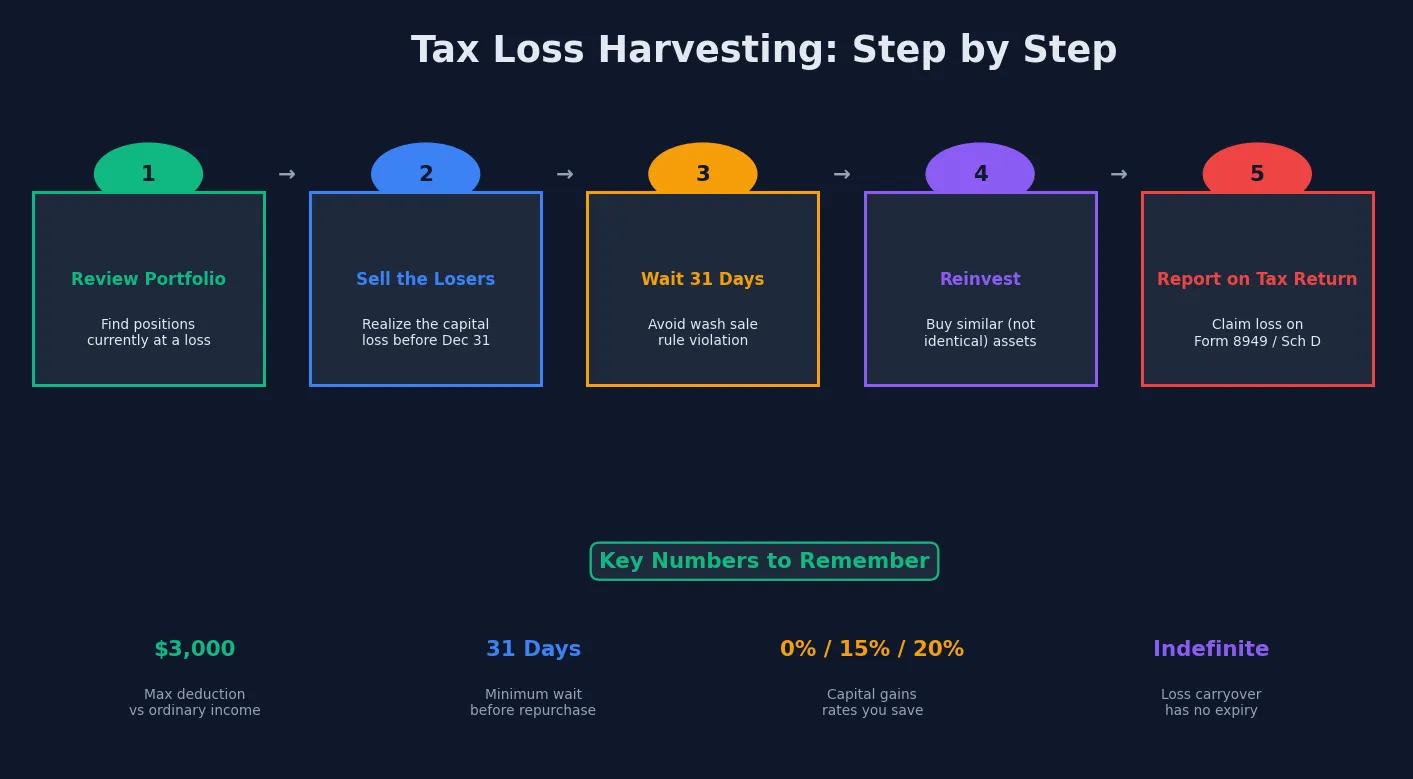
Step 1: Identify positions trading below your cost basis. Look through your portfolio for any investment where the current market value is less than what you paid for it. These are your harvesting candidates. The larger the loss, the more tax benefit you get from selling.
Step 2: Sell the losing positions before December 31. You must complete the sale during the current calendar year to claim the loss on this year's tax return. The trade date, not the settlement date, determines the year. So a sale executed on December 29 counts for this year even if settlement happens in January.
Step 3: Use the loss to offset your capital gains. After you sell, the loss goes on your Schedule D alongside your gains. The IRS nets your gains and losses together. Short-term losses first offset short-term gains, and long-term losses first offset long-term gains. If you have a net loss after all offsetting, up to $3,000 can be deducted against ordinary income like your salary.
Step 4: Reinvest in a similar but not identical position. This is where most people get tripped up by the wash sale rule. You want to maintain your investment exposure, but you cannot buy the same stock or a "substantially identical" security within 31 days of the sale. I will explain this in detail later.
Step 5: Report correctly on your tax return. Harvested losses go on Form 8949 and Schedule D, just like any other capital gain or loss. Our step-by-step guide to reporting capital gains shows you exactly which forms to fill out.
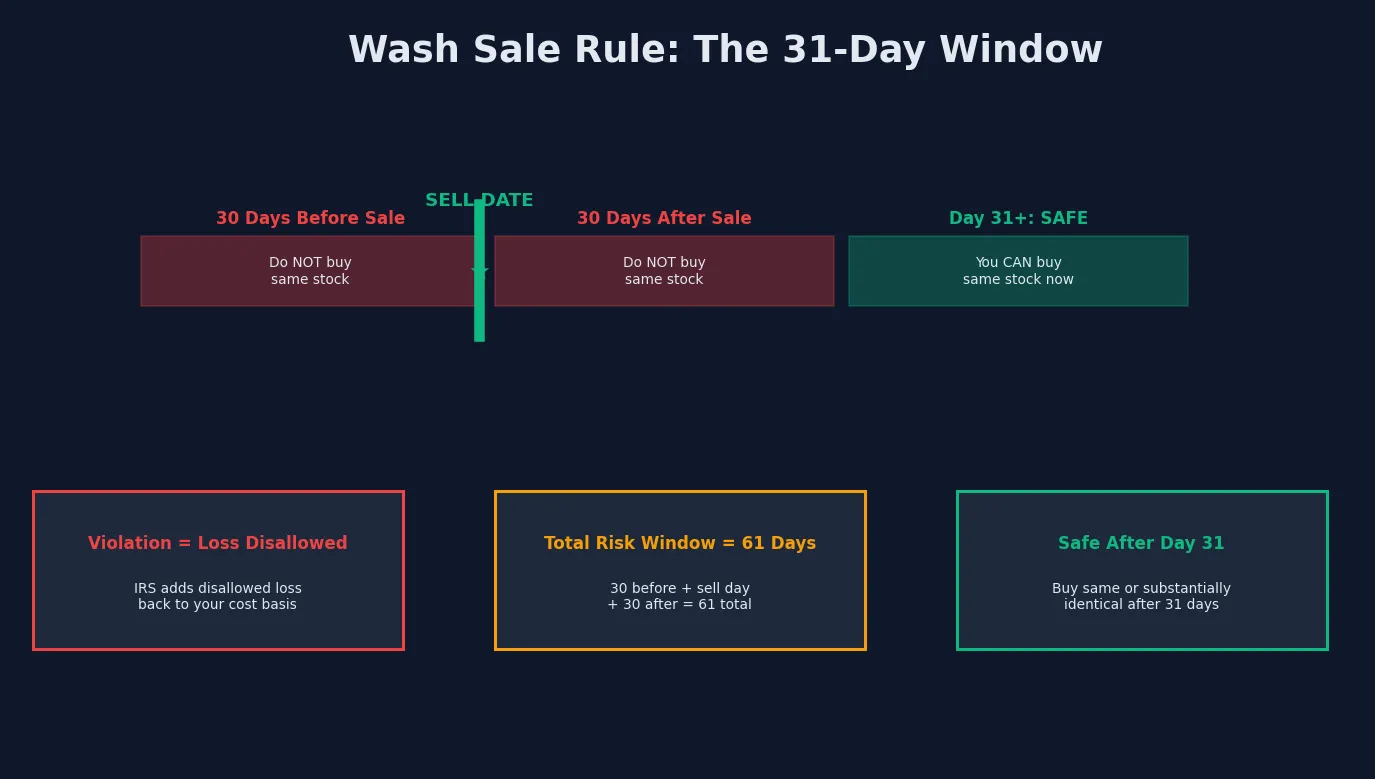
The Wash Sale Rule: The Trap That Can Destroy Your Harvesting
If there is one rule you must understand before harvesting, it is the wash sale rule. This IRS rule disallows your capital loss if you buy the same stock or a substantially identical security within 30 days before or after the sale that created the loss.
The wash sale window is actually 61 days total: 30 days before the sale, the day of the sale, and 30 days after. If you buy the same or substantially identical security anywhere within that 61-day window, your loss is disallowed.
What does "disallowed" mean? It does not mean the loss disappears forever. Instead, the IRS adds the disallowed loss to the cost basis of your new purchase. This effectively defers the loss rather than eliminating it — you will eventually claim it when you sell the replacement shares. But you lose the current-year tax benefit that was the whole reason you harvested the loss in the first place.
What counts as "substantially identical"? This is where the rule gets tricky and where many investors make mistakes. Here are the key guidelines:
Same company, different class: Buying Class A shares after selling Class B shares of the same company is substantially identical. The IRS treats these as the same investment.
Same company, different exchange: Selling shares on NASDAQ and buying the same company on NYSE within 31 days triggers the wash sale rule. The exchange does not matter.
Same index fund from different providers: Selling Vanguard S&P 500 ETF (VOO) and buying iShares S&P 500 ETF (IVV) within 31 days is NOT a wash sale. Different providers tracking the same index are generally not considered substantially identical. This is a key loophole that makes harvesting with index funds very practical.
Individual stock vs sector ETF: Selling Apple stock and buying a technology sector ETF is NOT a wash sale. An ETF tracking a broad sector is not substantially identical to a single stock within that sector.
Options and warrants: Buying call options on the same stock you just sold at a loss within 31 days IS a wash sale. Options on the same underlying security are considered substantially identical.
Our wash sale rule complete guide covers every nuance of this rule with real examples and specific strategies for avoiding violations.
Short-Term vs Long-Term Losses: Which to Harvest First
Not all losses are equally valuable. The character of your loss — short-term or long-term — determines which gains it offsets first, and this affects your total tax savings.
Short-term losses first offset short-term gains, which are taxed at ordinary income rates up to 37%. Long-term losses first offset long-term gains, which are taxed at 0%, 15%, or 20%. Because short-term gains carry higher tax rates, short-term losses are more valuable per dollar than long-term losses.
Let me show you the math. Suppose you have a $10,000 short-term gain and a $10,000 long-term gain, and you have both short-term and long-term losses available to harvest.
If you harvest a $10,000 short-term loss, it offsets the $10,000 short-term gain first. At the 32% ordinary income rate, you save $3,200 in tax.
If you harvest a $10,000 long-term loss, it offsets the $10,000 long-term gain first. At the 15% capital gains rate, you save $1,500 in tax.
The short-term loss saves you $1,700 more than the long-term loss on the exact same dollar amount. This is why experienced harvesters always prioritize short-term losses when they have a choice.
If your losses exceed your gains in one category, the excess crosses over to offset gains in the other category. A net short-term loss offsets long-term gains after the short-term gains are fully absorbed. A net long-term loss offsets short-term gains after the long-term gains are fully absorbed.
Use our short-term capital gains calculator and long-term capital gains calculator to see how your specific gains and losses interact.
The $3,000 Ordinary Income Deduction
One of the most powerful features of tax loss harvesting is the ability to deduct up to $3,000 of net capital losses against ordinary income each year. This deduction works even if you have zero capital gains.
Here is how it works. If your total capital losses exceed your total capital gains by more than $3,000, you deduct $3,000 against your wages, salary, interest income, and other ordinary income. The excess loss carries forward to future years.
For a single filer earning $100,000 in wages, a $3,000 ordinary income deduction reduces taxable income to $97,000. At the 22% marginal rate, that saves $660 in federal tax. Add state tax savings and the total benefit can exceed $900 per year, just from the ordinary income deduction alone.
For married couples filing jointly, the $3,000 deduction works the same way. For married filing separately, the limit drops to $1,500.
This deduction is not automatic. You must actually sell the losing investments and report the losses on Schedule D to claim it. Sitting on unrealized losses does nothing. Our capital gains tax loss carryover guide explains how unused losses beyond $3,000 carry forward indefinitely.
When to Harvest: Timing Strategies
Timing is critical for maximizing your harvesting benefit. Here are the key timing considerations:
Harvest before December 31. The sale must occur during the calendar year to count on that year's tax return. Many investors wait until the last week of December to review their portfolios — this is too late if you need to research replacement investments and execute trades. Start your harvesting review by early November.
Avoid harvesting in January. Some investors harvest losses in early January, thinking they will apply to the new tax year. While this works for the new year, it means you missed the opportunity to use the loss on the previous year's gains. If you had gains last year and losses available, harvest before December 31.
Consider your gain profile for the year. If you realized large capital gains this year from selling a property, exercising stock options, or liquidating a business interest, that is the year to aggressively harvest losses. Every dollar of loss offsets a dollar of gain at your marginal rate. If you have minimal gains this year, the $3,000 ordinary income deduction is still valuable, but the benefit is smaller.
Watch for year-end fund distributions. Mutual funds often distribute capital gains in December. If your fund is about to pay a large distribution, harvesting losses in the fund before the distribution date eliminates the taxable gain. Our mutual funds and ETFs tax guide explains how fund distributions work and when to harvest around them.
Coordinate with estimated payments. If you made estimated tax payments based on expected gains, harvesting losses reduces your actual tax liability. You may need to adjust your final estimated payment. Our estimated tax payments guide covers the safe harbor rules.
How to Replace Harvested Positions Without Triggering Wash Sales
The hardest part of tax loss harvesting is replacing your sold position without triggering a wash sale. You want to maintain your market exposure and investment strategy, but you cannot buy the same security for 31 days. Here are the most common replacement strategies:
Index fund substitution. This is the most popular and safest approach. If you sell Vanguard Total Stock Market ETF (VTI), you can buy iShares Core S&P Total US Stock Market ETF (ITOT) or Schwab US Broad Market ETF (SCHB) as a replacement. These track very similar indexes but are issued by different providers and are not considered substantially identical. After 31 days, you can switch back to VTI if you prefer.
Sector rotation within the same broad category. If you sell a specific technology stock like Microsoft, you can buy a broad technology ETF like XLK or VGT. A sector ETF is not substantially identical to an individual stock, so the wash sale rule does not apply.
Individual stock to similar but different company. If you sell Bank of America, you can buy JP Morgan Chase or Wells Fargo. Different companies in the same industry are not substantially identical. The risk profile changes slightly, but the sector exposure remains.
Bond substitution. If you sell a specific Treasury bond, you can buy a different Treasury bond with a different maturity date. Different maturities make the bonds not substantially identical. Our capital gains tax on bonds guide explains how different bond types are taxed.
Wait 31 days and buy back the original. The simplest strategy: sell, wait 31+ days, then buy back the same security. The downside is 31 days of market exposure risk. If the stock rallies during those 31 days, you miss the gains. If it drops further, you benefit from buying at a lower price.
Tax Loss Harvesting for Different Asset Types
Stocks and ETFs are the easiest assets to harvest because they trade instantly, have clear market values, and have plenty of similar replacements available. Most systematic harvesting focuses on stocks and ETFs. Use our stock capital gains calculator to estimate the tax impact.
Cryptocurrency can be harvested too. Selling crypto at a loss creates a deductible capital loss, just like selling stock. The wash sale rule currently does NOT apply to cryptocurrency because crypto is not a "security" under the IRS definition — it is treated as property. This means you can sell Bitcoin at a loss and buy Bitcoin back the same day without triggering a wash sale. But the IRS may change this rule in the future, so stay alert. Our cryptocurrency capital gains tax guide covers crypto-specific harvesting.
Real estate is harder to harvest because transactions take weeks to close and there are no "substantially identical" properties you can easily swap. But if you are selling a rental property at a loss, the loss is still deductible. The challenge is the 31-day replacement window — you cannot typically close on a replacement property that quickly. Our real estate investment property tax guide explains real estate loss treatment.
Mutual funds can be harvested by selling a specific fund and buying a similar fund from a different provider. The key is choosing a replacement that tracks a similar but not identical index. Our mutual funds and ETFs tax guide has specific replacement suggestions for popular funds.
The Net Investment Income Tax and Harvesting
If your modified adjusted gross income exceeds $200,000 (single) or $250,000 (married filing jointly), the 3.8% net investment income tax applies to your capital gains. Tax loss harvesting reduces your net investment income, which also reduces your NIIT liability.
On a $50,000 net capital gain, the NIIT adds $1,900 in tax. If you harvest $50,000 in losses, you eliminate both the regular capital gains tax and the NIIT — saving potentially $9,400 or more (15% capital gains + 3.8% NIIT). This makes harvesting especially valuable for high-income investors.
Our complete guide to the net investment income tax explains the NIIT thresholds and how harvesting interacts with them.
State Tax Benefits of Harvesting
Most states tax capital gains at the same rate as ordinary income, with no preferential rate. This means the state-level benefit of harvesting can be substantial.
In California, a $20,000 harvested loss saves you about 13.3% at the state level — that is $2,660 on top of your federal savings. In New York, it saves roughly 10.9% state tax. Even in moderate-tax states like Colorado at 4.4%, the combined savings add up.
States with no income tax — Florida, Texas, Nevada — offer no state-level harvesting benefit, but the federal benefit still applies fully. Check your specific state rules using our state capital gains tax rates guide.
6 Pro Strategies to Maximize Your Harvesting Benefit
1. Harvest Short-Term Losses First
As I explained earlier, short-term losses offset short-term gains taxed at ordinary income rates up to 37%. Long-term losses offset long-term gains taxed at 0-20%. Prioritize short-term losses when choosing which positions to sell.
2. Harvest Throughout the Year, Not Just December
Waiting until December creates a rush and increases the risk of wash sale violations. Review your portfolio quarterly and harvest losses as they occur. This also lets you capture losses at their maximum value before a recovery shrinks them.
3. Pair Harvesting with Gain Realization
If you have gains you want to realize this year — selling a winning stock, exercising stock options, or closing a fund position — harvest enough losses to offset those gains. This is called paired harvesting, and it lets you realize gains tax-free. Our capital gains tax deferral strategies guide covers more advanced deferral techniques.
4. Use the $3,000 Deduction Every Year
Even in years with no capital gains, harvest enough losses to claim the $3,000 ordinary income deduction. Over ten years, that is $30,000 of ordinary income reduced, saving $6,600 at the 22% federal rate plus state savings.
5. Avoid Wash Sales on Autopilot
If you use automatic investment plans, dividend reinvestment, or systematic purchases, check whether any of these will buy the same security you just harvested within 31 days. Automatic purchases are one of the most common wash sale triggers.
6. Keep Detailed Records
Track every harvested position, the sale date, the loss amount, the replacement purchase date, and whether the wash sale rule applies. This documentation protects you in case of an IRS audit and makes next year's harvesting easier.
Common Mistakes That Kill Your Harvesting Benefit
Mistake 1: Triggering wash sales accidentally. The most common and most costly mistake. Selling a stock at a loss and buying it back within 31 days disallows the loss. Check all your recent purchases before selling.
Mistake 2: Ignoring the short-term vs long-term distinction. Harvesting a long-term loss when you have short-term gains to offset wastes part of the benefit. Short-term losses are more valuable per dollar because they offset higher-taxed gains.
Mistake 3: Not harvesting in down years. When the whole market drops, many investors freeze. But down markets create the most harvesting opportunities. Every position in your portfolio may be at a loss, giving you maximum flexibility.
Mistake 4: Changing your investment strategy just to harvest. Harvesting should be a tax overlay on your existing investment strategy, not a reason to change it. Replace harvested positions with similar alternatives so your portfolio stays on track.
Mistake 5: Forgetting about loss carryover. If you harvest more losses than you can use this year, the excess carries forward indefinitely. Do not stop harvesting because you have no gains this year. Those losses will offset gains in future years. Our capital gains tax loss carryover guide explains how to track and use carryover losses across multiple years.
The Bottom Line
Tax loss harvesting is the single most accessible tax strategy available to regular investors. You do not need a complicated trust, a special fund, or a large minimum investment. You just need losing positions in your portfolio and the discipline to sell them before December 31.
The mechanism is straightforward: sell losers, offset gains, deduct up to $3,000 against ordinary income, carry forward the rest. The tricky part is the wash sale rule — avoid buying the same or substantially identical security within 31 days on either side of the sale. Use index fund substitutions, sector ETFs, or similar-but-different replacements to maintain your investment strategy without triggering wash sales.
For high-income investors, harvesting also reduces the 3.8% net investment income tax, making the total benefit even larger. For all investors, the state tax savings add another layer of value on top of the federal benefit.
Do not leave money on the table. Review your portfolio, identify your losing positions, and harvest them every year. Over a lifetime of investing, systematic tax loss harvesting can easily save you tens of thousands of dollars. Use our tax loss harvesting calculator to estimate your potential savings, and explore more strategies in our full library of capital gains tax guides.
Fact-Checked & Reviewed
This article was written by James Park (EA, CFP (Certified Financial Planner)) and reviewed for accuracy by Sarah Mitchell (CPA, MST (Master of Science in Taxation)). Published by Wasim Akram, Founder & Lead Researcher at TaxGainsCalc. All tax rates, thresholds, and rules referenced are based on IRS publications and current tax law as of the date published. Tax laws change frequently — always consult a qualified tax professional for advice specific to your situation.
Enrolled Agent & Tax Researcher
James Park is an Enrolled Agent licensed by the IRS and a Certified Financial Planner with over 12 years of experience in tax research and financial planning. He specializes in capital gains strategies for real estate investors and cryptocurrency tra...
Certified Public Accountant (CPA)
Sarah Mitchell is a Certified Public Accountant with over 15 years of experience in individual and business taxation. She holds a Master of Science in Taxation from Golden Gate University and specializes in capital gains tax planning, investment tax ...

Founder & Lead Researcher, TaxGainsCalc
Wasim Akram is an independent web publisher and digital entrepreneur based in India. Since 2018, he has been building custom CMS platforms, WordPress plugins, niche websites, and AI-powered digital products with over 8 years of real-world experience....
Disclaimer: This article is for informational purposes only and does not constitute tax, legal, or financial advice. Tax laws and regulations change frequently, and the information presented here may not reflect the most current updates. You should consult with a qualified CPA, tax attorney, or financial advisor before making any tax-related decisions. TaxGainsCalc is not responsible for any actions taken based on the information provided in this article.