Net Investment Income Tax 2026: The Complete Guide to the 3.8% Surtax
Everything you need to know about the 3.8% Net Investment Income Tax (NIIT) in 2026. Learn who pays it, how to calculate it, what income counts, and proven strategies to reduce or avoid this extra tax.

Most People Do Not Even Know This Tax Exists
I still remember the first time a client walked into my office furious about a tax he had never heard of. He had sold a rental property and walked away with a nice gain, only to discover an extra 3.8% surtax tacked onto his bill. "Where did this come from?" he asked. "I already paid capital gains tax on this money."
That extra 3.8% is the Net Investment Income Tax, or NIIT. It was created by the Affordable Care Act in 2013 and has been quietly collecting money from higher-income taxpayers ever since. Most people know about long-term capital gains tax rates and short-term capital gains brackets, but the NIIT flies under the radar until it shows up on your return.
Here is the simple version. If your modified adjusted gross income exceeds $200,000 as a single filer or $250,000 as a married couple filing jointly, you may owe an additional 3.8% tax on your investment income. That is on top of whatever capital gains rate you already pay. So instead of 15%, you could be paying 18.8%. Instead of 20%, you could be paying 23.8%.
This guide breaks down every detail of the NIIT for 2026. Who pays it, how to calculate it, what income counts, what income does not count, and the strategies that can legitimately reduce your exposure.
Who Has to Pay the NIIT
The NIIT applies to individuals who exceed specific income thresholds. It is not based on how much investment income you have — it is based on your total modified adjusted gross income, or MAGI.
The Income Thresholds for 2026
| Filing Status | MAGI Threshold |
|---|---|
| Single | $200,000 |
| Married filing jointly | $250,000 |
| Married filing separately | $125,000 |
| Head of household | $200,000 |
| Qualifying surviving spouse | $250,000 |
These thresholds are not indexed for inflation the way most tax brackets are. Congress set them in 2013 and has never adjusted them. That means more people cross these lines every year as incomes rise, which is exactly what happened to my client with the rental property sale.
What Counts as MAGI for the NIIT
Your modified adjusted gross income for NIIT purposes is generally your adjusted gross income plus any foreign earned income you excluded on Form 2555. For most people, MAGI and AGI are the same number. This includes your wages, business income, capital gains, dividends, interest, rental income, retirement distributions, and anything else that appears on the front of your Form 1040.
If your MAGI is below the threshold for your filing status, you do not owe the NIIT at all. No calculation needed. If your MAGI is above the threshold, you may owe it — but only on the portion that is considered net investment income.
What Counts as Net Investment Income
This is where the NIIT gets tricky. Not all income is created equal when it comes to this tax. The IRS divides your income into two buckets: investment income and non-investment income.
Income That Is Subject to the NIIT
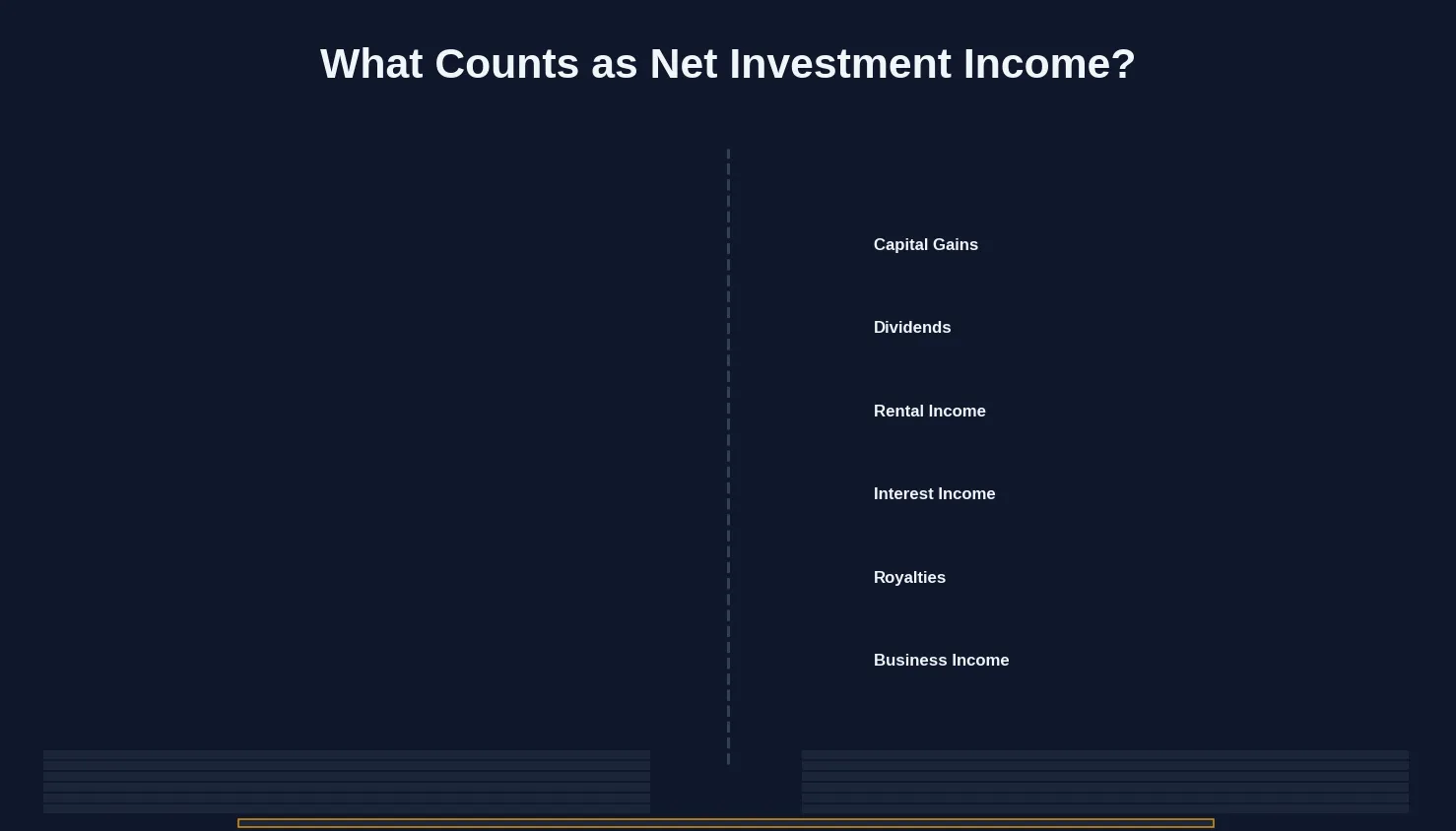
The following types of income are considered net investment income and can be hit with the 3.8% surtax:
- 1Capital gains — This includes gains from selling stocks, bonds, mutual funds, and other securities. Both short-term and long-term capital gains count.
- 1Dividends — Both qualified dividends and ordinary dividends are included. Even though qualified dividends get preferential capital gains rates, they still count as investment income for the NIIT.
- 1Rental income — Net rental income from real estate investment property is investment income. If you actively participate in managing the property, there are some nuances, but the default treatment is that it counts.
- 1Interest income — Taxable interest from bank accounts, CDs, corporate bonds, and other interest-bearing investments is included. Tax-exempt interest from municipal bonds is not.
- 1Royalties — Income from intellectual property, mineral rights, and similar sources counts as investment income.
- 1Passive business income — If you own a business but do not materially participate in its operations, the income from that business is considered investment income. Active business income is excluded.
- 1Gains from the sale of investment property — This includes selling your home if the gain exceeds the Section 121 exclusion, as well as gains from selling rental properties, land, and other investment real estate.
Income That Is NOT Subject to the NIIT
Just as important is understanding what does not count. The following are excluded from net investment income:
- W-2 wages and salaries — Your regular job income is not investment income, even if your MAGI is high enough to trigger the NIIT. A surgeon making $500,000 a year does not pay NIIT on her salary. She only pays it on any investment income she has.
- Active business income — If you materially participate in your business, the income is not investment income. The IRS uses the same material participation tests that apply to passive activity rules.
- Self-employment income — Income from an active trade or business where you materially participate is excluded.
- Social Security benefits — These are not investment income for NIIT purposes.
- Tax-exempt interest — Municipal bond interest is excluded from both your investment income calculation and your MAGI.
- Distributions from qualified retirement plans — Withdrawals from 401(k) plans, traditional IRAs, and similar accounts are not investment income. They increase your MAGI, which can push you over the threshold, but the distributions themselves are not subject to the 3.8% surtax.
- Veterans benefits — VA disability compensation and similar benefits are excluded.
- Alimony — For divorces finalized after 2018, alimony is neither deductible by the payer nor included in the recipient's income, so it does not factor into the NIIT calculation.
How to Calculate the NIIT
The NIIT is 3.8% of the smaller of two numbers: your net investment income, or the amount by which your MAGI exceeds the threshold for your filing status.
The Formula
NIIT = 3.8% x (smaller of: net investment income OR MAGI minus threshold)
This means two things. First, if your MAGI is below the threshold, you owe nothing regardless of how much investment income you have. Second, if your investment income is less than the excess amount, you only pay the 3.8% on the investment income, not the full excess.
Example 1: High Earner with Modest Investment Income
Lisa is single and earns $280,000 in W-2 wages. She has $15,000 in dividends and capital gains. Her MAGI is $295,000.
- Excess MAGI: $295,000 - $200,000 = $95,000
- Net investment income: $15,000
- NIIT applies to the smaller amount: $15,000
- NIIT: $15,000 x 3.8% = $570
Lisa pays $570 in NIIT. Her wages pushed her over the threshold, but the tax only applies to her investment income since that is the smaller number.
Example 2: Moderate Earner with Large Capital Gain
Mark and Jennifer are married filing jointly. They earn $180,000 combined in wages. Mark sold a piece of real estate investment property for a $120,000 long-term capital gain. Their MAGI is $300,000.
- Excess MAGI: $300,000 - $250,000 = $50,000
- Net investment income: $120,000 (capital gain)
- NIIT applies to the smaller amount: $50,000
- NIIT: $50,000 x 3.8% = $1,900
Notice what happened here. Even though Mark and Jennifer have $120,000 in investment income, the NIIT only applies to $50,000 of it. That is because the NIIT is limited to the amount by which their MAGI exceeds the threshold.
Example 3: Below the Threshold
Robert is single and earns $190,000 in wages with $5,000 in investment income. His MAGI is $195,000.
- Excess MAGI: $195,000 - $200,000 = -$5,000 (below threshold)
- NIIT: $0
Robert owes no NIIT at all because his MAGI is below the $200,000 threshold.
The NIIT and Your Combined Tax Rate
When you stack the NIIT on top of regular capital gains rates, the total can be surprisingly high. Let me show you the combined rates:
| Long-Term Gains Rate | Plus NIIT | Combined Rate |
|---|---|---|
| 0% | + 3.8% | 3.8% |
| 15% | + 3.8% | 18.8% |
| 20% | + 3.8% | 23.8% |
And that is before state taxes. If you live in a high-tax state, add state capital gains tax rates on top. A taxpayer in California with a large gain could face a combined rate of roughly 37% (20% federal + 3.8% NIIT + 13.3% state). New York City residents could see about 33% combined.
This is exactly why understanding the NIIT matters. It is not just a small add-on. It can push your effective tax rate on investment gains significantly higher, especially when combined with state taxes.
Strategies to Reduce or Avoid the NIIT
The good news is that there are legitimate strategies to minimize your NIIT exposure. None of these involve anything shady — they are all well-established tax planning techniques.
1. Maximize Retirement Contributions
Contributions to traditional 401(k) and IRA plans reduce your MAGI dollar for dollar. If you are near the threshold, increasing your retirement contributions could drop you below it. In 2026, you can contribute up to $23,500 to a 401(k), or $31,000 if you are 50 or older.
Let me walk through an example. Suppose you are single with $210,000 in MAGI and $15,000 in investment income. Right now, you owe NIIT on $10,000 (the amount by which $210,000 exceeds $200,000). If you increase your 401(k) contributions by $10,500, your MAGI drops to $199,500. You are now below the threshold. The NIIT goes to zero. You just saved $380 in NIIT and reduced your income tax bill as well.
2. Invest in Tax-Exempt Municipal Bonds
Municipal bond interest is excluded from both your net investment income and your MAGI for NIIT purposes. If you are in a high bracket and need income, tax-exempt bonds can be a smart move. You earn interest without increasing your NIIT exposure at all.
3. Use Tax-Loss Harvesting
Tax-loss harvesting reduces your net capital gains, which reduces your net investment income. If you have $30,000 in gains and $10,000 in losses, your net investment income from capital gains drops to $20,000. That could mean less NIIT.
Just remember the wash sale rule — you cannot buy back the same or substantially identical security within 30 days before or after the sale. Plan your harvests carefully.
4. Consider a 1031 Exchange for Real Estate
If you are selling investment real estate, a 1031 exchange allows you to defer the entire capital gain. Since there is no recognized gain, there is no investment income from the sale, and no NIIT on that transaction. This is one of the most powerful deferral tools available for real estate investors.
5. Manage the Timing of Gains and Income
If you are near the threshold, timing matters. Consider these approaches:
- Defer large gains to a low-income year. If you expect your income to drop next year — maybe you are retiring or changing jobs — wait to sell appreciated assets until then.
- Spread gains across multiple years. Instead of selling your entire stock position in one year, sell portions over two or three years to keep each year's MAGI closer to the threshold.
- Avoid realizing gains and taking large retirement distributions in the same year. Since retirement distributions increase your MAGI but are not themselves subject to NIIT, they can push more of your investment income into NIIT territory.
6. Convert to a Roth IRA Strategically
Roth conversions increase your MAGI in the year of conversion, which could trigger the NIIT. But in the right circumstances, paying the tax now can save you money over the long run. Roth distributions are tax-free and do not count toward MAGI, which means they cannot trigger the NIIT in future years.
This strategy works best in years when your income is unusually low, or when you can convert just enough to fill up the gap between your current MAGI and the NIIT threshold without crossing it.
7. Take Advantage of the Active Participation Exception
If you are a real estate professional who materially participates in rental activities, your rental income may be classified as non-passive rather than investment income. This is a complex area of tax law, but for taxpayers who qualify, it can exclude significant rental income from the NIIT calculation.
To qualify as a real estate professional, you must spend more than 750 hours in real property trades or businesses and more than half of your working time in those activities. If you meet this test and materially participate in specific rental properties, the rental income from those properties is not subject to the NIIT.
Reporting the NIIT on Your Tax Return
The NIIT is calculated on Form 8960, Net Investment Income Tax. Here is how it works:
- 1Part I calculates your total investment income — capital gains, dividends, interest, rental income, royalties, and passive business income.
- 1Part II allows you to deduct investment expenses that are directly connected to your investment income. This includes investment interest expense, state and local income taxes allocable to investment income, and certain miscellaneous deductions.
- 1Part III calculates the tax. You compare your net investment income to the excess of your MAGI over the threshold. The NIIT applies to the smaller amount at 3.8%.
- 1Part IV handles special reporting for certain types of trusts and estates.
The NIIT is reported on Line 12 of your Form 1040. It is added to your total tax liability along with your regular income tax and any other taxes you owe.
If you are also reporting capital gains on Form 8949 and Schedule D, make sure your capital gain numbers are consistent between Schedule D and Form 8960. The IRS cross-references these forms.
Common Mistakes People Make with the NIIT
I see these errors all the time, and they can cost you real money or trigger an IRS notice.
Mistake 1: Thinking the NIIT Only Applies to Capital Gains
Capital gains are the most common trigger, but dividends, interest, rental income, and royalties all count too. If you have $250,000 in wages and $30,000 in dividend income, the NIIT applies to the dividends, not to any capital gains.
Mistake 2: Forgetting That Retirement Distributions Increase MAGI
Your 401(k) distribution is not investment income, but it increases your MAGI, which can push more of your actual investment income into NIIT territory. A $50,000 IRA withdrawal might not be directly taxed by the NIIT, but it could cause $50,000 of your dividends and capital gains to become subject to the 3.8% surtax.
Mistake 3: Not Deducting Investment Expenses on Form 8960
You can deduct investment expenses directly connected to your investment income on Form 8960. This includes investment interest expense and state income taxes allocable to investment income. Many people skip this step and overpay.
Mistake 4: Overlooking the NIIT for Crypto Gains
When you sell cryptocurrency for a gain, that gain is investment income for NIIT purposes. With the surge in crypto trading, many taxpayers are surprised to find their crypto gains pushing them over the NIIT threshold.
Mistake 5: Ignoring State-Level Surtaxes
Some states have their own version of the NIIT or have proposed legislation to create one. While the federal NIIT is the main concern, check whether your state imposes additional surtaxes on investment income. Our state capital gains tax rates guide covers the full picture for all 50 states.
Special Rules for Trusts and Estates
Trusts and estates are also subject to the NIIT, but with a much lower threshold. For 2026, the NIIT threshold for estates and trusts is roughly $15,200 (this figure is adjusted annually for inflation, unlike the individual thresholds).
This means that even relatively modest investment income inside a trust can trigger the 3.8% surtax. If you are the trustee or beneficiary of a trust, this is something to watch carefully. Strategies like distributing income to beneficiaries (who may have higher individual thresholds) can reduce the overall NIIT burden.
The Bottom Line
The Net Investment Income Tax is a 3.8% surtax that catches many people by surprise. It applies to investment income when your modified adjusted gross income exceeds $200,000 as a single filer or $250,000 as a married couple. The tax is calculated on the smaller of your net investment income or the amount by which your MAGI exceeds the threshold.
Understanding what counts as investment income is critical. Capital gains, dividends, interest, rental income, royalties, and passive business income are all included. Wages, active business income, retirement distributions, and tax-exempt interest are excluded — but retirement distributions can still push your MAGI over the threshold.
The most effective strategies for reducing the NIIT are increasing retirement contributions, investing in tax-exempt bonds, harvesting tax losses, timing your gains carefully, and using a 1031 exchange for real estate. Each of these can legitimately lower your exposure without raising any red flags with the IRS.
If you think you might be subject to the NIIT, run the numbers before year-end. A few strategic moves before December 31 can save you thousands. For more tax planning strategies and detailed guides, browse our full collection of capital gains tax articles and resources.
Fact-Checked & Reviewed
This article was written by James Park (EA, CFP (Certified Financial Planner)) and reviewed for accuracy by Sarah Mitchell (CPA, MST (Master of Science in Taxation)). Published by Wasim Akram, Founder & Lead Researcher at TaxGainsCalc. All tax rates, thresholds, and rules referenced are based on IRS publications and current tax law as of the date published. Tax laws change frequently — always consult a qualified tax professional for advice specific to your situation.
Enrolled Agent & Tax Researcher
James Park is an Enrolled Agent licensed by the IRS and a Certified Financial Planner with over 12 years of experience in tax research and financial planning. He specializes in capital gains strategies for real estate investors and cryptocurrency tra...
Certified Public Accountant (CPA)
Sarah Mitchell is a Certified Public Accountant with over 15 years of experience in individual and business taxation. She holds a Master of Science in Taxation from Golden Gate University and specializes in capital gains tax planning, investment tax ...

Founder & Lead Researcher, TaxGainsCalc
Wasim Akram is an independent web publisher and digital entrepreneur based in India. Since 2018, he has been building custom CMS platforms, WordPress plugins, niche websites, and AI-powered digital products with over 8 years of real-world experience....
Disclaimer: This article is for informational purposes only and does not constitute tax, legal, or financial advice. Tax laws and regulations change frequently, and the information presented here may not reflect the most current updates. You should consult with a qualified CPA, tax attorney, or financial advisor before making any tax-related decisions. TaxGainsCalc is not responsible for any actions taken based on the information provided in this article.