Capital Gains Tax vs Ordinary Income Tax: The Difference That Costs or Saves You Thousands
Complete guide to capital gains tax vs ordinary income tax. Learn how each is taxed, the rate differences, what counts as capital gains versus ordinary income, and strategies to shift more of your income into the lower-taxed category.
The Two Tax Systems Running Your Financial Life
If you earn money in America, the IRS taxes it. But not all income gets taxed the same way. There are two completely different systems running side by side, and understanding which one applies to your money can literally save you thousands of dollars every year.
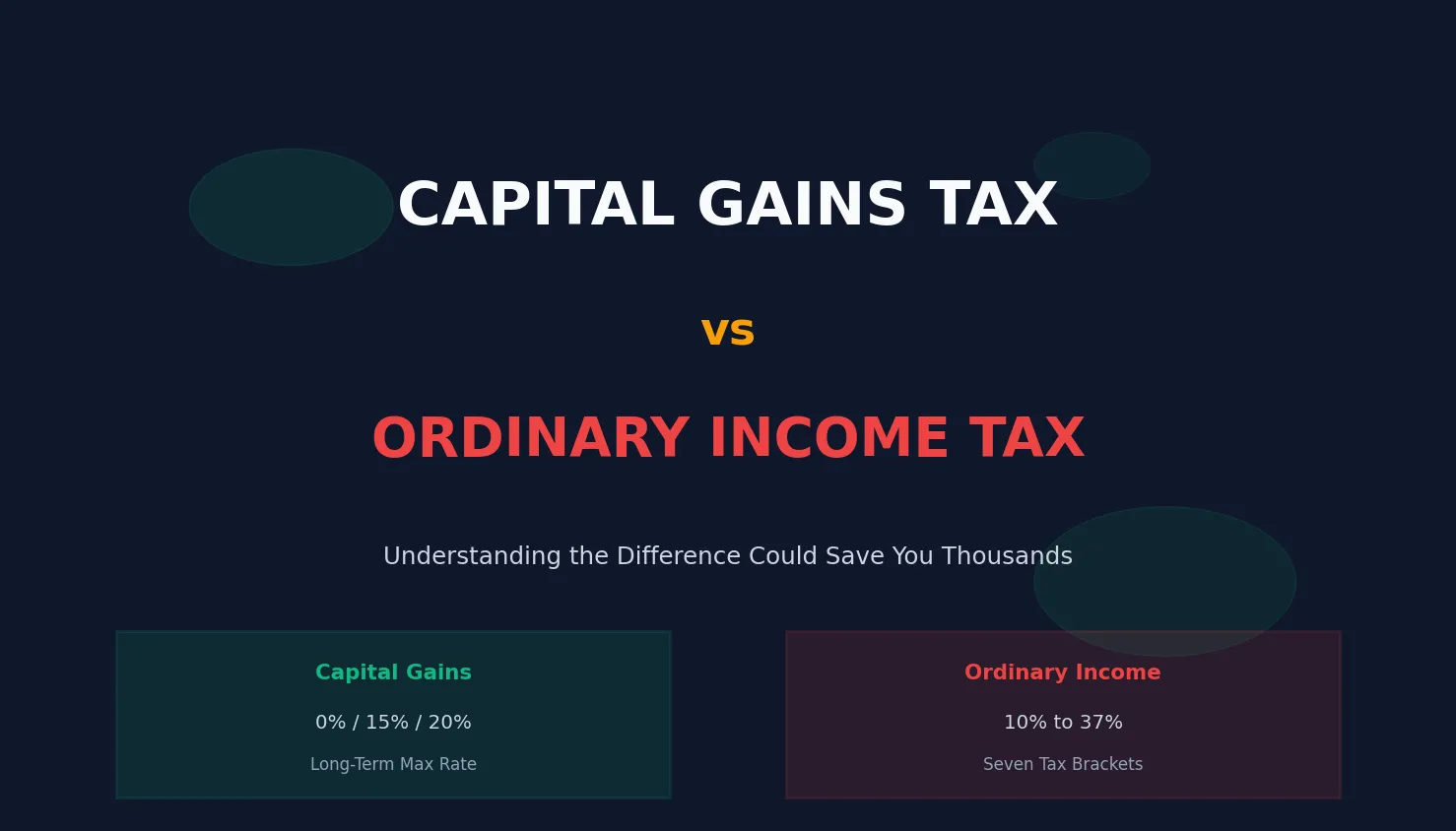
Ordinary income tax is what you pay on your salary, your freelance earnings, your interest income, and any short-term investment gains. The rates run from 10% all the way up to 37%. Capital gains tax is what you pay on profits from selling investments you held for more than a year. Those rates are 0%, 15%, or 20% for most assets.
That gap between the two systems is enormous. A married couple with $120,000 of ordinary income pays 22% on the top portion. That same couple with $120,000 of long-term capital gains pays just 15%. On a $50,000 gain, the difference is $3,500. On a $200,000 gain, we are talking about $14,000. This is not pocket change.
I remember sitting with a client named Robert who had just sold a rental property he owned for six years. He made a $180,000 profit. When I told him his tax bill would be roughly $27,000 at the long-term capital gains rate, he was relieved. Then I showed him what it would have been at ordinary income rates — about $50,000. His face went pale. That $23,000 difference existed entirely because of how the gain was classified.
This guide breaks down every difference between these two tax systems, shows you exactly what falls into each category, and gives you real strategies to keep more of your money in the lower-taxed column.
What Is Ordinary Income Tax?
Ordinary income tax is the default. If the tax code does not specifically say something gets special treatment, it gets taxed as ordinary income. The rates are progressive, meaning you pay higher percentages as your income goes up.
The seven ordinary income brackets for 2026 are 10%, 12%, 22%, 24%, 32%, 35%, and 37%. Your income fills up each bracket in order, so your first dollars are taxed at 10% and your last dollars might be taxed at 37%.
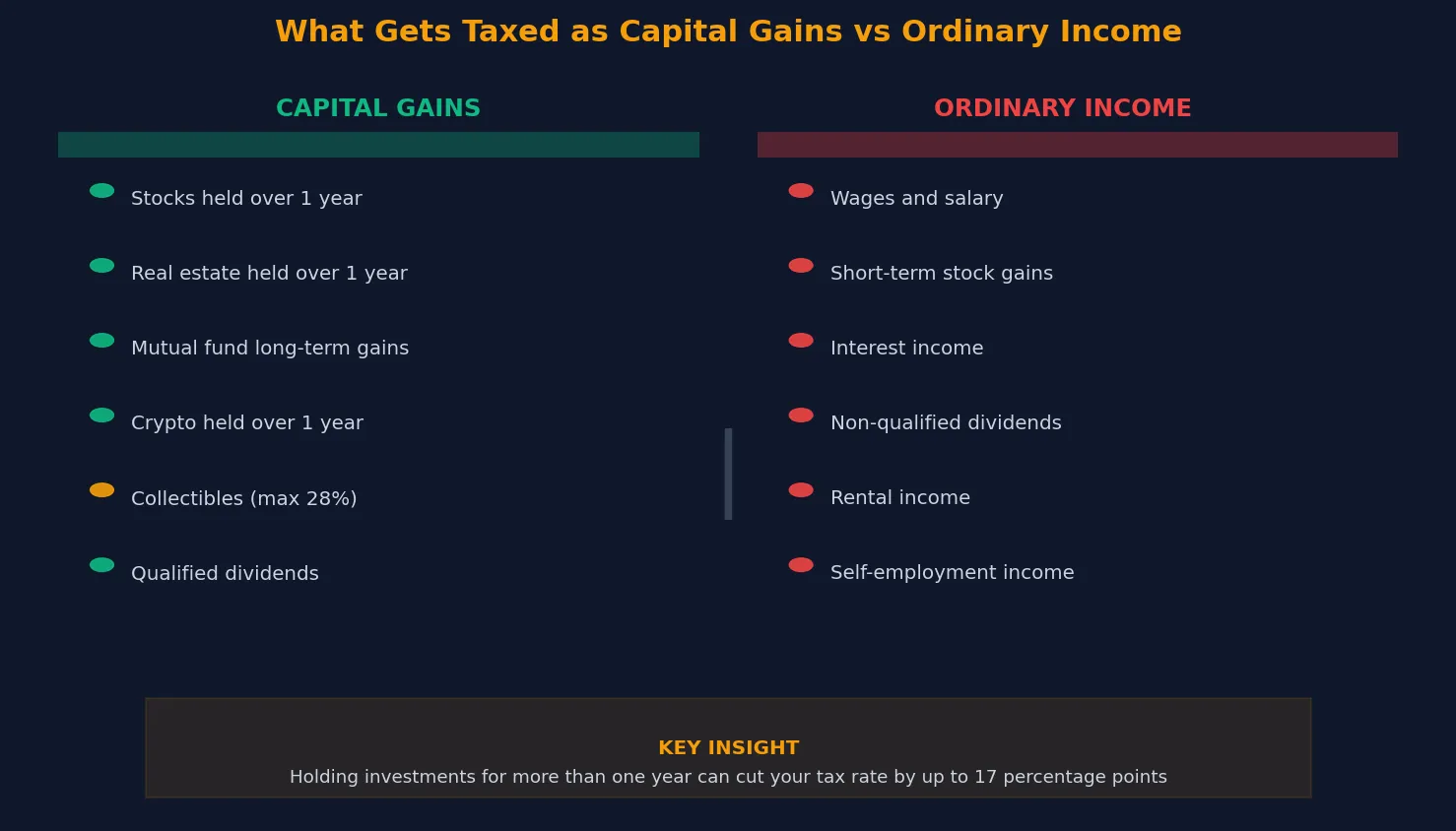
Here is what counts as ordinary income: your wages and salary, tips and bonuses, self-employment income, interest from bank accounts and bonds, short-term capital gains from investments held one year or less, non-qualified dividends, rental income, alimony received (for divorces finalized before 2019), and generally anything else that is not specifically given preferential treatment.
Most of your working income falls into this category. There is not much you can do to change how your salary gets taxed. But when it comes to investments, you have real choices that can shift income from the ordinary column to the capital gains column.
What Is Capital Gains Tax?
Capital gains tax applies when you sell a capital asset for more than you paid for it. The key word here is "sell." You do not owe capital gains tax until you actually sell. Paper gains — the unrealized appreciation in your portfolio — are not taxed at all.
Capital assets include stocks, bonds, mutual funds, real estate, cryptocurrency, collectibles, and most other investments you hold for personal use or investment purposes. Your primary residence is a capital asset too, with special exclusions we will discuss later.
The long-term capital gains rates are dramatically lower than ordinary income rates. For 2026, the three brackets are 0% for taxable income up to about $96,000 for married couples filing jointly, 15% for income up to about $583,000, and 20% for income above that threshold.
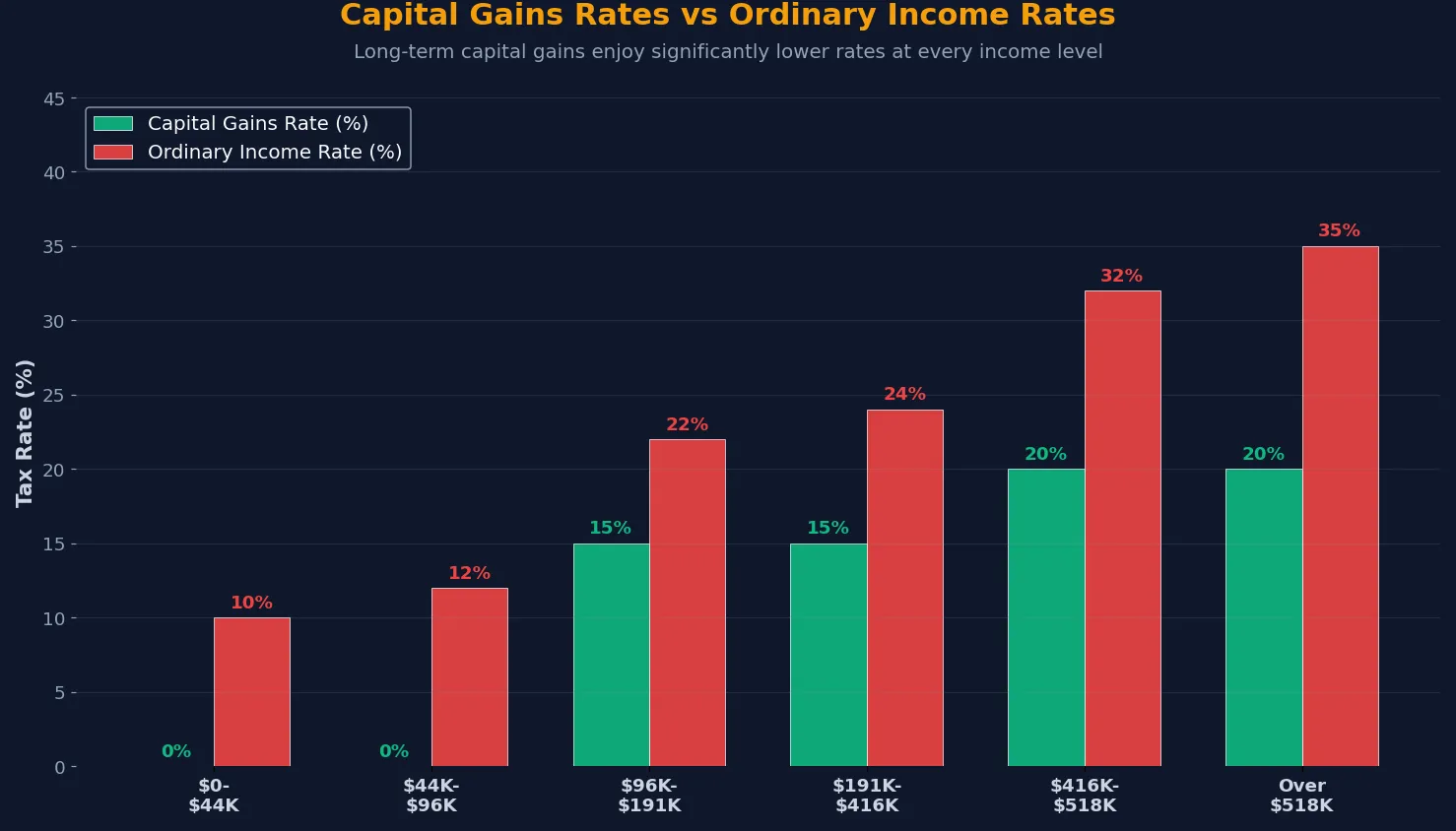
Compare that to the ordinary rates. A married couple in the $96,000 to $191,000 range pays 22% on ordinary income but only 15% on long-term capital gains. That is a 7-point difference on every dollar in that bracket. A single filer in the $48,000 to $100,000 range pays 22% on ordinary income but 15% on capital gains. Same story.
The holding period is what determines which system applies. Hold for more than one year, and you get the preferential capital gains rates. Hold for one year or less, and your gain is taxed as ordinary income. That one-day difference can change your tax bill by thousands.
Our comparison of short-term versus long-term capital gains walks through the exact math with real numbers if you want to see the calculations in detail.
The Rate Gap: By the Numbers
Let me show you the difference at specific income levels so you can see exactly how much is at stake. These numbers assume a married couple filing jointly in 2026.
At $80,000 of taxable income: Ordinary income would be taxed at 12%. Long-term capital gains would be taxed at 0%. Yes, zero percent. That means a couple at this income level pays absolutely nothing in federal tax on their long-term gains. If they have a $30,000 long-term gain, they keep all $30,000. If that same $30,000 is short-term or ordinary income, they pay $3,600 in tax.
At $150,000 of taxable income: Ordinary income hits the 22% bracket. Capital gains sit at 15%. On a $50,000 gain, that is $11,000 in ordinary income tax versus $7,500 in capital gains tax. You save $3,500 just by holding longer.
At $350,000 of taxable income: Ordinary income is at 32% or 35%. Capital gains are still at 15% or possibly 20%. On a $100,000 gain, the difference between 35% and 20% is $15,000. That is a huge gap.
At $600,000 of taxable income: Ordinary income reaches the 37% top bracket. Capital gains max out at 20%. On a $200,000 gain, that is $74,000 in ordinary income tax versus $40,000 in capital gains tax. A $34,000 difference from the exact same gain, just classified differently.
These numbers tell the whole story. The higher your income, the bigger the gap between the two systems, and the more incentive you have to structure your income as capital gains rather than ordinary income.
What Counts as Capital Gains
Not every profit qualifies for the lower capital gains rates. Here is a clear breakdown of what does and does not count.
Stocks and bonds that you hold for more than one year produce long-term capital gains when sold at a profit. This is the most common type of capital gain. Your brokerage reports these sales on Form 1099-B. Our guide to reporting capital gains on your tax return covers exactly which forms to use.
Real estate held for more than one year also produces long-term capital gains when sold. Your primary residence gets a special exclusion of up to $250,000 for single filers or $500,000 for married couples, which can wipe out the gain entirely. Investment property works differently because of depreciation recapture, which is taxed at a flat 25% rate. Our real estate investment property tax guide explains the full breakdown.
Mutual funds and ETFs generate capital gains in two ways: when you sell your shares at a profit, and when the fund distributes capital gains from its own trading activity. Both can qualify for the lower rates if the holding period requirement is met. See our mutual funds and ETFs tax guide for details.
Cryptocurrency is treated as property by the IRS. When you sell crypto held for more than a year, the gain is a long-term capital gain. Our cryptocurrency tax guide covers which transactions are taxable.
Collectibles like gold, silver, art, and antiques have a special maximum rate of 28% instead of 20%. Our collectibles tax guide explains this in detail.
Qualified dividends are not technically capital gains, but they are taxed at the same preferential rates. This is a big deal for investors who receive significant dividend income. Our dividend tax guide explains the qualification requirements.
What Stays as Ordinary Income
Some types of income will always be taxed at ordinary income rates, no matter what you do. Knowing what falls into this category helps you plan around it.
Wages and salary are the most obvious example. Your paycheck gets taxed at ordinary income rates, with brackets from 10% to 37%. There is no way to convert salary into capital gains unless you receive stock options or equity compensation that can appreciate over time.
Interest income from bank accounts, CDs, corporate bonds, and most other fixed-income investments is always ordinary income. Treasury bonds are exempt from state tax but still taxed at ordinary rates at the federal level. Municipal bond interest is the exception — it is tax-free at the federal level. Our bonds tax guide explains this distinction.
Short-term capital gains from selling investments held one year or less are taxed at ordinary income rates. This is the biggest trap investors fall into. A stock held for 364 days generates ordinary income, while the same stock held for 366 days generates capital gains. The rate difference can be 17 percentage points or more.
Non-qualified dividends are taxed at ordinary income rates. These include dividends from REITs, master limited partnerships, and certain foreign corporations. Not all dividends get the preferential rate.
Rental income from investment properties is ordinary income, not capital gains. Even though real estate is a capital asset, the rental income it generates is treated separately from the gain you make when you sell the property.
Self-employment income is ordinary income, subject to both income tax and self-employment tax. The total effective rate can exceed 40% when you factor in both taxes.
The Holding Period: Your Most Powerful Tax Lever
If there is one concept from this guide that I want you to remember, it is this: the holding period is the single most important factor in determining whether your investment gains get taxed at capital gains rates or ordinary income rates.
One year. That is the magic number. Hold an investment for more than one year, and your gain qualifies for the preferential capital gains rates. Hold it for one year or less, and it is ordinary income.
The calendar calculation matters. Your holding period starts the day after you buy the asset and ends on the day you sell it. If you buy stock on January 15, your holding period starts January 16. If you sell on January 15 of the following year, you have held it for exactly 365 days — which is one year or less, so it is short-term. If you sell on January 16, you have held it for 366 days — more than one year — and it is long-term.
This distinction is so consequential that I have advised clients to delay selling by a few days just to cross the one-year threshold. On a $100,000 gain, waiting a few extra days can save you $5,000 to $17,000 in taxes depending on your bracket.
Our short-term capital gains rates guide shows you the exact brackets and calculations for gains that do not qualify for the preferential rates.
The 3.8% Net Investment Income Tax: An Extra Burden
On top of everything else, higher-income taxpayers face an additional 3.8% surtax on investment income. The net investment income tax applies when your modified adjusted gross income exceeds $200,000 (single) or $250,000 (married filing jointly).
This tax applies to both capital gains and certain types of ordinary investment income. So your effective maximum capital gains rate is actually 23.8% (20% plus 3.8%), and your effective maximum ordinary income rate is 40.8% (37% plus 3.8%).
The NIIT adds the same percentage to both categories, so the gap between capital gains and ordinary income remains the same. But it makes the overall tax burden heavier for everyone above the thresholds. Our complete guide to the net investment income tax explains the thresholds, calculations, and planning strategies in detail.
State Taxes Apply to Both Types
Do not forget that most states impose their own income tax on top of the federal rates. And most states tax capital gains at the same rate as ordinary income, with no preferential rate for long-term gains.
California, for example, taxes everything at ordinary rates up to 13.3%. A California resident in the top bracket pays 37% federal plus 3.8% NIIT plus 13.3% state on ordinary income, for a combined rate of about 54%. On long-term capital gains, it is 20% plus 3.8% plus 13.3%, or about 37%. Still high, but the gap is enormous.
States with no income tax — like Florida, Texas, Nevada, and Washington — let you keep the full benefit of the preferential capital gains rates. Our state capital gains tax rates guide breaks down every state so you can see exactly what you owe.
6 Strategies to Shift Income from Ordinary to Capital Gains
1. Always Hold Investments for More Than One Year
This is the simplest and most effective strategy. If you are anywhere near the one-year mark on an investment, wait. The tax savings from qualifying for capital gains rates almost always outweigh the risk of a few more days of market exposure.
2. Use Tax-Loss Harvesting to Offset Ordinary Income
When you sell losing investments, you can use up to $3,000 of net capital losses per year to offset ordinary income. Any excess carries forward indefinitely. This is a direct reduction in your ordinary income tax bill, dollar for dollar. Our tax-loss harvesting guide explains the full strategy including how to avoid the wash sale rule.
3. Maximize Qualified Dividends
Not all dividends are created equal. Qualified dividends get the preferential capital gains rates, while non-qualified dividends are taxed as ordinary income. Hold dividend-paying stocks for at least 61 days around the ex-dividend date to ensure your dividends qualify. Our dividend tax guide has the exact holding period rules.
4. Consider Opportunity Zone Investments
If you have a large capital gain, investing it in a Qualified Opportunity Zone Fund can defer the original gain and potentially reduce it by up to 15% if you hold the investment for seven years. Plus, any gain on the opportunity zone investment itself is tax-free if held for ten years. Our capital gains tax deferral strategies covers this and other deferral options.
5. Use the Section 121 Home Sale Exclusion
When you sell your primary residence, you can exclude up to $250,000 of gain (single) or $500,000 (married) if you lived in the home for at least two of the five years before the sale. This exclusion turns what would be a capital gain into completely tax-free income. Our home sale tax guide explains the qualification rules in detail.
6. Time Your Gains to Low-Income Years
If you expect a year with lower income — maybe you are between jobs, taking a sabbatical, or retiring — that is the time to realize capital gains. In a year where your taxable income is below $83,000 (single) or $166,000 (married), your long-term capital gains rate drops to 0%. That means you pay absolutely nothing in federal tax on those gains. For retirees especially, this strategy is incredibly powerful. Our capital gains tax guide for seniors and retirees goes deeper into retirement-specific strategies.
Common Mistakes That Cost You Money
Mistake 1: Selling too soon. The biggest mistake by far is selling investments before the one-year mark. People do this all the time because they are excited about a profit or nervous about a pullback. But the tax cost can be devastating. On a $50,000 gain, selling one week too early can cost you an extra $8,500 in taxes if you are in the 32% ordinary bracket versus the 15% capital gains bracket.
Mistake 2: Not tracking cost basis. If you cannot prove what you paid for an investment, the IRS may treat your entire sale proceeds as taxable gain. Keep your purchase records, and make sure your brokerage is reporting your basis correctly.
Mistake 3: Ignoring the wash sale rule. If you sell a stock at a loss and buy it back within 30 days, the IRS disallows the loss deduction. This means you lose the tax benefit of the loss without actually changing your investment position. Our wash sale rule guide explains exactly how this works.
Mistake 4: Forgetting about estimated payments. If you have a large capital gain during the year, you may need to make estimated tax payments to avoid underpayment penalties. Our estimated payments guide walks you through the safe harbor rules.
Mistake 5: Not using the 0% bracket. If your income is low enough, your long-term capital gains are taxed at 0%. Many people leave this benefit on the table because they do not realize it exists. Even if you normally earn too much, a sabbatical year, a gap between jobs, or early retirement can create the perfect window to realize gains tax-free.
The Bottom Line
The difference between capital gains tax and ordinary income tax is one of the most powerful forces in your financial life. Capital gains rates are 0%, 15%, or 20% for most assets. Ordinary income rates range from 10% to 37%. The gap can be as much as 17 percentage points, which translates to thousands or even tens of thousands of dollars on a single transaction.
The holding period is your most important tool. Hold investments for more than one year, and you unlock the lower capital gains rates. Sell too soon, and your gains get taxed at ordinary income rates.
Use the strategies in this guide to maximize the amount of income that falls into the capital gains category and minimize the amount that gets taxed at ordinary income rates. Over a lifetime of investing, these decisions can easily add up to six figures in tax savings.
For more strategies, calculators, and guides, explore our full library of capital gains tax resources.
Fact-Checked & Reviewed
This article was written by James Park (EA, CFP (Certified Financial Planner)) and reviewed for accuracy by Sarah Mitchell (CPA, MST (Master of Science in Taxation)). Published by Wasim Akram, Founder & Lead Researcher at TaxGainsCalc. All tax rates, thresholds, and rules referenced are based on IRS publications and current tax law as of the date published. Tax laws change frequently — always consult a qualified tax professional for advice specific to your situation.
Enrolled Agent & Tax Researcher
James Park is an Enrolled Agent licensed by the IRS and a Certified Financial Planner with over 12 years of experience in tax research and financial planning. He specializes in capital gains strategies for real estate investors and cryptocurrency tra...
Certified Public Accountant (CPA)
Sarah Mitchell is a Certified Public Accountant with over 15 years of experience in individual and business taxation. She holds a Master of Science in Taxation from Golden Gate University and specializes in capital gains tax planning, investment tax ...

Founder & Lead Researcher, TaxGainsCalc
Wasim Akram is an independent web publisher and digital entrepreneur based in India. Since 2018, he has been building custom CMS platforms, WordPress plugins, niche websites, and AI-powered digital products with over 8 years of real-world experience....
Disclaimer: This article is for informational purposes only and does not constitute tax, legal, or financial advice. Tax laws and regulations change frequently, and the information presented here may not reflect the most current updates. You should consult with a qualified CPA, tax attorney, or financial advisor before making any tax-related decisions. TaxGainsCalc is not responsible for any actions taken based on the information provided in this article.