Capital Gains Tax on Land Sale: Vacant Land, Raw Land and the Rules Nobody Tells You About
Complete guide to capital gains tax on land sales. Learn how selling vacant land, raw land, and lots is taxed differently from other real estate, why Section 121 does not apply, how 1031 exchanges work for land, and strategies to reduce your tax bill.
Selling Land Creates Tax Problems Most Owners Never Expect
You bought a piece of land years ago. Maybe it was a vacant lot near your neighborhood, maybe it was raw acreage out in the country, or maybe it was a parcel you picked up at a tax sale. The price was low, you held it patiently, and now someone wants to buy it for much more than you paid. That profit feels great — until you realize the IRS wants a cut.
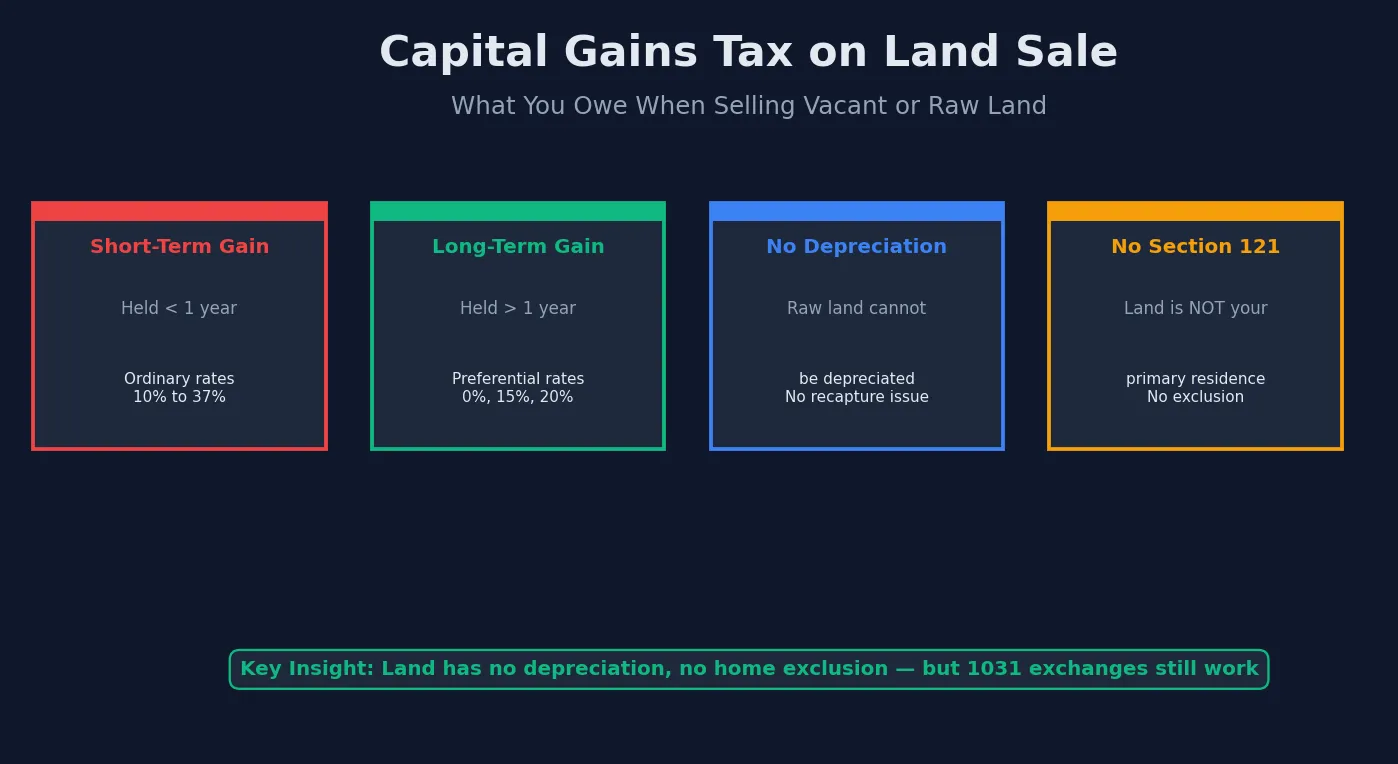
Land is a capital asset, just like stocks and bonds. When you sell it for more than you paid, you have a capital gain, and that gain is taxable. But land has some unique characteristics that make its tax treatment different from almost every other type of real estate. There is no depreciation to recapture, no Section 121 exclusion to shelter your gain, and no rental income to offset. What you make on the sale is what the IRS sees, and they tax it accordingly.
I worked with a client named Tom who bought 20 acres of farmland in Iowa for $40,000 back in 2010. A developer approached him in 2025 offering $220,000 for the same parcel. Tom was thrilled — a $180,000 profit on land he barely touched. But when I calculated his tax bill, it came to roughly $30,000 at the long-term capital gains rates plus another $6,000 in state tax. He never expected land to generate such a big tax hit, and he had zero plan for it.
This guide explains exactly how capital gains tax works on land sales, what makes land different from other real estate, and the strategies you can use to keep more of your profit when you sell.
How the IRS Classifies Your Land
The first question the IRS asks when you sell land is: what was the land used for? Your tax treatment depends entirely on this classification, and getting it wrong can cost you thousands.
Investment land is property you bought primarily to hold and appreciate in value. You are not developing it, you are not renting it, and you are not using it for business. Most vacant lots and raw acreage fall into this category. When you sell investment land at a profit after holding it for more than one year, the gain is a long-term capital gain taxed at 0%, 15%, or 20%.
Business land is property used in your trade or business. If you operate a farm on the land, run a construction business from it, or use it for any regular business purpose, it qualifies as business property. The gain from selling business land is still a capital gain, but you may have additional considerations like depreciation recapture if you claimed any deductions over the years.
Personal-use land is property you use for personal enjoyment rather than investment or business. A hunting property, a recreational lot, or a parcel next to your home that you use as a yard — these can all be personal-use land. The gain from selling personal-use land is still a capital gain, but the loss from selling it at a price below what you paid is NOT deductible. This is a critical distinction that catches many people off guard.
Our guide to capital gains tax for beginners covers the basic classification rules if you want a broader overview of how the IRS categorizes different assets.
Short-Term vs Long-Term Gains on Land
Just like with stocks and other investments, the holding period determines whether your land sale gain gets preferential tax rates or ordinary income rates. This is the single most important factor in your tax calculation.
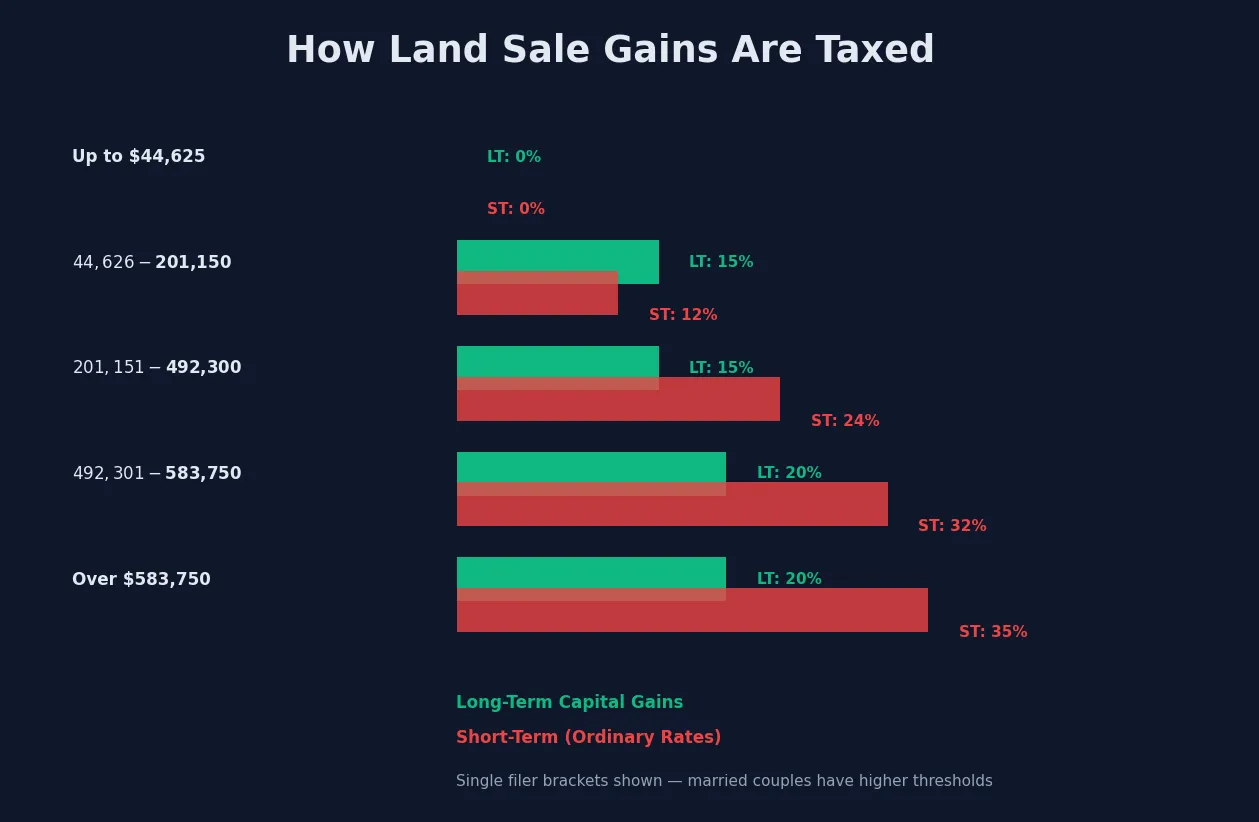
If you hold the land for more than one year before selling, your gain qualifies as a long-term capital gain. The long-term capital gains rates are 0%, 15%, or 20%, depending on your total taxable income. For 2026, a single filer with taxable income below about $48,000 pays 0% on long-term gains. Most middle-income taxpayers pay 15%. High-income taxpayers above about $525,000 pay 20%.
If you hold the land for one year or less, your gain is a short-term capital gain taxed at ordinary income rates. These rates range from 10% to 37%, and they can be dramatically higher than the capital gains rates. Our comparison of short-term versus long-term capital gains shows the exact rate difference at every income level.
On Tom's $180,000 land gain, the difference between holding for more than one year versus less than one year was staggering. At the 15% long-term rate, his federal tax was about $27,000. At the 32% ordinary income rate (where his total income placed him), the tax would have been about $57,600. That is a $30,600 difference from the exact same gain, just from holding a few extra days.
Why Land Is Taxed Differently From Other Real Estate
Land has three characteristics that make its tax treatment unique compared to houses, apartments, and commercial buildings. Understanding these differences is essential for accurate tax planning.
No depreciation deductions. This is the biggest difference. Unlike buildings, land cannot be depreciated because it does not wear out or lose value over time. When you own a rental house, you claim depreciation deductions every year, which reduces your taxable rental income. When you sell that house, you must "recapture" those deductions at a 25% rate. But with raw land, there are no depreciation deductions to claim during ownership and no recapture to worry about at sale. This sounds like an advantage, but it actually means you have no annual tax benefit from holding the land, and your entire gain is subject to capital gains rates without any recapture layer.
Our real estate investment property tax guide explains how depreciation works for buildings and what happens when you sell — rules that do not apply to raw land.
No Section 121 exclusion. The home sale exclusion that lets you shelter up to $250,000 of gain (single) or $500,000 (married) when selling your primary residence does NOT apply to vacant land. Even if the lot is right next to your house, even if you considered it part of your property, the IRS treats land separately from your main home unless the land is an integral part of the dwelling. A vacant lot next to your house does not qualify. Only land that is physically attached to and used as part of your primary residence can potentially be included in the Section 121 exclusion, and even then, the rules are strict.
No rental income offset. If you own a rental property, the rental income is taxed as ordinary income, but you also get depreciation deductions, mortgage interest deductions, and other expenses that reduce the taxable amount. With vacant land that you are not renting, you have no income from the property but also no deductions. Your carrying costs — property taxes, maintenance, interest on any loan — may be deductible against other income, but they do not reduce the capital gain when you sell.
Calculating Your Capital Gain on Land
The gain calculation for land is straightforward, but there are details that can change the numbers significantly.
Your capital gain equals your sale price minus your cost basis minus selling expenses. The cost basis is what you originally paid for the land plus any costs associated with the purchase, such as title fees, survey costs, and legal expenses. Selling expenses include real estate agent commissions, closing costs, advertising, and legal fees for the sale.
Improvements increase your basis. If you added a road, installed a well, cleared trees, or put in a fence, those improvement costs increase your cost basis and reduce your taxable gain. Keep records of every improvement you make. Routine maintenance like mowing or weed control does not count as an improvement, but structural additions to the land do.
Inherited land gets stepped-up basis. If you inherited the land, your basis is the fair market value on the date the person who left it to you died, not what they originally paid. This "step-up" can dramatically reduce your gain. Our guide to capital gains on inherited property explains the stepped-up basis rules in detail.
Gifted land carries over the giver's basis. If someone gave you the land as a gift, your basis is whatever the giver's basis was — you inherit their cost, not the current market value. This can create a surprisingly large taxable gain if the land appreciated significantly before you received it.
Let me walk through an example. Suppose you bought a 5-acre vacant lot for $30,000 in 2015. You paid $1,500 in closing costs at purchase, and you spent $8,000 clearing trees and installing a gravel driveway over the years. In 2026, you sell the lot for $150,000. The real estate commission is $9,000 and closing costs on the sale are $2,500.
Your cost basis is $30,000 + $1,500 + $8,000 = $39,500. Your selling expenses are $9,000 + $2,500 = $11,500. Your net proceeds are $150,000 - $11,500 = $138,500. Your capital gain is $138,500 - $39,500 = $99,000. Since you held the land for more than one year, this is a long-term capital gain taxed at 0%, 15%, or 20% depending on your income.
The 3.8% Net Investment Income Tax on Land Gains
If your modified adjusted gross income exceeds $200,000 (single) or $250,000 (married filing jointly), you face an additional 3.8% net investment income tax on your land sale gain. This surtax applies on top of the regular capital gains rate, pushing your effective maximum rate to 23.8%.
For someone with high income and a large land gain, this extra tax can be significant. On Tom's $180,000 gain, the NIIT added another $6,840 to his federal tax bill. Our complete guide to the net investment income tax explains the thresholds, calculations, and planning strategies.
State Taxes on Land Sale Gains
Your state will also tax the gain from selling land. Most states tax capital gains at the same rate as ordinary income, with no preferential rate for long-term gains. This means your combined federal and state rate can be much higher than the federal rate alone.
California adds up to 13.3%, New York adds up to 10.9%, and other high-tax states pile on their own rates. A California resident selling land with a $200,000 long-term gain pays about 15% federal plus 3.8% NIIT plus 13.3% state, totaling roughly 32.1%. Compare that to a Florida resident who pays just 15% plus 3.8% NIIT, since Florida has no state income tax.
Our state capital gains tax rates guide has the complete breakdown for every state so you can calculate your true combined rate.
1031 Exchange: The Best Way to Defer Tax on Land
The single most powerful strategy for avoiding capital gains tax on a land sale is the 1031 exchange. This provision in the tax code lets you defer the entire gain by reinvesting the proceeds into another investment property — including more land.
A 1031 exchange works like this for land. You sell your land, but instead of receiving the cash directly, the proceeds go to a qualified intermediary who holds them in escrow. Within 45 calendar days of the sale, you must identify one or more replacement properties. Within 180 calendar days of the sale, you must close on the replacement property. The intermediary then uses your sale proceeds to purchase the replacement property, and the capital gain on your original land sale is fully deferred.
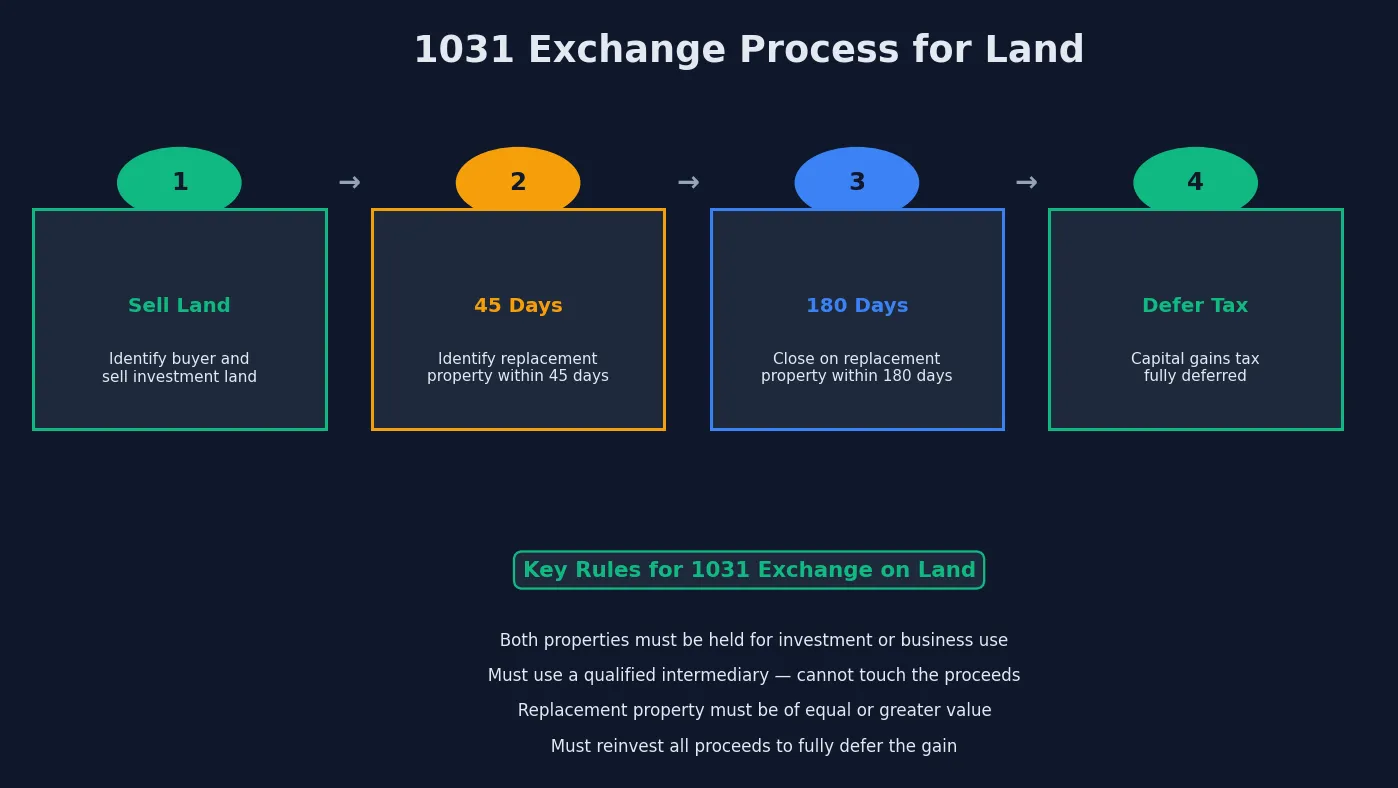
The key requirements are strict. Both the sold property and the replacement property must be held for investment or business use. Vacant land qualifies as investment property on both sides of the exchange. You must use a qualified intermediary — you cannot touch the sale proceeds yourself. The replacement property must be of equal or greater value to fully defer the gain. And you must reinvest all proceeds, not just some.
Our capital gains tax deferral strategies guide covers 1031 exchanges, opportunity zones, installment sales, and other deferral methods in detail.
Land-to-land exchanges are the simplest type. Because there is no depreciation recapture involved on either side, the exchange is cleaner than a building-to-building exchange where recapture complicates the calculation. You can exchange farmland for a vacant city lot, rural acreage for a developed subdivision lot, or any other combination of investment land.
Partial exchanges are possible too. If you sell land for $200,000 but only reinvest $150,000 into a replacement property, you defer tax on $150,000 but recognize a gain on the $50,000 you did not reinvest. This "boot" is taxable in the year of the exchange.
Installment Sales: Spreading the Gain Over Multiple Years
If the buyer pays you over time instead of all at once, you can use the installment sale method to spread your capital gain across the years you receive payments. This can keep you in a lower tax bracket each year instead of pushing you into a high bracket all at once.
Under the installment method, you calculate your gross profit percentage (gain divided by total contract price) and apply that percentage to each payment you receive. Each payment is partially a return of your basis (not taxable) and partially a gain (taxable at capital gains rates).
This works especially well for land because there is no depreciation recapture to worry about. With buildings, the recapture portion must be reported entirely in the year of sale regardless of the installment method. But with land, the entire gain can be spread across the payment years.
The downside is you tie up your money over time and take the risk that the buyer might default. But for a large gain that would push you into the 20% bracket or trigger the NIIT, spreading the income across several years can save you thousands.
Subdividing Land: A Tax Trap to Watch For
If you subdivide a large parcel into smaller lots and sell them individually, you need to be careful about how the tax treatment changes. Selling subdivided lots can potentially shift your gain from capital gains treatment to ordinary income treatment if the IRS determines you are acting as a developer rather than an investor.
The IRS looks at several factors to determine whether you are an investor selling subdivided land or a developer engaged in a business activity. These factors include how many lots you create, how quickly you sell them after subdivision, whether you improve the lots with roads or utilities before selling, and whether you advertise and market the lots actively.
If the IRS classifies your subdivision activity as a business, the gains from selling the individual lots are taxed as ordinary income, not capital gains. This can double your tax rate. The key distinction is between someone who subdivides a few lots from a long-held parcel (likely still investment activity) and someone who buys land specifically to subdivide and sell quickly (likely a business activity).
If you are considering subdividing, keep the number of lots small, hold the land for a significant period before subdividing, and minimize improvements. Talk to a tax professional before making any subdivision plans.
Tax-Loss Harvesting on Land
If you are selling land at a loss, that loss is a capital loss that can offset your capital gains from other investments. This is one of the few silver linings in a bad land deal.
If your land sale loss exceeds your total capital gains for the year, you can deduct up to $3,000 of the excess against ordinary income. Any remaining loss carries forward indefinitely to offset gains in future years. This is tax-loss harvesting applied to real estate.
There is one important restriction: you cannot deduct a loss on the sale of personal-use land. If the IRS classifies your land as personal property rather than investment property, the loss is not deductible at all. Make sure you can demonstrate that you held the land for investment purposes, not personal enjoyment.
Our wash sale rule guide explains how to avoid repurchasing similar property within 30 days if you want to claim the loss and then buy land again later.
How to Report Land Sale Gains on Your Tax Return
Reporting a land sale on your tax return follows the same process as reporting gains from stocks or other real estate, with a few land-specific details.
Form 8949 and Schedule D are the primary forms. You report each land sale transaction on Form 8949, which then flows to Schedule D. If you received a Form 1099-S from the closing agent, check that the reported sale price matches your records. Our step-by-step guide to reporting capital gains walks you through every form and line.
Installment sales require Form 6252 in addition to Schedule D. This form calculates the gain portion of each payment you receive during the year.
1031 exchanges are reported on Form 8824. This form documents the exchange, calculates the deferred gain, and establishes the basis of your replacement property.
Estimated tax payments may be necessary if your land gain is large enough to push your total tax above the safe harbor thresholds. You generally need to pay either 90% of your current year tax or 100% of last year's tax through withholding and estimated payments to avoid penalties. Our estimated payments guide explains the safe harbor rules.
5 Strategies to Reduce Tax on Land Sales
1. Always Hold Land for More Than One Year
This is the simplest and most impactful strategy. The difference between short-term and long-term rates can be 17 percentage points or more. If you are close to the one-year mark, wait. On a $100,000 gain, those extra few days can save you $5,000 to $17,000.
2. Use a 1031 Exchange to Defer the Entire Gain
If you want to stay invested in real estate, the 1031 exchange eliminates the tax entirely by rolling your gain into a new property. Land-to-land exchanges are the cleanest type because there is no depreciation recapture involved.
3. Consider an Installment Sale for Large Gains
Spreading your gain across multiple years keeps you in lower brackets and may help you avoid the NIIT in years where your total income is below the threshold. This strategy works especially well for land because there is no recapture to report upfront.
4. Track Every Improvement to Increase Your Basis
Every dollar you spend improving the land — roads, wells, fences, clearing — reduces your taxable gain. Keep receipts and records for every improvement. These costs add to your basis, and they can significantly cut your tax bill on a large gain.
5. Time the Sale to a Low-Income Year
If you have a year with reduced income — between jobs, early retirement, or a sabbatical — sell your land during that year. If your taxable income falls below the 0% long-term capital gains threshold, you pay zero federal tax on the entire gain. Our capital gains tax guide for seniors and retirees explores this strategy in detail for retirees who often have lower income years.
Common Mistakes With Land Sale Taxes
Mistake 1: Assuming the home sale exclusion applies. Many landowners think the Section 121 exclusion covers their vacant lot. It does not, unless the lot is physically part of your primary residence. Standalone vacant land is fully taxable.
Mistake 2: Not tracking improvements. Every improvement you make to the land increases your cost basis and reduces your gain. If you fail to track these costs, you overpay on taxes because your basis is too low.
Mistake 3: Selling before the one-year mark. On a large land gain, selling just weeks too early can cost you tens of thousands in extra tax. Always check your holding period before agreeing to a sale.
Mistake 4: Classifying land as personal-use. If you treat the land as a personal recreational property, you lose the ability to deduct losses and you may face different tax rules. Keep documentation showing your investment intent.
Mistake 5: Subdividing without tax advice. Subdividing land and selling lots quickly can turn capital gains into ordinary income. Consult a tax professional before any subdivision plan to preserve your preferential rates.
The Bottom Line
Selling land triggers capital gains tax that can take a big bite out of your profit. Unlike selling a home, there is no exclusion to shelter your gain. Unlike selling a rental property, there are no depreciation deductions to offset during ownership and no recapture rules at sale. The gain is straightforward and fully taxable.
But the strategies available to land sellers are powerful. Holding for more than one year unlocks the preferential rates. A 1031 exchange can defer the tax entirely. An installment sale spreads the burden across years. And tracking every improvement keeps your basis as high as possible.
The key is planning before you sell. Do not wait until closing to think about taxes. Understand your holding period, calculate your basis, explore deferral options, and time the sale to minimize your total tax. For more strategies, calculators, and guides, explore our full library of capital gains tax resources.
Fact-Checked & Reviewed
This article was written by Sarah Mitchell (CPA, MST (Master of Science in Taxation)) and reviewed for accuracy by James Park (EA, CFP (Certified Financial Planner)). Published by Wasim Akram, Founder & Lead Researcher at TaxGainsCalc. All tax rates, thresholds, and rules referenced are based on IRS publications and current tax law as of the date published. Tax laws change frequently — always consult a qualified tax professional for advice specific to your situation.
Certified Public Accountant (CPA)
Sarah Mitchell is a Certified Public Accountant with over 15 years of experience in individual and business taxation. She holds a Master of Science in Taxation from Golden Gate University and specializes in capital gains tax planning, investment tax ...
Enrolled Agent & Tax Researcher
James Park is an Enrolled Agent licensed by the IRS and a Certified Financial Planner with over 12 years of experience in tax research and financial planning. He specializes in capital gains strategies for real estate investors and cryptocurrency tra...

Founder & Lead Researcher, TaxGainsCalc
Wasim Akram is an independent web publisher and digital entrepreneur based in India. Since 2018, he has been building custom CMS platforms, WordPress plugins, niche websites, and AI-powered digital products with over 8 years of real-world experience....
Disclaimer: This article is for informational purposes only and does not constitute tax, legal, or financial advice. Tax laws and regulations change frequently, and the information presented here may not reflect the most current updates. You should consult with a qualified CPA, tax attorney, or financial advisor before making any tax-related decisions. TaxGainsCalc is not responsible for any actions taken based on the information provided in this article.