Capital Gains Tax on Bonds & Fixed Income 2026: How Interest and Gains Are Taxed Differently
Complete guide to capital gains tax on bonds in 2026. Treasury, municipal, corporate, and savings bonds — how interest income and capital gains are taxed differently, which forms to use, and strategies to reduce your tax bill.
Why Bond Taxes Catch So Many Investors Off Guard
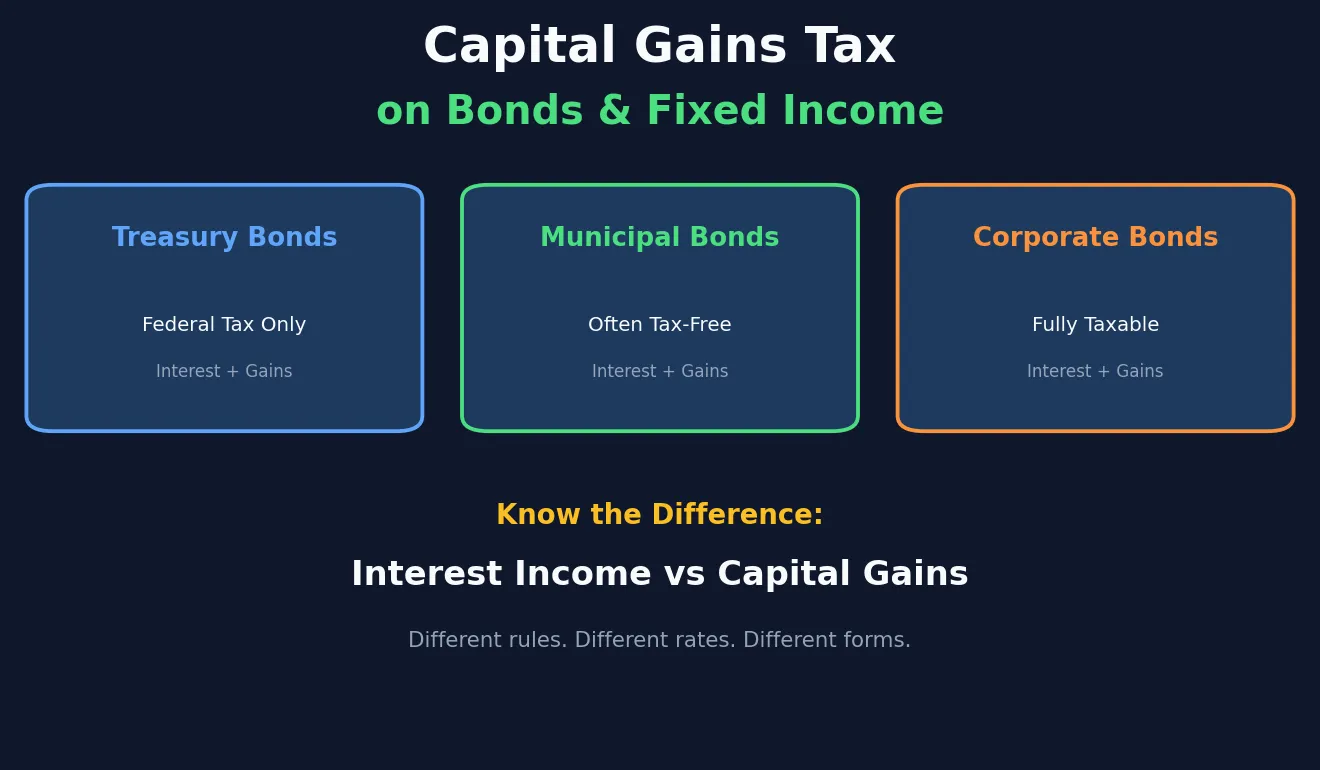
I talk to investors all the time who assume bonds are the simple part of their portfolio when it comes to taxes. After all, bonds are supposed to be boring and predictable, right? The truth is that bond taxation is one of the most misunderstood areas of the tax code. The interest you earn from a bond is taxed completely differently from the gain or loss you realize when you sell that bond before maturity.
And it gets even more complicated. Different types of bonds — Treasury, municipal, corporate, savings bonds — each have their own set of tax rules. Some are exempt from federal tax. Some are exempt from state tax. Some let you defer the interest until you cash them in. If you own a mix of bonds across different categories, you could be making tax mistakes without even realizing it.
This guide breaks down every type of bond, every tax rule, and every strategy you need to understand. Whether you hold individual bonds, bond funds, or ETFs, you will walk away knowing exactly how your fixed-income investments are taxed and what you can do about it.
The Big Distinction: Interest Income vs Capital Gains
Before we get into specific bond types, you need to understand the fundamental distinction that drives everything else in this article. When you own a bond, there are two completely separate ways you can earn money, and they are taxed differently.
Interest income is the regular payments you receive from the bond issuer. These are the coupon payments that arrive in your account every six months (or monthly, depending on the bond). Interest income is generally taxed as ordinary income, meaning it goes into the same bucket as your wages and gets taxed at your marginal rate, which can be as high as 37%.
Capital gains happen when you sell a bond for more than you paid for it. This typically occurs when interest rates have fallen since you bought the bond, making your higher-yielding bond more valuable to other investors. Capital gains qualify for preferential tax rates if you held the bond for more than a year — 0%, 15%, or 20% depending on your income.
The reverse is also true. If you sell a bond for less than you paid, you have a capital loss. You can use that loss to offset other capital gains and up to $3,000 of ordinary income per year. Any excess carries forward to future years.
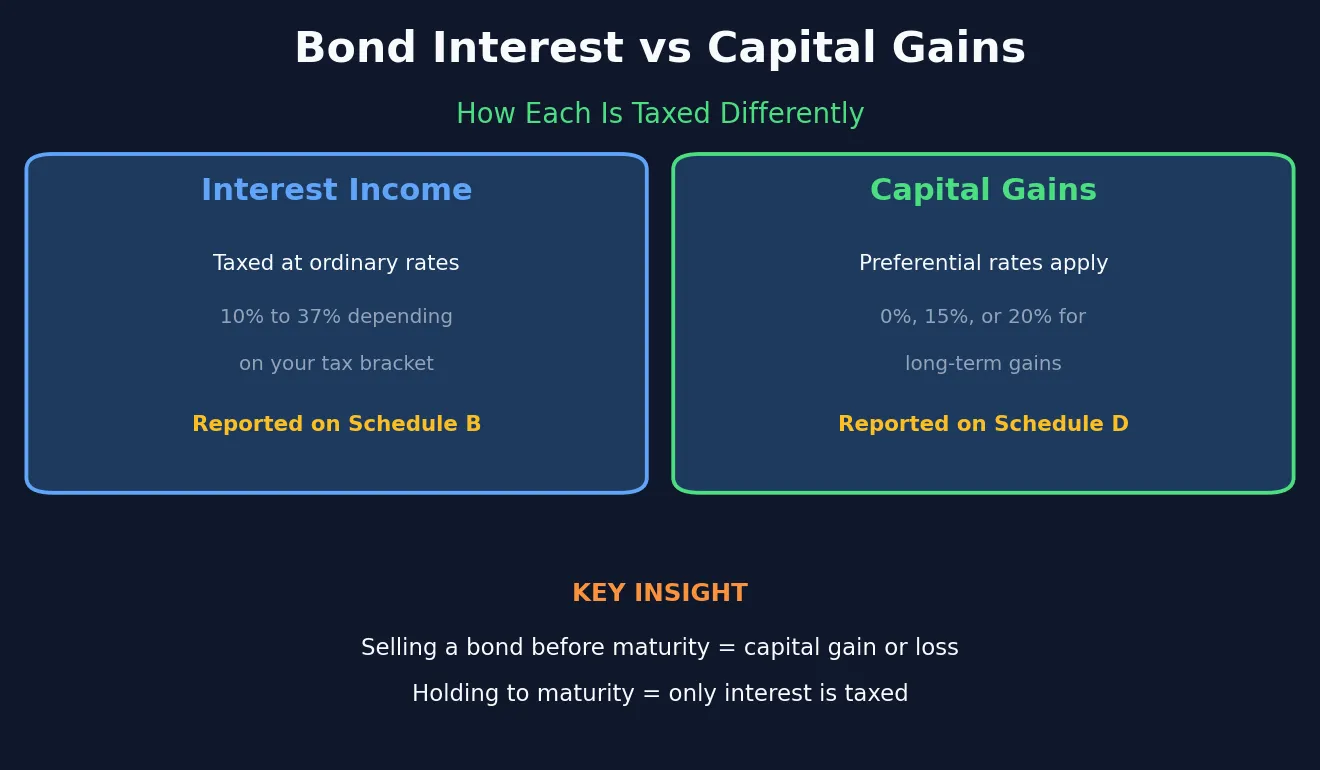
This distinction matters enormously. If you hold a bond to maturity, you only deal with interest income — no capital gains or losses. But if you sell before maturity, you need to account for both the interest you earned and the gain or loss on the sale.
How US Treasury Bonds Are Taxed
Treasury bonds, bills, and notes are debt securities issued by the US federal government. They are considered among the safest investments in the world, and their tax treatment has one especially attractive feature.
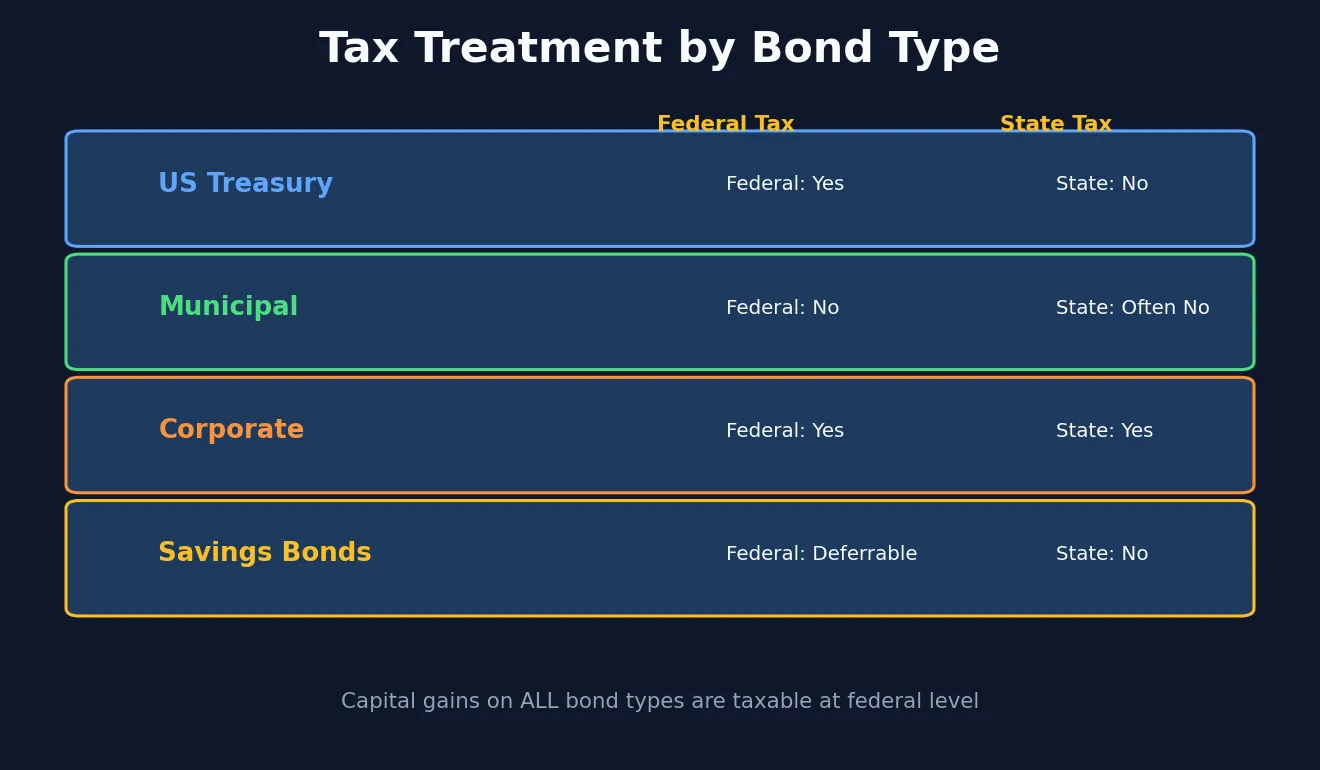
Interest from Treasuries is exempt from state and local income taxes. This is a big deal if you live in a high-tax state like California, New York, or New Jersey. The federal government does not let states tax interest on its own debt. So if you are in the 9.3% California state bracket, earning Treasury interest instead of corporate bond interest is like getting a nearly 10% boost to your after-tax return.
At the federal level, Treasury interest is taxed as ordinary income. There is no special rate. It goes on your tax return alongside your wages and other interest income.
Capital gains on Treasuries are taxed the same as gains on any other asset. If you sell a Treasury bond before maturity at a profit and you held it for more than a year, you pay the long-term capital gains tax rate of 0%, 15%, or 20%. If you held it for a year or less, you pay your ordinary income rate on the gain.
One thing people often miss: Treasury bills (which have maturities of one year or less) are always short-term holdings. Since you can never hold a T-bill for more than one year, any gain on sale is always taxed at ordinary income rates.
How Municipal Bonds Are Taxed
Municipal bonds — or "munis" — are issued by state and local governments to fund public projects. Their tax advantage is legendary and for good reason.
Interest from municipal bonds is generally exempt from federal income tax. If you buy a muni issued by your own state, the interest is typically exempt from state tax too. This makes munis incredibly attractive for investors in high tax brackets, especially those in high-tax states.
A married couple filing jointly with $500,000 of taxable income would pay 37% federal tax on corporate bond interest. But municipal bond interest? Zero. That is a massive difference that more than compensates for the typically lower yields on munis.
Capital gains on municipal bonds are fully taxable. This surprises a lot of people. The tax exemption only applies to interest. If you buy a muni at $950 and sell it at $1,020, that $70 gain is a capital gain and it is taxed at the applicable capital gains rate — the same as if you sold a stock for a profit.
You also need to be aware of the de minimis rule for munis purchased at a discount. If you buy a municipal bond at a deep enough discount, the IRS may treat part of your gain as taxable interest rather than capital gain. The threshold depends on how far the bond is from maturity when you buy it.
How Corporate Bonds Are Taxed
Corporate bonds have the simplest tax treatment, which also happens to be the least favorable. There are no special exemptions.
Interest from corporate bonds is fully taxable at both the federal and state level as ordinary income. You pay your full marginal rate on every coupon payment. For high earners, this can mean losing 37% of your interest to federal tax plus whatever your state charges on top.
Capital gains on corporate bonds follow the standard rules. Held for more than a year? Long-term capital gains rates apply. Held for a year or less? Ordinary income rates. The same rules that apply to stocks and other capital assets apply here.
One important note about corporate bonds purchased at a discount: if you buy a bond at a discount to its face value, the difference between what you paid and the face value (called original issue discount, or OID) is generally taxed as interest over the life of the bond, not as a capital gain when the bond matures. This is true even if you hold the bond to maturity and never sell it.
How Savings Bonds Are Taxed
US Savings Bonds — Series EE and Series I — have their own unique tax rules that can work in your favor if you understand them.
You can defer the tax on savings bond interest until you cash the bond in. Unlike most other bonds where you pay tax on interest as you receive it each year, savings bonds let you postpone the tax bill for decades. You do not owe any tax until you actually redeem the bond or it reaches final maturity, whichever comes first.
This deferral can be powerful. If you buy a Series I bond and hold it for 20 years, you accumulate two decades of tax-deferred interest. You only pay tax when you cash it in, which means you control the timing of the tax hit.
Savings bond interest is exempt from state and local taxes, just like Treasury interest. At the federal level, it is taxed as ordinary income when you finally report it.
There is also a special education exclusion. If you use savings bond proceeds to pay for qualified higher education expenses, and your income is below certain limits, the interest may be entirely tax-free. This is one of the few legitimate tax-free investment strategies available to middle-income families.
Capital gains do not really apply to savings bonds because you buy them directly from the government at a fixed price and redeem them directly with the government. There is no secondary market where you sell them at a premium. The difference between your purchase price and redemption value is all treated as interest, not capital gains.
Original Issue Discount and Market Discount Bonds
Two situations create confusion around bond taxation: original issue discount (OID) and market discount. Both affect whether your gain is taxed as interest or as capital gains.
Original Issue Discount (OID): When a bond is issued at a price below its face value, the difference is called OID. The IRS requires you to report a portion of the discount as interest income each year, even though you do not receive any cash payment. You will receive a Form 1099-OID showing the amount to report. This is most common with zero-coupon bonds, which pay no interest at all and are issued at a deep discount.
Market Discount: When you buy an existing bond on the secondary market for less than its face value, the difference between your purchase price and the face value is market discount. If the bond is held to maturity, the market discount is generally treated as ordinary income, not capital gain. If you sell the bond before maturity, any gain attributable to the market discount is taxed as ordinary income, while any additional gain above the face value is a capital gain.
The de minimis rule provides a small exception: if the market discount is less than 0.25% of the face value multiplied by the number of years to maturity, it is treated as a capital gain rather than ordinary income. This is a tiny threshold, but it can matter for bonds close to maturity.
Bond Funds and ETFs: Different Animal Entirely
If you invest in bond mutual funds or ETFs rather than individual bonds, the tax picture changes significantly. This is one of the areas where investors are most frequently caught off guard.
When you own a bond fund, you receive regular distributions. These distributions can include three different components, each taxed differently:
Ordinary income distributions come from the interest the fund earned on its bond holdings. These are taxed at your ordinary income rate, just like interest you earned directly.
Qualified dividend distributions are rare for bond funds but can occur if the fund holds certain types of preferred stock or bonds with special features. These qualify for the lower dividend tax rates.
Capital gains distributions happen when the fund sells bonds at a profit. These are passed through to you and taxed as capital gains. Even if you never sold a single share of the fund, you could owe capital gains tax because the fund manager was buying and selling bonds inside the fund.
When you sell your bond fund shares, any gain or loss is a capital gain or loss on your part. The holding period starts from when you purchased the shares. This works just like selling any other investment.
For more details on how fund distributions work, our guide to capital gains tax on mutual funds and ETFs goes deeper into the mechanics.
Strategies to Reduce Bond Taxes
Strategy 1: Hold Treasuries in High-Tax States
If you live in a state with high income taxes, tilt your bond allocation toward Treasuries. The state tax exemption on Treasury interest can save you significant money compared to holding corporate bonds with similar yields.
Strategy 2: Use Municipal Bonds in Taxable Accounts
Munis belong in your taxable accounts, not your IRA or 401(k). Since muni interest is already tax-free at the federal level, there is no benefit to sheltering it in a tax-deferred account. Put your taxable bonds in the retirement accounts and keep munis outside.
Strategy 3: Consider Tax-Loss Harvesting on Bonds
Yes, bonds can lose value too. When interest rates rise, existing bonds with lower rates drop in price. If you have a bond or bond fund trading below your cost basis, you can sell it to realize the loss and use it to offset other gains. Our tax-loss harvesting guide explains the full strategy, including the wash sale rules you need to watch out for.
Strategy 4: Hold Bonds to Maturity When Possible
If you hold an individual bond to maturity, you avoid capital gains entirely. You get back the face value, and the only tax you owe is on the interest you received along the way. This is one of the few situations where doing nothing is actually the best tax strategy.
Strategy 5: Time Your Savings Bond Redemptions
Since you control when savings bond interest is taxed, you can redeem bonds in years when your income is lower. Maybe you are between jobs, taking a sabbatical, or having a year with large deductions. That is the time to cash in savings bonds and report the deferred interest when your tax bracket is at its lowest.
What About the Net Investment Income Tax?
If your modified adjusted gross income exceeds $200,000 (single) or $250,000 (married filing jointly), you owe an additional 3.8% net investment income tax on your investment income. This includes bond interest, capital gains from bond sales, and bond fund distributions.
This tax is often overlooked because it is relatively new and it does not show up on your pay stub. But it adds up quickly, especially for investors with large bond portfolios generating significant interest income. If you are near the threshold, consider strategies to reduce your modified AGI, such as maximizing retirement contributions or using capital gains tax deferral strategies.
Reporting Bond Income on Your Tax Return
Here is a quick reference for which forms you need:
Interest income goes on Schedule B of Form 1040. You will receive Form 1099-INT from your brokerage showing how much interest you earned. Treasury interest goes in one box, and you subtract the state-tax-exempt amount when filing your state return.
OID income is reported on Schedule B using Form 1099-OID. Even though you did not receive cash, you still owe tax on the accrued discount.
Capital gains from bond sales go on Form 8949 and Schedule D, just like gains from selling stocks. Your brokerage will send you Form 1099-B showing the proceeds, cost basis, and gain or loss for each sale.
Municipal bond interest is reported on Form 1040 but is excluded from taxable income. You still need to report it for information purposes, even though you do not pay federal tax on it.
If you are unsure about how to report any of this, our step-by-step guide on how to report capital gains on your tax return walks you through every form and every line.
The Bottom Line
Bond taxation is not as simple as most people think. Interest income and capital gains are taxed differently. Different bond types have different rules. And the choices you make — which bonds to hold, where to hold them, and when to sell — can have a real impact on your after-tax returns.
The three things to remember are these: First, know the difference between interest and capital gains on your bonds, because they go on different forms and are taxed at different rates. Second, take advantage of the tax benefits specific to each bond type — Treasuries for state tax exemption, munis for federal tax exemption, savings bonds for deferral. Third, be strategic about where you hold bonds, choosing taxable or tax-advantaged accounts based on the tax characteristics of each bond type.
For more tax planning strategies that go beyond bonds, explore our full library of capital gains tax guides and resources.
Fact-Checked & Reviewed
This article was written by James Park (EA, CFP (Certified Financial Planner)) and reviewed for accuracy by Sarah Mitchell (CPA, MST (Master of Science in Taxation)). Published by Wasim Akram, Founder & Lead Researcher at TaxGainsCalc. All tax rates, thresholds, and rules referenced are based on IRS publications and current tax law as of the date published. Tax laws change frequently — always consult a qualified tax professional for advice specific to your situation.
Enrolled Agent & Tax Researcher
James Park is an Enrolled Agent licensed by the IRS and a Certified Financial Planner with over 12 years of experience in tax research and financial planning. He specializes in capital gains strategies for real estate investors and cryptocurrency tra...
Certified Public Accountant (CPA)
Sarah Mitchell is a Certified Public Accountant with over 15 years of experience in individual and business taxation. She holds a Master of Science in Taxation from Golden Gate University and specializes in capital gains tax planning, investment tax ...

Founder & Lead Researcher, TaxGainsCalc
Wasim Akram is an independent web publisher and digital entrepreneur based in India. Since 2018, he has been building custom CMS platforms, WordPress plugins, niche websites, and AI-powered digital products with over 8 years of real-world experience....
Disclaimer: This article is for informational purposes only and does not constitute tax, legal, or financial advice. Tax laws and regulations change frequently, and the information presented here may not reflect the most current updates. You should consult with a qualified CPA, tax attorney, or financial advisor before making any tax-related decisions. TaxGainsCalc is not responsible for any actions taken based on the information provided in this article.